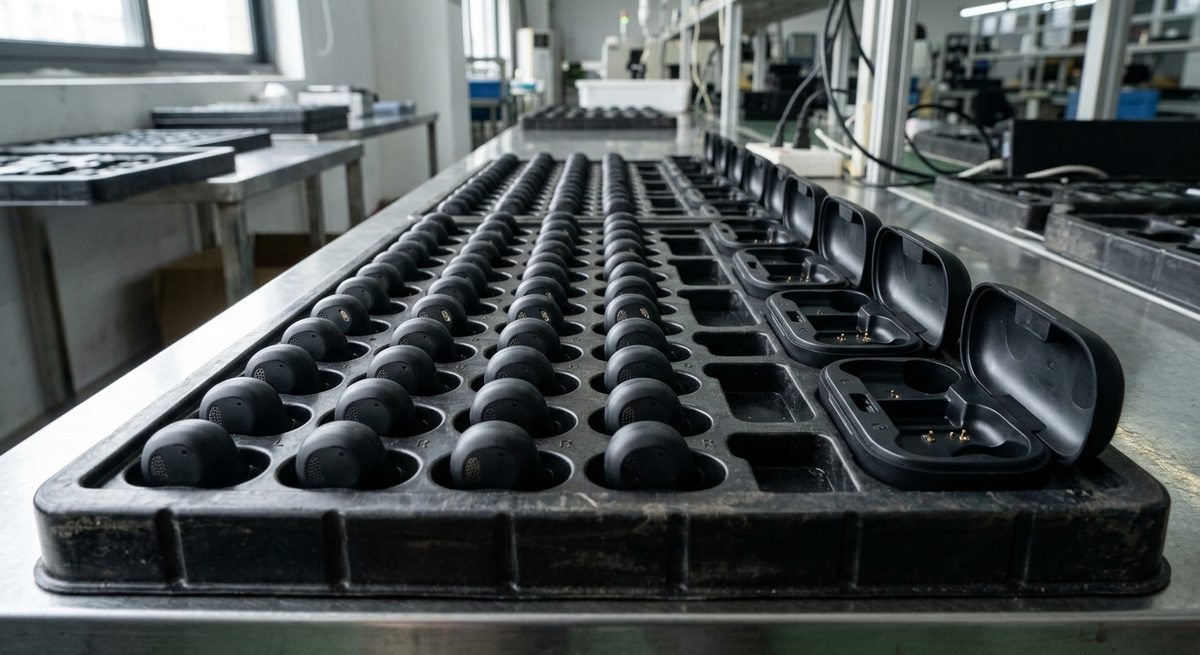
What does it actually take to import wireless earbuds from China, from the first email to cartons on your warehouse floor? Easiest answer: follow one order all the way through. The one below is stitched together from many we’ve run for clients, keeping the details that repeat, because earbud projects tend to rhyme even when the buyers don’t. Our team sits in Guangzhou. The factories in this story sit in the Shenzhen and Dongguan acoustic cluster, where a large share of the world’s true wireless earbuds get built.
Week One: Turning a Feeling into a Spec Sheet
The enquiry rarely arrives as a specification. It arrives as a feeling. A sound the client likes, a price their customers accept, a look they want to own. The first week goes into converting that feeling into numbers a factory can quote against: Bluetooth version and chipset family, driver size, battery capacity in the buds and in the case, noise cancelling or none, wireless charging or none, app or no app, an ingress rating if gym use matters. Every line moves the price. So we quote two or three configurations instead of one, and the client sees what each feature costs before falling in love with it.
This is also when the shortlist forms. Because we import from Guangzhou for clients across a lot of categories, we keep live files on audio suppliers: who owns a proper acoustic lab, who builds for serious export brands, who quotes low and farms out the hard parts. Three factories made this shortlist. Two got a visit. The acoustic lab is a strange place to stand, by the way. The test booth is padded on every surface, and the moment the door seals your ears feel stuffed, like the room swallowed the sound before you made it. A factory that owns one of those isn’t guessing about tuning.
Open Tooling or Your Own Mould
Every earbud project hits the same fork. Open tooling means using the factory’s existing shell: fast, cheap to start, and shared with whoever else buys that shell. A private mould means a shape nobody else can order, tooling paid up front, weeks added to the calendar. For a first order I’d take open tooling almost every time, and that’s what this client did: custom colours, a logo, their own case finish, and the saved budget pushed into packaging instead. Our brand building support handled the artwork, the box structure and the unboxing flow, because in this category the box does a surprising amount of the selling.
Samples Arrive, and Most of Them Lose
Two weeks after the sampling deposit, five sets landed at our Guangzhou office. We test before forwarding anything, and the first pass isn’t subtle listening. It’s the boring stuff:
- Pairing from cold, ten times in a row, on both Android and iOS devices.
- Range through two office walls, and the handoff when one bud goes back in the case.
- Charging case magnets, hinge feel, and whether the lid survives a pocket full of keys.
- Real battery runtime at moderate volume against the factory’s claimed figure.
- Microphone quality on calls in a noisy room, which is where cheap models collapse.
One factory’s sample dropped connection at the office kitchen. Every time. Same doorway. That factory left the project, and the client did listening tests on the survivors, picked a warmer tuning, and the factory adjusted it in firmware within days.
The Pilot Run in Dongguan
Rather than release the full quantity at once, the order started with a small paid pilot batch on the real line at the Dongguan plant, in the real packaging. A pilot tells you things a hand-built sample can’t. Whether the printing holds its colour across hundreds of boxes. Whether the case hinge feels the same on unit four hundred as on unit four. Whether line workers seat the driver mesh straight when nobody’s watching. We attended the start of the run, checked the first units off the line against the sealed golden sample, and released the balance only after the pilot passed. The client paid a little more for the cautious sequence and called it the cheapest insurance in the whole project afterwards. We agree, and we push every earbud client toward a pilot even when the calendar is screaming.
Inspection Day: Pairing Stations and Weighed Batteries
Pre-shipment inspection for earbuds doesn’t look like inspection for most goods. Alongside the usual carton drops and artwork checks, the inspector runs a pairing station: units pulled at random from sealed boxes, paired, played, checked for left-right balance and case charging. Battery cells get weighed against the approved sample, because a lighter cell often means less capacity than the spec sheet claims. Serial numbers, regulatory marks and the manual’s compliance text all get photographed. This report ran long. It flagged two cosmetic issues on charging cases, and the factory reworked those cartons before anything moved.
Batteries Change the Freight Conversation
Earbuds contain lithium cells, and lithium changes shipping. The goods need battery test documentation and correctly classed paperwork, couriers apply their own rules to small parcels, and some routings won’t take the cargo at all. It’s a paperwork problem, not a crisis, but it has to be handled before booking rather than after. This order went by sea from Guangzhou, consolidated with the client’s packaging stock, with the battery documents prepared alongside the export declaration. If you’re planning to import wireless earbuds from China, raise the battery question with your forwarder in week one. Not in the week the goods are ready.
Asked and Answered: Earbud Order Questions
How long does a first earbud order usually take end to end?
With open tooling, the path from confirmed spec to goods leaving China commonly runs a few months once sampling, a pilot run and inspection are included. A private mould adds the tooling build on top. Rushing the sampling stage is the most expensive shortcut in this category, so don’t.
What documentation do wireless earbuds need for export?
Expect radio and safety compliance for your destination market, battery test documentation for the lithium cells, and the usual commercial paperwork for customs. Requirements differ by country, so confirm the exact set with your compliance advisor and customs broker before production begins.
Can I get my own sound tuning without my own mould?
Often, yes. Tuning lives mostly in firmware and driver selection, so factories can adjust the signature on an open-tooling model. The practical limit is the acoustic chamber shape, which is fixed, so radical changes need custom hardware. A listening session with adjustable samples settles it quickly.
If you’re weighing up an earbud project, write to us through the contact form or WhatsApp. We’re on the ground in Guangzhou, the acoustic factories are within a day trip, and we’re happy to meet you at the airport, sit with you in the listening room and walk the lines together before you commit to an order.
Read next
The Faults That Sink USB Cable and Charger Imports from China
Want to import USB cables from China? These are the faults that ruin shipments, from thin copper to charger safety gaps, and…
Visiting Dash Camera Factories in China: A Buyer’s Field Guide
What to check in person before you import dash cameras from China: lens benches, burn-in rooms, firmware teams and the…