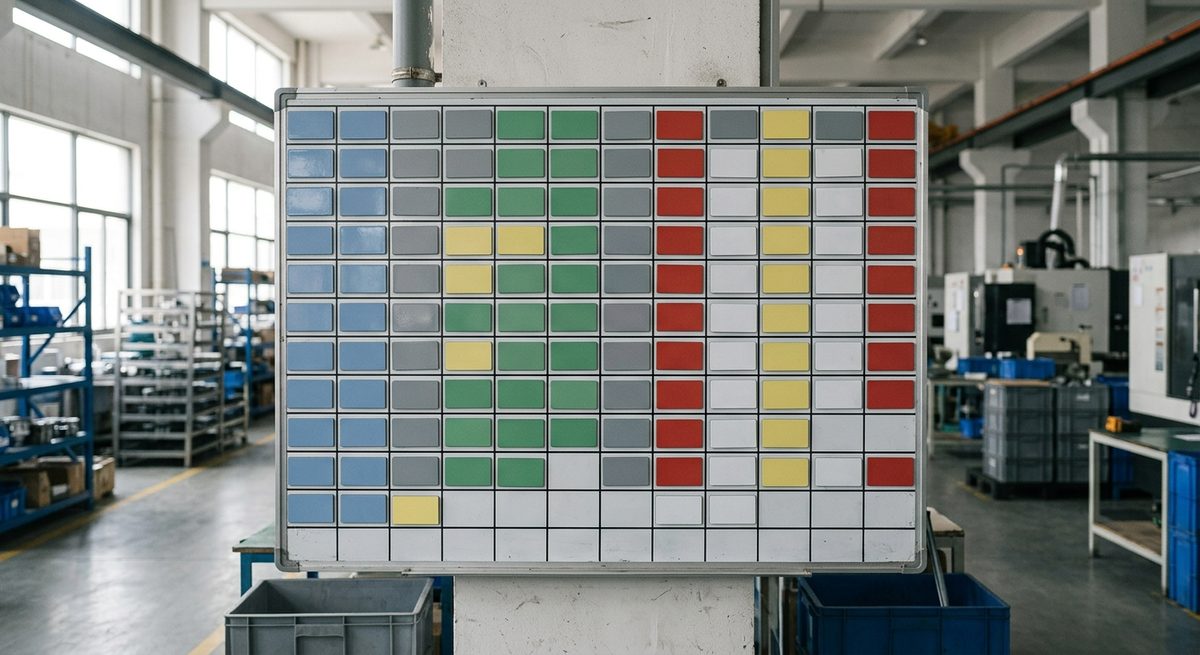
In the planning office of a Dongguan assembly factory there’s a magnetic whiteboard the size of a dining table, covered in coloured strips, one strip per order, one row per line. In October you can’t see the board for strips. The planner, a woman who’s held the job for a decade, moves them around all day like a chess problem, and every buyer whose goods are late that month believes their strip should move right and someone else’s should move left. Some buyers get that. Most don’t. The difference is rarely about who shouts loudest, and understanding what actually moves a strip is worth more than any contract clause I’ve seen.
How the queue really gets built
A factory production schedule China side is a negotiation between materials, labour and promises. An order enters the queue when its deposit clears and its spec is final, not when the contract is signed. Materials get ordered against it, a line slot gets pencilled in, and from then on the planner defends the sequence against a daily storm of changes: a machine down, a rush order from a huge customer, a colour approval that hasn’t come back.
Notice what that means. Two buyers can sign on the same day and land weeks apart in the queue, purely on how fast their deposit moved and their spec froze. The factory didn’t favour anyone. The paperwork did.
The three things that quietly move you up
Ask planners, not salespeople, what earns priority and the answers are unglamorous.
- Money that moves on time. Deposits that clear the day terms say they will. A buyer whose payments never need chasing is a buyer whose orders never need re-planning.
- Specs that don’t wobble. Every change after production planning re-opens materials, tooling and the line slot itself. Buyers known for frozen specs get scheduled with confidence, and confidence gets the good slots.
- Approvals that come back the same day. Pre-production samples, colour swatches, packaging proofs. Every day you sit on an approval is a day your strip drifts right, and the planner didn’t do it. You did.
None of this costs money. All of it compounds. After a year of behaving this way, you’re the account the factory plans around rather than fits in.
What a forecast buys you
The strongest lever isn’t in the current order at all. Give a factory a rolling picture of your next two or three orders, hedged honestly, and you’ve changed their maths: they can buy materials ahead, level their line loading, and hold a slot for you in weeks they’d otherwise sell twice over. We’ve seen mid sized buyers with credible forecasts get October slots that bigger, noisier customers couldn’t. The forecast doesn’t need to be a promise. It needs to be a pattern they can believe, which means the first few need to come true.
Keep the forecast alive, too. A spreadsheet sent once and never updated decays into noise within a quarter. Ours go to key suppliers monthly, marked with what firmed up and what moved, and the planners on the other end have told us plainly that the updates matter more than the numbers. A forecast that admits its own changes is one they’ll keep trusting.
Book the slot before you’re ready
In peak months we’ll reserve production windows for clients before final quantities are fixed, then firm them up as the order lands. Factories accept this from buyers with history because a partly defined order from a reliable customer beats an empty week. It’s the single most effective trick we know for the pre-holiday crush, and it costs only earlier planning.
Pressure that works and pressure that backfires
When you genuinely need an order pulled forward, ask for something specific and offer something real: an earlier balance payment, a relaxed non-critical spec, splitting the order so the urgent half ships first. Planners can work with trades. What they can’t work with is “make it faster”, and the angry version of that sentence actively hurts you, because factories quietly deprioritise accounts that are unpleasant to serve. I’ve watched it happen from inside the planning office. Nobody announces it. The strip just stops moving.
Escalation has its place, but aim it correctly: a calm call to the owner about a missed commitment, with dates and documents, once. Product categories with genuinely seasonal lines feel all of this hardest, and if yours is one of them, the peak-season notes in Apparel & Textiles: From Fabric to Packaging QC show how we structure orders around fabric lead times specifically.
Being easy to make is a competitive advantage
Here’s the opinion part. Buyers obsess over price and treat their own behaviour as irrelevant, when their behaviour is half their lead time. A clean spec pack, stable artwork, consistent carton requirements, one point of contact who answers overnight questions by morning China time: an order like that flows through a factory with almost no friction, and factories compete to keep it. We’ve rebuilt more than one client’s ordering process around exactly this idea, sometimes for products as simple as the ones in Sourcing Stationery & Office Products from Guangzhou, and watched quoted lead times shorten with no negotiation at all.
Scheduling questions we field a lot
Does paying extra buy a faster slot?
Sometimes, in the form of overtime or weekend shifts, and it’s a legitimate offer to make for a real emergency. But it’s a painkiller, not a cure, and factories that say yes too easily are often quoting lead times they never intended to hold. Fix the planning rhythm and you’ll rarely need to buy speed.
How do I know if my order has actually started?
Ask for stage photos tied to milestones: materials received, first units off line, packing begun. Dated pictures of your product are hard to fake and easy to send. A factory that resists this on a confirmed order is telling you where your strip really sits.
Is a contract penalty clause for lateness worth having?
Have one, but treat it as a conversation anchor rather than a weapon. Collecting penalties from a factory you intend to keep working with poisons more value than it recovers. The clause’s real job is making the promised date feel owned. The relationship does the enforcing.
We sit between buyers and planning offices every week, from Guangzhou, in person. If your orders keep landing at the back of someone’s queue, send us the story and we’ll tell you which of these levers you’re not using, and if you visit during peak season we’ll show you one of those whiteboards up close.
Read next
Turning One Order Into a Working Supplier Relationship
A Chinese supplier relationship is built between orders, not during them. A Guangzhou team on reorders, terms, feedback and…
Customs Paperwork Buyers Should Collect Before Shipping
The china export documents your broker will demand, explained by a Guangzhou sourcing team: what each paper does, who issues…
What Slows a Shipment Down After It Leaves the Factory
Most shipping delays from China happen between the factory gate and the vessel. A Guangzhou team maps where the days go and…