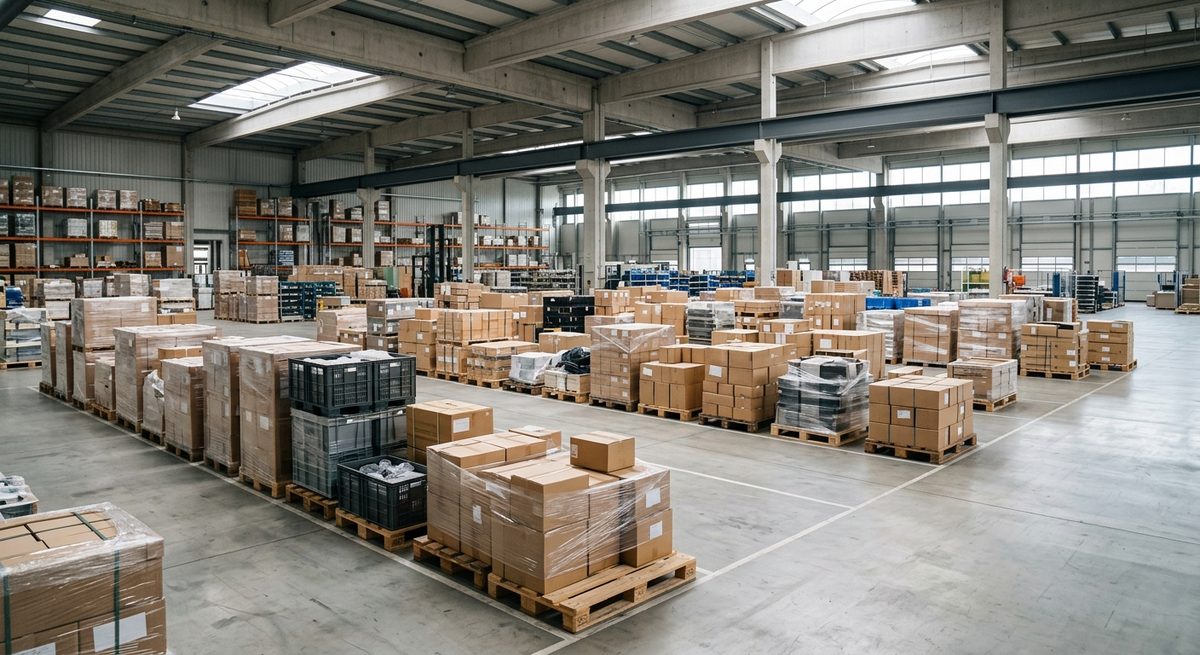
Tuesday morning at our warehouse, and four trucks are queuing at the dock for one client’s shipment. Kitchen gadgets from a Foshan plant, packaging printed in Baiyun, silicone parts up from a Dongguan workshop, and a pallet of chargers that came down overnight from Shenzhen. By Friday all of it needs to leave as one container with one set of documents, and somewhere in between, every carton gets opened, counted and stacked into a loading plan drawn like a puzzle. That in-between is consolidation, and for buyers using more than one supplier, it’s the quiet stage that decides whether the shipment lands as a tidy delivery or a month of emails.
Why several small shipments cost more than one big one
Ship from each supplier separately and you pay the overheads separately: minimum freight charges, document fees, destination handling, customs entries, each multiplied by the number of suppliers. Worse, your goods arrive on four different days, so your own warehouse handles four receipts and your product launch waits for the slowest parcel anyway. Pulling everything into one export shipment collapses those overheads into a single set and gives you one arrival, one entry, one delivery. For orders that fill a decent part of a container, the saving is usually obvious the first time you compare the two sums. Below a certain size, though, consolidation into shared container space matters even more, because that’s how small consignments get fair freight rates at all.
What actually happens inside the warehouse week
The mechanics are unglamorous and they matter enormously.
- Each supplier delivers, or we collect, against a booking that names carton counts and weights in advance
- Every delivery is checked in: cartons counted, weighed, measured, photographed, matched to the packing list
- Cartons get openings on a sampling basis, more if the supplier is new or the goods are fragile
- Shipping marks are unified so the destination warehouse can sort by product, not by guesswork
- A loading plan puts heavy goods low, crushable goods high, and last-out goods near the door
The check-in step catches things nobody expects to catch at a warehouse. Cartons that arrive rain-softened from an open truck. A supplier who shipped 96 cartons against an invoice that says 100. Gift boxes crushed because the factory packed them flat-out to meet the truck. Finding this in Guangzhou, while the supplier still owes you a fix, costs a phone call. Finding it in Rotterdam costs the difference between a discount conversation and a write-off.
The loading day itself
Container loading is physical chess played fast. The container arrives on a chassis, the dock team gets a couple of hours, and the plan meets reality: someone’s cartons bulge two centimetres over spec, someone’s pallet won’t survive double stacking. You learn to keep a margin of space and a supervisor with a tape measure at the door, counting every carton aboard against the tally sheet. Measure twice throughout, in fact: suppliers quote carton dimensions optimistically, and a loading plan built on quoted sizes can miss by a pallet, which is why we re-measure at check-in and redraw the plan the same day if the numbers argue. We photograph the container empty, half full, full, and sealed, and that seal number goes to the client the same afternoon.
The paperwork has to merge too
One container, one export declaration, one bill of lading, but the cargo inside still comes from several makers, and the documents must tell that story cleanly. Commercial invoice and packing list need line items per product with the right values and quantities; anything electrical or battery-powered brings its transport paperwork; and your customs broker at destination will want product descriptions that match what inspection actually found in the cartons. Battery goods add real constraints on what may share a container and how it’s declared, which is one more reason gadget-heavy shipments deserve early planning. We wrote about the ordering side of that in How to Order Consumer Electronics & Smart Gadgets from Guangzhou.
Timing: the slowest supplier owns your schedule
Here’s the trap in multi-supplier shipments. Four suppliers, three finish on time, one slips ten days, and the whole container waits, storage accruing, season ticking. You have three honest options. Wait, and accept the delay for everyone. Ship without the latecomer and send their goods later at worse rates. Or plan for the risk from the start: order the historically slow product first, build a buffer week into the booking, and decide in advance which goods are droppable. We push clients toward that third option, and toward doing quality checks at each factory before delivery rather than only at the warehouse, because a QC failure discovered at consolidation is a schedule problem, while one discovered at the factory is just a production problem. The checks that matter most for powered goods are collected in Electronics in Guangzhou: QC Risks and Golden Rules.
When consolidation isn’t worth it
One supplier, full container, straightforward goods? Load at the factory and skip the extra handling; you don’t need a warehouse in the middle, or us. The service earns its fee when suppliers multiply, when cartons need re-marking, when somebody’s packing can’t be trusted unopened, or when small orders need to share space. Pay for the stage that solves a real problem, not for the ritual.
Questions we get about combining shipments
Can suppliers in different cities all feed one container?
Yes, and it’s the normal case. Domestic trucking across the Pearl River Delta is cheap and quick, so goods from Shenzhen, Dongguan, Foshan and beyond flow into a Guangzhou warehouse within a day or two of dispatch. Consolidation in Guangzhou works precisely because the city sits in the middle of the manufacturing map with the ports close by.
How long do goods usually sit in the warehouse?
In a well-planned shipment, days rather than weeks: deliveries land across one week and the container loads early the next. Storage becomes costly only when planning slips, which is another argument for managing the slowest supplier hardest.
Who’s responsible if something breaks between factory and container?
Whoever’s terms cover that leg, which is why the check-in photos matter: they establish the condition of goods at handover. Insist on documented check-in whoever runs your warehouse, and insure the shipment itself; cargo insurance is cheap against the value it protects.
Our warehouse runs weeks like the one this article opened with all year round, and clients get the photo trail at every step: check-in, opened cartons, loading, seal. If your next order involves more than one supplier, tell us the pieces through the site or WhatsApp and we’ll sketch the consolidation plan, including a straight answer on whether you need one.
Read next
How Money Actually Moves to a Chinese Supplier
What paying a factory in China really involves: deposits and balances, bank details done properly, currency choices, and…

Dongguan Factories: What Buyers Find in the Workshops
Field notes from years of visiting dongguan factories: how the towns divide the work, what the workshops look and sound…