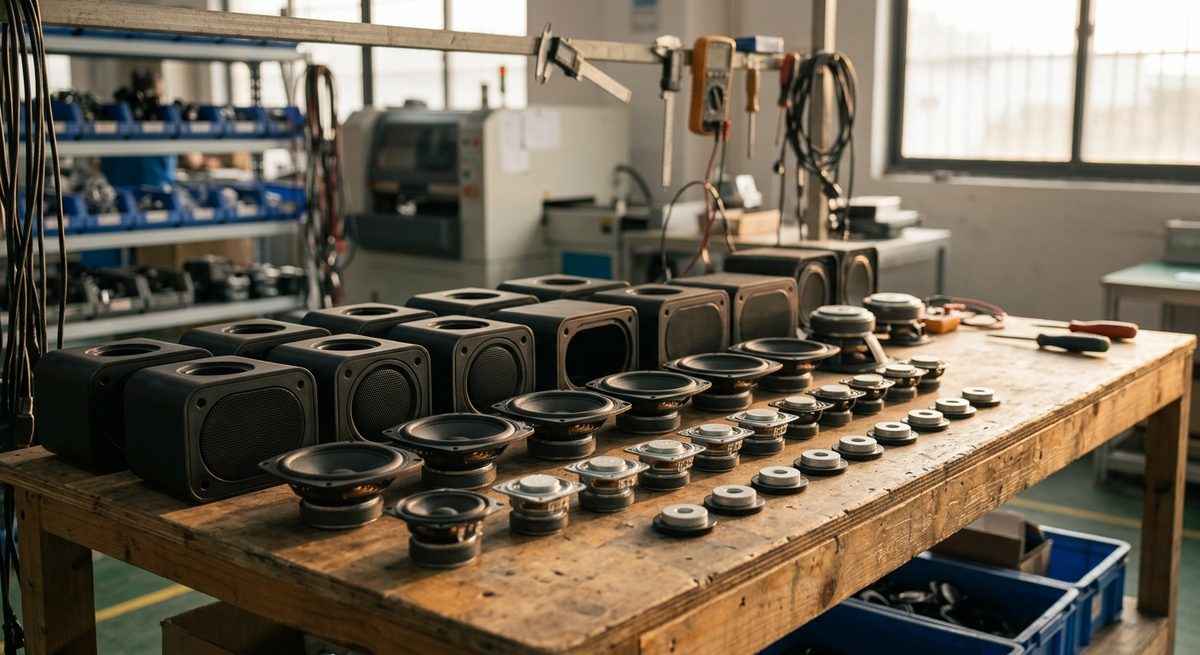
In the test room of an audio factory in Shenzhen’s Bao’an district, a shelf of speakers plays the same eight bars of the same pop track at full volume, hour after hour, while a technician walks the line with his head tilted, listening for the one unit that buzzes. You can hear that room from the stairwell. It’s where good orders get separated from expensive lessons, because buyers who import bluetooth speakers from China learn fast that this product hides its faults well. A speaker can look flawless, power on, pair, and still embarrass the brand printed on it the first time a customer turns the volume up. So the job is knowing what actually goes wrong, and testing for exactly that before the cartons seal.
The defects that show up order after order
Audio products fail in ways a visual check never finds. Across our speaker inspections, the recurring offenders are:
- Rub and buzz: a voice coil scraping or a loose part vibrating, audible only at certain frequencies.
- Rattle at high volume from badly seated drivers, loose magnets or unglued internal wires.
- Distortion near maximum volume where the amplifier or driver runs past its honest limits.
- Battery playtime below the advertised figure, or a battery that fades after a few charge cycles.
- Pairing problems: short range, dropped connections, failure to reconnect to a known device.
- Charging port faults, from loose sockets to units that charge only with the supplied cable.
- Cosmetic issues on the enclosure: fabric wrinkles, mould flash, paint mismatch between batches.
- Waterproof claims the physical unit can’t meet because a seal was pinched during assembly.
Each of these has a specific test. That’s the whole argument for inspecting audio goods with an audio procedure instead of a general checklist.
Sweeps, buzz hunts and the full volume hour
The frequency sweep
A sweep tone runs from low bass to high treble through each sampled unit in a quiet space. Rub and buzz announces itself at particular frequencies, so a sweep finds in thirty seconds what casual music playback can hide for days. Inspectors judge each unit against the approved golden sample, never against personal taste.
Maximum volume endurance
Part of the sample then plays bass-heavy material at or near full volume for a long stretch. This shakes loose exactly what customers complain about: rattling grilles, buzzing passive radiators, amplifiers that clip harshly, units that cut out as the battery sags under load. A speaker that honestly survives that hour is a far safer bet than one that only played background music in a meeting room. Don’t skip it to save time. It’s the test that earns its fee.
Battery, charging and connection checks
Playtime gets verified by instrument, not by trust. Units are charged full, then discharged at a defined volume while a log runs until shutdown, and the result is compared with the claim on your retail box, because that box is your legal statement to the customer, not the factory’s. Charging gets its own pass: port engagement tried with several common cables, and a check that a full charge completes within the stated time. Wireless behaviour rounds it out. Pairing distance walked out in open space, reconnection after power cycling, what happens when the paired phone drifts to the edge of range and back. None of this needs exotic equipment. A written procedure, a stopwatch, and the discipline to run it on every order, including the reorders everyone’s tempted to wave through.
Waterproof ratings on paper and in the tank
Outdoor and shower speakers usually advertise an ingress protection rating, and that rating is a testable claim, not a design intention. Lab certification establishes the design can meet it. Inspection confirms this production run still does, because waterproofing fails at the assembly level, a pinched gasket, a missed bead of sealant, a membrane sitting a millimetre off. So a practical spot check submerges or sprays a few sampled units per the claimed rating, dries them, then retests sound and charging. If your branding leans on outdoor durability, make this a standing line in the inspection plan and accept losing a few units per order. That’s the cost of the claim, and it’s cheap.
Turning the tests into an inspection plan
The routine that ties all this together follows accepted sampling practice: units pulled at random from sealed export cartons once production is substantially complete, sample sizes set by recognised statistical tables against defect limits agreed in the purchase order, results recorded against the golden sample. For a first production run we’d add an earlier during-production visit, which catches a bad driver batch or a wrong fabric colour while the line can still fix it cheaply. And write the acceptance criteria, playtime, volume test duration, cosmetic standards, into the purchase contract itself. That way the inspection measures the deal instead of negotiating it after the fact. Our inspectors work out of Guangzhou and can be inside a Bao’an factory the same morning a line finishes.
Two cities build one speaker
The electronics, drivers, boards, batteries, largely come out of the Bao’an audio cluster in Shenzhen, while many of the enclosures, the injection moulded shells, aluminium grilles and the fabric wrapping the current generation of home speakers, get made in Dongguan workshops. Final assembly can sit in either city. That’s why cosmetic batch differences appear when an enclosure supplier changes mid-order, and why we log shell batch codes during inspection. Buyers who import from Guangzhou with local support can realistically see both halves of their product in a single day trip.
For clients building a house brand, our brand building support covers enclosure finishes, logo application and gift packaging, and the golden samples for all of it live in our Guangzhou office, where every later shipment gets judged against them.
Speaker inspection questions, answered plainly
How many units get sound tested in a typical inspection?
Sampling follows statistical tables based on order size, with the listening tests applied to the drawn sample and the long endurance and waterproof checks applied to a smaller subset. Exact counts get agreed before the inspection, and they shift with order size and how strict your defect limits are.
Can an inspection really verify the advertised playtime?
Yes. Sampled units run from full charge to shutdown at a defined volume with the time logged. What that verifies is this production batch under stated conditions, which is precisely what you need before approving the balance payment.
What should the golden sample include for a speaker?
A signed-off production unit covering sound character, enclosure colour and finish, packaging and print, plus a written spec listing driver size, battery capacity and firmware version. Keep one at the factory, one with your agent in Guangzhou, one at your own office, and refuse changes to any of the three without a signed update.
If a speaker project is moving toward production, and especially if you plan to import bluetooth speakers from China under your own name, contact us through the website form or WhatsApp. We’re in Guangzhou, an easy drive from both Bao’an and the Dongguan enclosure shops, and we’ll happily meet you at the airport, sit with you through the factory visits and run the first inspection at your side.
Read next
The Faults That Sink USB Cable and Charger Imports from China
Want to import USB cables from China? These are the faults that ruin shipments, from thin copper to charger safety gaps, and…
Smart Watch Private Label: From Factory Firmware to Your Logo
See how to import smart watches from China under your own brand: firmware, straps, packaging, tooling costs and support from…
Electronics in Guangzhou: QC Risks and Golden Rules
Electronics sourced from Guangzhou and neighbouring Shenzhen have powered global supply chains for decades. The region is…