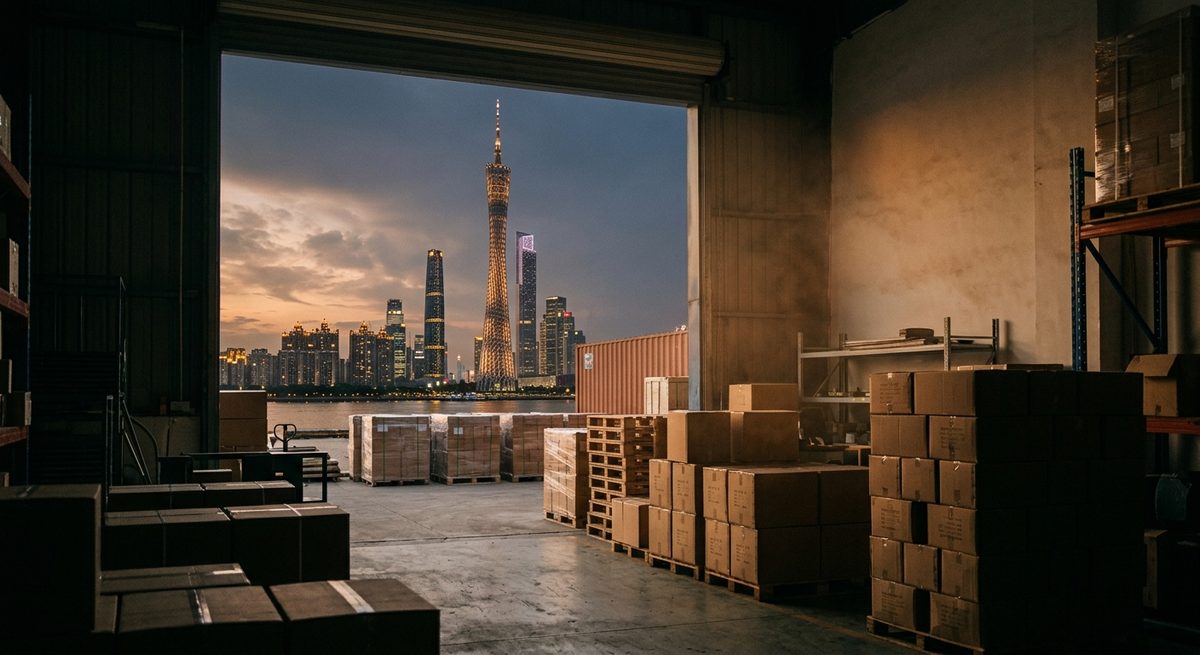
Guzhen town in Zhongshan calls itself the lighting capital of China, and after one day on its main road you won’t feel like arguing. Showroom towers stand shoulder to shoulder for several kilometres, every floor hung with chandeliers, flush mounts, pendant clusters and office battens. If you plan to import ceiling lights from China, there’s a strong chance your goods get built in or just behind this town. It’s also the category where a flight pays for itself faster than almost any other. A photo flattens a chandelier. Standing under a lit one doesn’t.
A town that measures itself in showrooms
Guzhen is roughly a ninety minute drive from Guangzhou. The front streets are all glass and display lighting. The workshops that cut crystal, bend arms and wire canopies sit in the blocks behind, and in the villages around. One thing worth settling early: some showrooms belong to a single factory, others are sales offices fronting several workshops. Neither is a problem. But you should know which building your order actually comes from, because that’s where quality gets decided. When we take buyers there, we push past the showroom and ask for the assembly benches, the plating line, and whatever orders are on the floor that week.
One more thing nobody warns you about. Every showroom floor is freezing, even in July, because a few hundred lit fittings throw off real heat and the air conditioning fights back hard. Under the sales chatter you can hear a faint chorus of LED drivers humming. Thousands of them. Bring a jacket, seriously.
Open the canopy before you admire the arms
The part of a ceiling light that fails first is the part nobody photographs. Open the canopy on a sample and you’ll find the driver, the terminal block, the wiring and the strain relief. In person you can check whether the wire gauge matches the load, whether the solder joints are clean, and whether the driver carries the markings your market expects. Ask which driver the factory fits as standard and what a better one costs. Pay the surcharge. In my experience the difference between two driver options decides how many warranty emails you answer two years from now, and factories answer these questions far more precisely across a table than over chat.
The crystal question
Crystal is where lighting budgets quietly stretch or shrink. K9 optical crystal is heavier, clearer and dearer than moulded glass, and the two look identical in photos. Under showroom light you can compare refraction side by side, feel the weight, and hunt for the faint seam lines that moulding leaves behind. Check the pinning too. The little wires and butterfly clips holding strands together should be plated, because bare steel can mark or corrode in humid transit. And ask how the factory sorts crystal by clarity grade. You want your whole order drawn from one grade, not whatever’s left.
Finish and plating
Chrome, brushed brass, antique bronze and painted steel all age differently. Look down the length of each arm for plating consistency. Run a finger along the cut edges. Ask whether a lacquer goes over the brass tones. My favourite habit is pulling three units of the same model from stock instead of judging the one polished piece on display. If the three match, the line is under control. If they don’t, you’ve just saved yourself an expensive lesson.
Display models flatter everyone
Every showroom piece was assembled slowly, adjusted by hand and dusted daily. Production pieces get built at pace. The honest way to close that gap is to ask, politely, to watch an order being packed for another market, then compare a boxed unit against the display. After that, insist your own pre-production sample comes off the line, not out of the sample room. Guzhen factories hear this request from experienced buyers all the time, and how they take it tells you plenty about how your order will be treated once you’ve flown home.
The packing room tells the truth
Chandeliers travel badly when packing is an afterthought. Sea freight means vibration, stacking pressure and humidity, and glass forgives none of it. So spend real time in the packing area and look for the habits of a factory that has already paid for its mistakes:
- Foam moulds cut to the shape of each arm and body, not loose chips poured around the parts
- Crystal strands wrapped individually, bagged and labelled by hanging position
- A small bag of spare crystals and clips in every unit
- Double-walled cartons with drop test results they can actually show you
- Assembly diagrams packed inside, in the language of your market
Ask what breakage rate they expect on sea shipments and how replacements work. The number varies by design and route. What matters is the speed of the answer. A factory that replies instantly has measured it, and that’s the factory you want.
Making the trip itself painless
A Guzhen visit works best as part of a short Guangdong circuit: land in Guangzhou, see fittings and export showrooms there, then drive out to Zhongshan for the factory days. We host buyers on exactly this route, with airport pickup, hotel booking, an interpreter and accompanied visits, so if you’d rather not organise it alone you can meet us in China and visit the factories with our team beside you. Two well planned days on the ground usually replace weeks of long distance back and forth.
Buyers who make the trip often leave with more than a supplier. Seeing the finish options, box printing and custom arm designs in person tends to turn a simple purchase into a plan for an own-label lighting range. Our brand building support covers that path: naming, packaging artwork, manuals and a web store, built while the first order is still in production.
Three questions lighting buyers ask before flying over
Do I need my own testing and certification for lighting?
Electrical goods usually need testing and documentation for the destination market, and the scheme differs by country. Many Guzhen factories hold reports for common markets already. Ask to see them, check the model numbers match what you’re buying, and confirm the exact requirements with your own lab or customs broker before production starts. Don’t skip that last step.
Can I mix chandeliers, flush mounts and wall lights in one container?
Yes, and most buyers do. Orders from different workshops around Guzhen and Zhongshan can be collected and consolidated in Guangzhou, packed to balance heavy bases against light volume, and shipped as one consignment with one document set.
How long does a lighting order usually take?
It varies by factory and specification. Samples commonly take a couple of weeks, and a custom finish takes longer than stock designs, especially before the big trade fairs when every line is full. Build the sea time for your port into the plan from day one.
If ceiling lights are on your list for next season, get in touch through our contact form or WhatsApp. We’ve been based in Guangzhou since 2007, and we’re glad to meet you at the airport, sit with you over the shortlist, and walk the Guzhen factory floors with you in person.
Read next
Faucet Samples, MOQs and Payment Terms When Buying from China
Understand sampling, minimum order quantities and payment terms before you import faucets from China, with notes from the…