
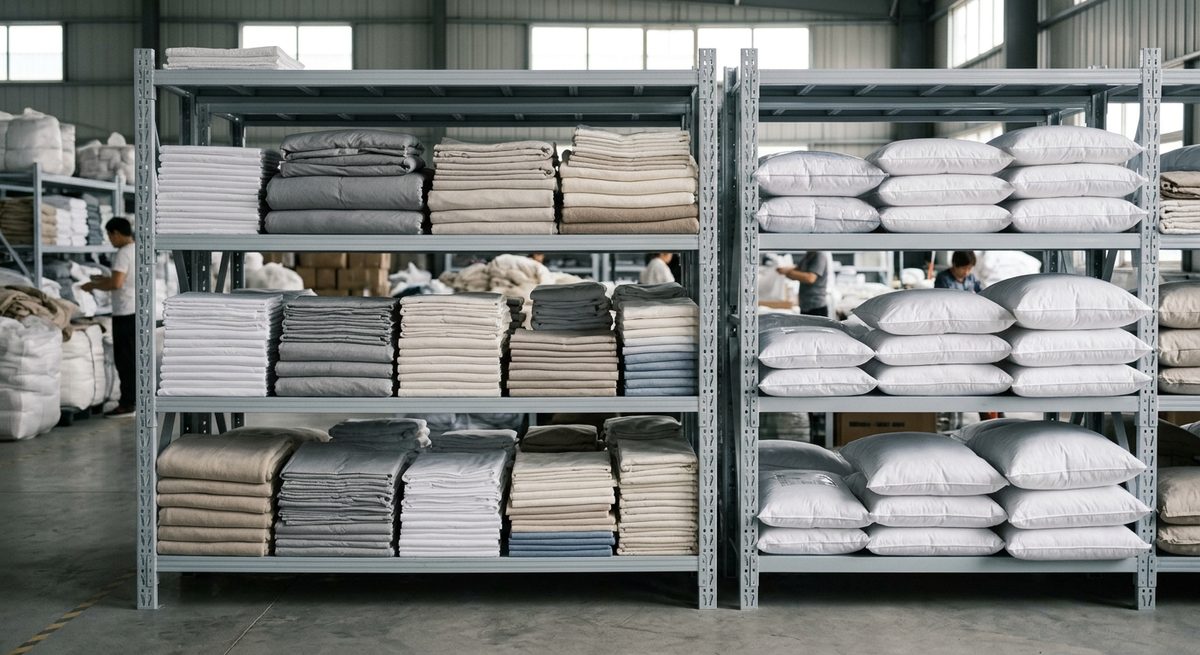
An hour southwest of Guangzhou the office towers thin out and the truck traffic changes. Flatbeds stacked with spring units. Vans crammed with foam blocks under stretch film. This is Longjiang, a town in Foshan that has spent a generation doing not much else besides making beds, and if you want to import mattresses from China, the town will touch your order one way or another. Nearly every link in the chain sits within a short truck ride of the next one, which is unusual even by Guangdong standards.
A town that split the job into pieces
Nobody planned Longjiang. It grew up beside the wider Foshan furniture trade, and the workshops sorted themselves over the years. One family coiled springs. Another cut and glued foam. A third quilted covers. Those workshops are proper factories now, but the division of labour survived, so a finished mattress leaving Guangdong has usually passed through several companies before the last one sews the cover shut.
That structure works for you. You’re not married to one giant supplier. An assembly factory can swap foam grades, ticking fabric or edge support by phoning a workshop two streets over, and a revised sample often comes back in days rather than weeks. I’ve seen a buyer ask for a firmer edge at ten in the morning and squeeze the corrected corner sample that same evening.
Springs, foam, fabric: who does what
It pays to know the component trades before you negotiate, because each one moves the price and the feel in its own way.
- Spring plants turn out Bonnell, continuous coil and pocket units in standard heights, with heavier wire on request.
- Foam plants pour polyurethane in a spread of densities, plus memory and gel versions for the comfort layers. The pouring halls smell of fresh resin and the floor is soft with offcut crumbs.
- Knitting mills make the stretchy ticking and will knit a brand name straight into the weave.
- Quilting and tape edge shops handle the sewing that gives a mattress its finished face.
- Latex and coconut fibre layers come from their own specialists, often starting from imported raw latex.
A quotation that looks strangely low is hiding in one of those lines. Thinner wire, lighter foam, cheaper fabric. Ask for the specification sheet component by component and the mystery usually clears up on its own.
Container maths, and why rolling changed it
A mattress is a bulky thing to move, so the numbers only start working at volume. Roll packing shifted everything. Compress a mattress, roll it, box it, and it takes a fraction of the space a flat one needs, which is why so many export models are all foam or pocket spring builds that can survive compression. Old style Bonnell mattresses with stiff border rods still ship flat, stacked and wrapped. They fill a container fast.
Minimums vary by factory and specification. In many cases a plant will take a single 40 foot high cube as a first order, sometimes with two or three models mixed inside it. Smaller trial lots exist, but the unit price climbs and the freight per piece climbs harder. That container threshold is really the point where it starts to make sense to import mattresses from China at all, and below it, honestly, the sums rarely flatter you.
Reading a factory in the first ten minutes
Not every plant in the bed belt fits every buyer. Some run long lines for hypermarket programmes and want repeat volume. Others build firmer product on contract grade fabrics for hotel projects. A third group lives on compressed bed in a box goods for online sellers. Walk in and the truth is on display: the machinery, the fabric racks, the cartons waiting at the dock. Ten minutes tells you who they really serve.
Fire safety is the other dividing line. Flammability standards differ by market, and export minded factories keep treated fabrics and barrier layers on hand for the destinations they know. Confirm which standard your market applies, then ask to see recent third party reports for that exact standard, not a cousin of it. Selling into several markets at once? Agree early which build goes where. One specification almost never satisfies every destination, and pretending it does gets expensive later.
Putting your own name on the bed
Covers, labels, boxes and law tags are all made to order anyway, so mattresses take to private label unusually well. Plenty of our clients start on an open catalogue model, then add their own ticking design and packaging once sales prove out. If that’s the road you’re on, you can build your own brand with our team, from naming and packaging artwork through to the web store that sells the finished bed.
Getting a soft, fat product to the port
Longjiang sits close to the Pearl River, and export cargo usually trucks to the terminals at Nansha or Shekou. Mattresses cube out a box long before they weigh it down, so the loading plan earns its keep. A good one mixes sizes so the final row packs tight, and it keeps boxed rolls away from anything that could crush them. If you’re buying frames, bases or bedding from other suppliers at the same time, consolidation and export handling lets everything meet in one warehouse, get checked, and leave as one container with one set of documents.
Before loading, an inspection should open sample cartons, measure the compressed roll diameters, press the foam against the approved sample and read every label. Once a rolled mattress is boxed, nobody sees it again until a customer cuts the film open in a bedroom somewhere. This is the last look. Use it.
Questions we field about mattress orders
How long can a mattress stay compressed in its roll?
Most factories say unpack within a few months of production, sooner for high density foams. The window depends on the build, so get it stated in writing and have the compression date printed on every carton. Cheap insurance.
Can one container carry mixed firmness levels and sizes?
Usually, yes. Longjiang factories load mixed containers all the time, and two or three models across several sizes is normal. Small surcharges can apply below certain quantities per variation, which isn’t the factory being difficult, just the line being reset more often.
Will the factory hold the certificates my market wants?
Export plants keep test reports for the markets they serve regularly, but a report belongs to a specific build. Check that it matches the exact mattress you’re ordering, and budget for fresh testing whenever you change foams or fabrics.
Weighing up suppliers in the bed belt? Talk to us. We live and work in Guangzhou, we’ll collect you at the airport, sit beside you in the meetings and drive you through Longjiang factory by factory until the right one is obvious. The contact form or WhatsApp both reach us, so tell us what you’d like to put your customers to sleep on.
Read next
Sofa Inspections in Foshan: What Good Quality Control Catches
How staged inspections protect buyers who import sofas from China: frame checks before upholstery, foam density, leather…
What You Actually Pay For in an Office Chair Made in China
What drives the price when you import office chairs from China: gas lift class, mechanism, mesh, carton volume and the road…
One Wireless Earbud Order, Followed from Enquiry to Delivery
Follow one real order to import wireless earbuds from China: spec sheet, tooling choice, samples, pilot run, inspection,…