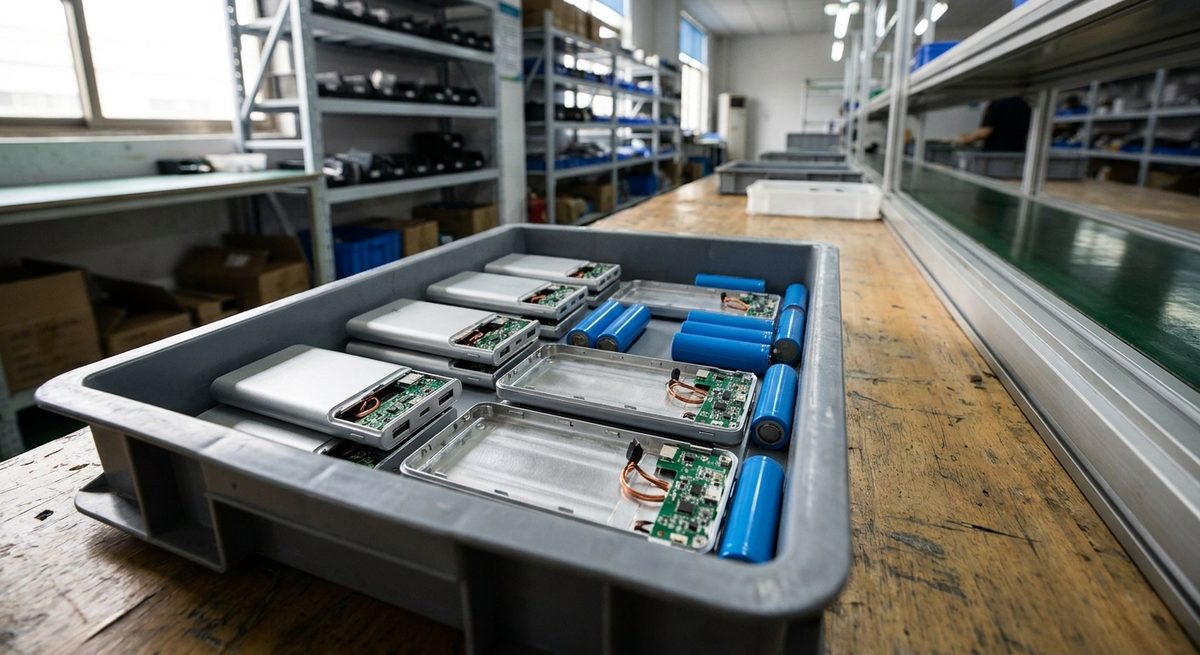
Why do two power banks with the same printed capacity leave their factories at prices far apart? The cases look alike. The boxes claim the same milliamp hours. Yet the quotations disagree, sometimes by half, and anyone preparing to import power banks from China should be able to read a quote line by line and know which component each dollar is buying. So let’s take the product apart, cell, board, casing, paperwork, freight, and then stack the pieces back up into the landed cost that actually decides your margin.
The cell is half the story
Inside every power bank sits either cylindrical 18650 cells or a flat lithium polymer pack, and this choice, plus the grade of the cell, moves the price more than anything else on the page. Polymer packs allow the slim shapes the market wants and cost more per watt hour. Cylindrical cells are economical and add thickness. Within each type, cells are graded, and lower grades with less consistent capacity and cycle life trade at a discount that flows straight into the finished price. A supplier quoting noticeably below the pack gets one precise question from us: which cell brand and grade, in writing, on the spec sheet. Real capacity follows the same logic. A quote built on cells that genuinely deliver the rated figure won’t match one built on optimistic labelling, which is why a discharge test on samples is the first gate, before any price comparison means anything at all.
Boards, protocols and charging speed
The circuit board is the second cost centre. At minimum it protects against overcharge, over-discharge and short circuit. From there the price climbs with capability: higher wattage, fast charging on input and output, multiple ports managed at once, a percentage display, a wireless coil under the top shell. Fast charging deserves the closest look. Supporting the common protocols properly requires licensed controller chips, and quotes differ depending on whether a factory buys the genuine parts or a lookalike that negotiates the handshake unreliably. If your market expects a phone to fast charge from your product, name the protocol and version in the spec, then verify it on samples with a USB power meter. It’s a twenty dollar tool. It settles arguments in seconds.
Casing, tooling and the quiet extras
Housings run from plain ABS to aluminium shells with anodised finishes, and every step up in touch and feel is a visible line in the cost build. Using a factory’s existing case moulds keeps entry cost low. A custom shape means tooling, which turns into either an upfront mould charge or a higher unit price spread across an agreed quantity. Then the accessories creep in: a built-in cable, a lanyard, a pouch, a manual in three languages, a gift box with foam insert instead of a plain white carton. None of these costs much alone. Together they commonly move the unit price by a noticeable margin, so we make the factory itemise every one of them, and the buyer adds or strikes them consciously instead of paying for a bundle unseen. I’d strike the pouch first, if you’re asking.
Paperwork that costs real money
Battery products carry document costs that hard goods never see, and the time to price them is before the order, not after samples are approved. Carriers want a UN38.3 test summary and a safety data sheet before they’ll book the cargo, and destination markets commonly expect safety and electromagnetic compatibility reports to their own rules, which your test lab or customs broker can map precisely. These reports attach to a product design, so their cost spreads thinly across a big order and heavily across a tiny one. That’s a genuine scale effect, worth remembering when your numbers look worse than a big seller’s retail price. Budget calendar time too. A booking can’t move without the transport documents in hand.
Freight for class 9 cargo, and the landed build-up
Power banks are dangerous goods for transport, class 9, and that shapes the whole freight plan. Sea, with a properly declared dangerous goods booking, is the routine path for volume. Air exists under strict rules with limited carrier acceptance, so a launch plan that quietly assumes “we’ll just fly a top-up” needs checking with the forwarder before anyone leans on it. The landed cost then assembles like so:
- Ex-works unit price, with cells, board, casing and accessories itemised.
- Testing and battery transport documentation, spread across the order quantity.
- Inland trucking from the factory, commonly Shenzhen or Dongguan, to the port warehouse.
- Ocean freight with dangerous goods surcharges, insurance, and destination port charges.
- Import duty and taxes at your end, confirmed via the tariff code with your own customs broker.
- Final delivery and any warehouse repacking at destination.
If you’re combining power banks with other electronics in one container, the dangerous goods declaration has to be planned around the whole load, which is exactly the situation our consolidation and export handling service was built to manage.
Where the price is made: Shenzhen and Dongguan
Most of the assembly happens in the electronics belt east of Guangzhou. Shenzhen factories dominate the design-led end, in-house engineers, quick iterations on new charging standards, while Dongguan plants are excellent at stable volume assembly once a design settles. Specialist battery makers nearby feed cells to both. Sitting in Guangzhou, we can reach either city within the morning and compare two candidate factories in one day. The test bench is where it gets real: rows of finished units wired to load testers, the little cooling fans whining away, and the bench top noticeably warm under your palm from all that energy being dumped. You don’t forget which factory ran that test willingly. For buyers managing this category from abroad, having help in Guangzhou means the cost lines above get verified at the source: cells checked against the contract brand, boards opened up for the genuine chips, cartons weighed before booking. Verify once you import power banks from China at volume, and the quote sheet stops being a matter of trust.
Cost questions buyers ask about power banks
Can I ship power banks by air at all?
Standalone lithium battery cargo faces tight restrictions under the dangerous goods rules, many carriers decline it, and acceptance terms change over time. Treat air as an exception to arrange case by case through a forwarder who knows class 9, and build the plan around sea.
How do I check that rated capacity is real before paying the balance?
Have samples, then production units, discharge-tested with a load tester: charge fully, discharge at a stated current, log the delivered energy. We run this during pre-shipment inspection, so the numbers come from your actual order rather than the datasheet.
Does a custom shape make sense for a first order?
Usually not on round one. Existing moulds with custom printing and packaging get a brand to market without tooling risk. Once sales prove out, a custom housing becomes a calculated second step instead of an opening gamble.
If you have a target retail price and want to know what power bank it honestly buys, message us through the contact form or WhatsApp. The team is based in Guangzhou, a short drive from the Shenzhen and Dongguan factories, and we’ll gladly host you here and walk the assembly lines with you before you place an order.
Read next
Bluetooth Speaker Quality Control: Catch Faults Before They Ship
Plan quality control before you import bluetooth speakers from China: the defects speakers hide, the audio tests that find…
Smart Door Locks by the Carton: Weight, Batteries, Freight
How to import smart door locks from China without freight surprises: battery paperwork, heavy cartons, drop protection and…
One Wireless Earbud Order, Followed from Enquiry to Delivery
Follow one real order to import wireless earbuds from China: spec sheet, tooling choice, samples, pilot run, inspection,…