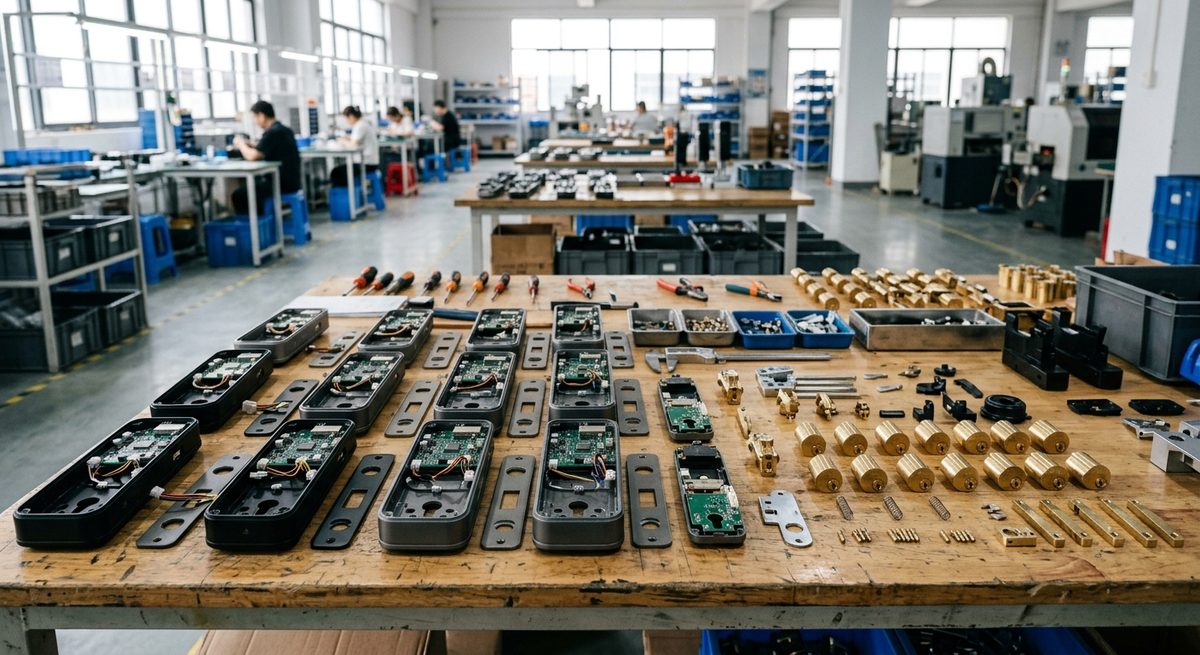
Pick up a boxed smart lock sometime. Go on, guess the weight first. Almost everyone guesses low, because the die-cast zinc body, the mortise, the strike plate and the handle set add up to a small dense brick, and a master carton of ten is something you lift with your knees. That density quietly runs the economics when you import smart door locks from China, and it’s why this article is about cartons, batteries and freight rather than fingerprint sensors.
Weight decides your freight bill, not volume
Most consumer goods out of South China are volume problems. Locks are the opposite. A pallet of them hits its weight ceiling long before it fills its space, so the numbers that matter on your quote sheet are gross weight per master carton and units per carton, not cubic metres. Two suppliers offering the same lock can produce meaningfully different landed costs purely through packaging weight and carton count.
This has a pleasant flip side. Sea freight charges largely by space, so dense goods travel efficiently by ocean, and even modest orders can make a shared container sensible. Ask for the packing data early, in the quoting stage. We put it in a spreadsheet before we ever discuss shipping mode.
Sort the battery question before you sort anything else
Every smart lock ships with power in mind, and the choice echoes all the way to the shipping documents. Three situations come up constantly:
- Locks running on standard AA cells, with batteries excluded from the shipment. Simplest paperwork by far.
- Locks with alkaline cells packed in the box. Straightforward, though the batteries add real weight across thousands of units.
- Locks with rechargeable lithium packs, inside the device or boxed with it. These travel under dangerous-goods rules, and carriers commonly ask for test summaries and safety data sheets before accepting them, with air freight the strictest.
None of this is a reason to avoid lithium models. It’s a reason to decide the battery configuration at the purchase-order stage and hand your forwarder the documents up front, because the expensive version of this lesson is a pallet sitting at the airline’s acceptance desk going nowhere. Rules differ by carrier and destination, so let your forwarder confirm the current requirements rather than working from an old checklist.
Metal from Xiaolan, brains from Shenzhen
It helps to know what you’re actually consolidating. The lock hardware trade concentrates around Xiaolan in Zhongshan, a town that has machined and cast locks for a long time, while the electronic heart, the fingerprint modules, radios and boards, overwhelmingly comes out of Shenzhen. Many finished-lock factories sit between the two, buying bodies from one direction and modules from the other. On a factory floor there you’ll usually find the endurance room: racks of mounted locks wired to actuators, latching and unlatching around the clock, a wall of them clacking out of sync like a room full of impatient typists. I find the sound weirdly reassuring. It means someone is counting cycles instead of just quoting them.
Guangzhou sits an easy drive from both places, which is why buyers use it as the base to import from Guangzhou while the goods themselves come together from Zhongshan and Shenzhen. One trip covers all three.
Packaging that survives the journey it’s actually going on
A lock is tough. Its gift box isn’t. The retail box does the selling on a shelf, and it arrives crushed if the export packing pretends the journey is gentle. What we specify and then check at inspection:
Molded pulp or foam trays that hold the lock body and handle apart, because loose metal parts chew through any box given enough kilometres of vibration. Double-wall master cartons at sensible unit counts, since a carton that’s too heavy gets dropped more, by everyone, at every handover. Corner protection on pallets and a real drop test on the packed carton, not a promise of one. If your locks include batteries, the carton markings need to match the paperwork exactly.
Buyers building their own brand feel this hardest, since a premium unboxing is part of what they’re selling. Our brand building support covers the retail box design, and we make sure the export packing protects that box as carefully as the lock inside it.
Sea, air, or a bit of both
For stock orders, ocean freight is the default and density works in your favor. Air makes sense for samples, certification units and small launch batches, with the battery configuration setting how painful the paperwork is. A pattern that serves growing lock brands well: launch quantity by air with AA-powered models, then move volume by sea once sales data justifies it. Rail exists on some routes too. Ask for all three prices when timing is flexible, because the spread changes through the year.
Whatever the mode, insure the shipment. Locks are dense, valuable and attractive, three words an insurer understands perfectly.
Lock shipping questions we hear every month
Can the factory ship my locks with batteries already installed?
Often yes for alkaline cells, while lithium packs installed in equipment fall under specific dangerous-goods provisions that your forwarder must confirm for the route. Many buyers have the factory pack lithium cells beside the device rather than inside it, or leave batteries out entirely for retail markets where customers expect to fit their own.
How many locks fit in a twenty-foot container?
Fewer than the space suggests, because you’ll approach the container’s payload limit before the walls. The honest answer comes from your specific model’s packing data: units per carton, cartons per pallet, gross weights. We run that math during quoting so the freight estimate is grounded in your product, not a category average.
Should spare parts travel in the same shipment?
Yes, and it’s easy to forget. Spare strike plates, screws, sensors and a small percentage of complete spare units cost little to add and rescue you months later when a customer needs a part. Adding them to a sea shipment is nearly free. Sending them alone by courier afterwards never is.
If you’re comparing lock suppliers and the freight math is getting foggy, come and do it with us in person. We’re in Guangzhou, we visit Zhongshan and Shenzhen factories with clients every month, and we’ll happily meet you at the airport and put the packing data, the samples and the tea on the same table. Message us through the site or on WhatsApp.
Read next
From Spec Sheet to Shipment: An LED Strip Light Order in China
Follow one real order to import LED strip lights from China: the spec sheet, Guzhen factories, samples, aging racks,…
How to Order Consumer Electronics & Smart Gadgets from Guangzhou
Guangzhou is one of the world's top hubs for consumer electronics manufacturing, and for good reason. From earbuds and…
Electric Scooter Freight: Batteries, Cartons and Container Math
Ready to import electric scooters from China? Learn how packing, UN38.3 battery files and shipping mode choices shape your…