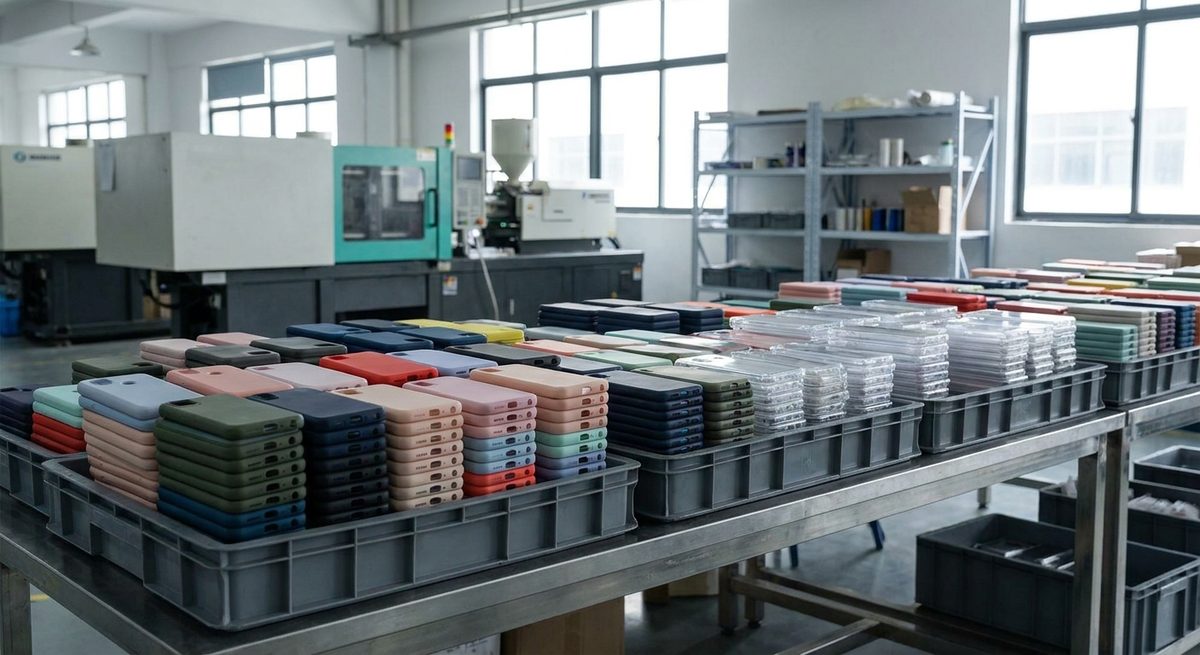
Eight in the morning at the accessory halls near Huaqiangbei, and phone cases are already moving by the sack. Not the piece. The sack. Traders shout model numbers for handsets that launched a week ago, and the stock on those counters was moulded in Dongguan yesterday and printed overnight. That’s the machine you’re plugging into when you import phone cases from China, and it’s spread across three cities. Learn who does what, and where, and you’ll buy well. Skip that homework and you’re buying blind.
Three cities, one case
The Pearl River Delta splits the work. Dongguan holds the injection moulding: the workshops that cut mould steel, run the presses and turn out raw TPU and polycarbonate shells by the million. Shenzhen holds the trade layer, the counters and small design houses that react to every handset launch and push orders back to the moulding shops. Guangzhou holds the finishing end. Leather workshops for flip covers, print houses for UV artwork, packaging suppliers, and the export warehouses where mixed orders come together.
No single city completes a serious order alone. Talk only to a Shenzhen counter and you get speed but no say over production. Visit only a Dongguan mould shop and you get sharp shell pricing but no printing, no boxes, no export paperwork. The orders that run smoothly are planned across the whole map from day one. I’ve watched plenty that weren’t, and they all wobble in the same places.
Where a case is actually born
A phone case starts as a block of mould steel. A Dongguan workshop machines that block into a cavity matching the handset down to the camera bump and the button cutouts. Most moulds carry two, four or eight cavities, and the cavity count decides how fast a press produces. Cycle times on soft TPU are short, often under a minute a shot, so one busy press can feed a surprisingly big order. Stand next to a bank of those presses for ten minutes and you feel it as much as hear it: the hiss of the hydraulics, the clack of the mould closing, and a floor that stays faintly slippery with release agent no matter how often someone mops it.
Material matters as much as the mould. Soft TPU is forgiving and cheap to run. Rigid polycarbonate warps if the process drifts. Liquid silicone gives that premium matte feel, but it runs on different machines with longer cycles, and you’ll see that in the unit price. If your market expects a certain weight in the hand, that expectation gets set in a Dongguan moulding room long before anyone prints a logo.
One thing buyers keep missing: ask who owns the mould. Paid a tooling fee for a custom design? Then the mould should be yours on paper, with the tool number recorded in your contract. Factories here are used to the arrangement. It still has to be written down.
New handset, new case, same week
The Shenzhen accessory trade lives on release calendars. Case dimensions leak through the supply chain early, and moulds are often cut before a new phone ever reaches a shop. Days after a launch, the counters carry dozens of designs for it. Useful, twice over. The counters show you instantly which styles the market is betting on, and they let you buy small mixed lots to test on your own customers before you commit to a factory order.
One caution. Counter stock varies, and two lots that look identical can come off different presses with different material grades. My advice hasn’t changed in years: treat market stock as research, then place the real order with a named factory where material, colour and print process are locked in writing. Serious buyers who import phone cases from China keep both channels open. Counter stock for fast tests, factory orders for consistency.
Match the product to the district
Your quotes sharpen the moment you send the enquiry to the district that actually makes the thing. A rough guide from years of orders:
- Soft TPU and clear cases: Dongguan moulding shops, quoted by material grade and cavity count.
- Liquid silicone and premium rubber finishes: specialist Dongguan and Shenzhen plants with silicone lines.
- Leather and PU flip covers: Guangzhou leather workshops, where the stitching separates good suppliers from cheap ones.
- Printed and UV pattern designs: Guangzhou and Shenzhen print houses working on blank shells.
- Magnetic ring and wallet styles: Shenzhen, close to the component trade that supplies magnets and card holders.
Prices vary by factory and specification, so use the map to shortlist, then compare at least three suppliers on the same written spec sheet. A quote means nothing until every bidder is pricing the same material, thickness, print method and packaging. Nothing.
One shipment from three sources
Most real case orders end up mixed. Some clear TPU, some printed designs, some leather covers, plus retail packaging from a fourth supplier. Shipping each piece separately would be slow and pricey, so the practical answer is one warehouse where everything arrives, gets checked, and loads together. Ours does exactly this, and working with a shipping agent in Guangzhou means the cartons from Dongguan, Shenzhen and the local print houses meet in one place before export.
Consolidation is also where the checking happens. We pull cases from random cartons and test them against the approved sample: fit on the actual handset, print alignment, button feel, and smell, because cheap TPU has a chemical odour customers notice the moment they open the box. If you want to know the people doing that checking, read about who we are and how long we’ve been working on the ground here.
What buyers ask us before ordering cases
What minimum quantity should I expect for custom printed cases?
For printing on existing blank shells, a few hundred pieces per design gets most factories interested. A fully custom mould is a different project altogether, since tooling only pays for itself across real volume. Every factory sets its own floor, and it moves with how busy the presses are, so treat any published MOQ as an opening position.
How fast can cases for a brand new phone model be supplied?
For popular models, moulds are often ready around the launch date and stock hits Shenzhen within days. A custom design on a new model needs time for mould adjustment, sampling and your sign off before mass production. Don’t rush that sign off. A hurried yes is the most common reason a whole order fits badly.
Can I mix several handset models and case styles in one order?
Yes, and most buyers do. Factories quote per SKU, and the warehouse packs everything into one export shipment. Keep each SKU above the factory’s per design floor and the mix costs you very little extra.
Planning a case order and want eyes on the actual factories? Get in touch through the contact form or WhatsApp. We’re based in Guangzhou, we host buyers in person, and we’ll drive you to the moulding shops in Dongguan and the trade floors in Shenzhen so you can see the whole map for yourself.
Read next
What Drives the Price of an LED Advertising Display from China
What really sets the price when you import led display screens from China: pixel pitch, lamps, cabinets, control gear and…
Bluetooth Speaker Quality Control: Catch Faults Before They Ship
Plan quality control before you import bluetooth speakers from China: the defects speakers hide, the audio tests that find…
Smart Door Locks by the Carton: Weight, Batteries, Freight
How to import smart door locks from China without freight surprises: battery paperwork, heavy cartons, drop protection and…