
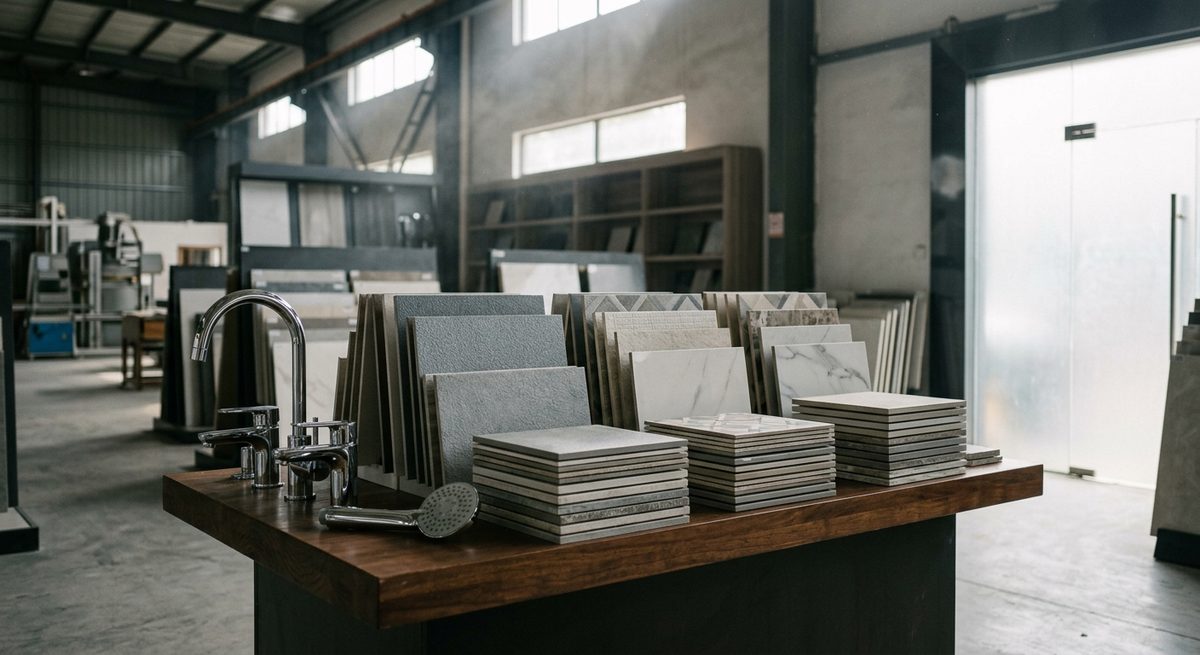
A porcelain tile comes out of the kiln anonymous. Nothing on it says who made it, and nothing says who sells it. Everything that turns it into a product people ask for by name gets added afterwards: the printed face, the box, the display board, the brand on the pallet wrap. That’s why I tell buyers who want to import ceramic tiles from China to treat the order as a branding project first and a freight job second. The Nanzhuang tile belt in Foshan, half an hour from Guangzhou, exists to support exactly that way of working.
Showrooms by the kilometre
Nanzhuang town in Foshan’s Chancheng district packs tile showrooms, trading offices and design studios into a few dense kilometres, with the production plants spread through the counties around it. The exhibition buildings are air conditioned so hard that I carry a jacket in July, and inside them you walk past full room mock ups in marble looks, terrazzo and wood plank effects until the showrooms start to blur together. Most of what you see can carry your name. Your boxes, your labels, your display system, at minimums that are surprisingly humane for a heavy industry.
Inkjet printing is the reason. Modern lines print the tile face digitally, so changing a design is closer to changing a file than changing a machine. Factories refresh their catalogues constantly, and a buyer who knows what sells at home can pull a coherent private label range out of several plants in a single trip.
Where your name can go, and where it can’t
Customisation runs deeper than most first timers expect. It also has hard limits, and you’d rather learn them now than mid order.
- Surface designs can be adapted: colour shifts, pattern scale, gloss or matt, the number of different faces per design.
- Sizes come from the press moulds the factory already owns. Picking an existing size is quick. A new size means new tooling and serious volume promises.
- Edges can be rectified for tight grout joints, which mid market buyers increasingly expect.
- Back stamps with your brand can be moulded or printed on many lines, subject to quantity.
- Packaging is entirely yours: carton artwork, pallet wrap, shade and calibre labels in your language.
My honest advice? Spend your budget on the box and the display system before you ask for exotic changes to the tile itself. Customers stare at packaging and showroom boards every day. Nobody studies the back of a tile.
The carton does more work than you think
A tile carton carries the brand, and it carries the technical story too: size, thickness, shade batch, calibre, slip rating, coverage per box. Getting that layout right in your market’s language, with your logo and your support number on it, is one of the least expensive upgrades in the whole project. Factories around Nanzhuang print custom cartons routinely, though printed boxes bring their own minimum runs, so the artwork needs to be final before mass production starts. A late carton change can strand a finished order on the factory floor. I’ve watched it happen. Painful.
Inventory doesn’t sell itself
A tile range without displays is just stacked weight. Handily, the district that makes the tiles also makes the selling tools: MDF display boards, rotating stands, boxed sample sets, folders with real tile chips glued inside. Order them with the first container and your showroom, or your dealers, can start selling the week the goods clear. This is also where a wider brand plan earns its money. Our brand building support covers logo and packaging design, photography and a web presence, so the range lands with an identity instead of a factory code.
From approved sample to loaded container
Once the range is chosen, the path is fairly predictable. Design confirmation and sampling come first, with A4 or full size pieces couriered for approval. Carton and display artwork gets finalised while the factory books kiln time. Production of a popular size commonly takes a few weeks, moving with the season and the order book. Then inspection, which should check shade consistency between boxes, calibre marking, breakage in sample cartons and the print quality of your packaging. Not just the tiles.
A China sourcing agent in Guangzhou keeps all those threads in one pair of hands on the ground: chasing artwork approvals, sitting in the pre production meeting, walking the warehouse before loading. Tiles are heavy, low value per kilo and unforgiving. A problem costs far less to fix in Foshan than at your port.
Shade codes, repeats and the long game
Minimums for private label tiles vary by factory and specification. In many cases a plant will run a custom carton programme from a single container per design group, while a fully custom face asks for more. The harder question is the repeat order. Ceramic shades drift slightly between firing batches, which is the whole reason shade codes exist. Keep records of the shade and calibre of every shipment. Tell customers to buy a whole room from one batch. Ask the factory to hold same batch stock when a project looks likely to reorder. Distributors who import ceramic tiles from China on a steady rhythm often lock in a rolling production slot with their main plant, which smooths shade control and carries them through seasonal kiln congestion. Easy to arrange once the relationship exists. Very hard to improvise in a rush.
Three things branded tile buyers ask us
Can one factory make my whole range?
Rarely. Plants specialise by size and body type, so a range of floor tiles, wall tiles and big slabs usually draws on two or three factories. Consolidating them into shared containers under one brand is everyday practice in the Foshan belt.
Do I own the design the factory adapts for me?
Only if the contract says so. Exclusivity can be agreed, sometimes limited to your market or tied to a minimum annual volume. Get the terms in writing before sampling starts, not after the range takes off.
How much breakage is normal inside a container?
With proper palletising and corner protection, breakage on a well packed container is normally small and sits in the edge cartons. Inspect before loading and photograph the stuffing, and you’ll have the evidence if a claim is ever needed.
If a tile brand of your own is the goal, come walk Nanzhuang with us. We’re based in Guangzhou, we host buyers in person, and we can take you from showroom to kiln to carton printer in two well planned days. Send a message through the site or on WhatsApp and we’ll start mapping the route.
Read next
Read next
Curtain and Blind Orders from China: What Goes Wrong
Learn where curtain orders go wrong before you import curtains from China: fabric swaps, sizing errors, dye lot drift and…
What You Actually Pay For in an Office Chair Made in China
What drives the price when you import office chairs from China: gas lift class, mechanism, mesh, carton volume and the road…
Test Reports and Paperwork for Kitchen Appliance Imports
Import kitchen appliances from China with the right test reports, safety marks and food contact documents. A practical…