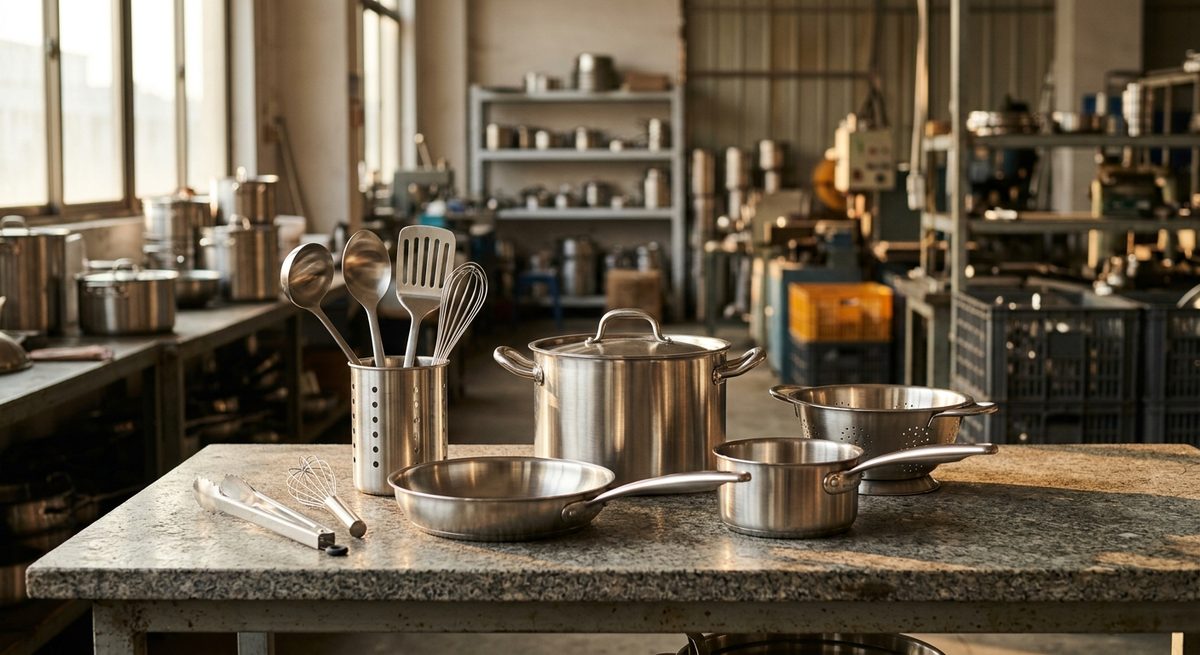
Hold a magnet against the wall of a stainless pot and you learn something, though less than most buyers think. Grade 304 steel is largely non-magnetic while cheaper 201 pulls a magnet harder, yet deep drawing can make even good steel slightly magnetic in places. That’s this product in miniature. Quality hides in details that need proper checks, not folk tests. Anyone planning to import stainless steel cookware from China should build the order around inspection from day one, because a pot that looks flawless on a shelf can still fail in a kitchen. Here’s what our inspectors actually look for.
Grades, and the honesty of a spec sheet
Most cookware bodies are drawn from 304 or 201 stainless, with 430 common on outer capsule bases because induction hobs need a magnetic layer. Every grade has a legitimate use. The trouble starts only when the quotation says one thing and the coil of steel says another. So the protection is written and physical at once: the contract names the grade and wall thickness for each component, and the inspection includes spot testing with a portable analyser or lab verification on random pieces. Thickness matters as much as grade, by the way. A thin 304 body can cook worse than a well made heavier pot, so we measure walls and bases with a gauge instead of trusting the catalogue line.
The faults that keep turning up
Cookware fails in patterns. After enough factory days the checklist nearly writes itself:
- Weld spatter or discolouration where handle meets body, hidden under quick polishing
- Rivet burrs inside the pot that catch a sponge and later rust along the scratch
- Uneven mirror polishing with swirl marks that only show under kitchen lighting
- Pitting or black spots in the surface, often from sloppy final cleaning
- Capsule bases that delaminate or sound hollow when tapped, a sign of poor bonding
- Lids that rock or spin instead of seating quietly on the rim
- Handles that loosen under a torque test or heat up faster than the design claims
Every item on that list has a test an inspector can run on the factory floor with simple tools. A tap test, a torque driver, a straight edge, a boil test, a bright lamp. None of it slows shipment when it’s planned into the schedule.
Jieyang, a city built on this metal
A large share of China’s stainless cookware and kitchen tools comes from Jieyang in eastern Guangdong, a city so identified with the material that people just call it a stainless steel town. Workshops there run from small pressing shops to full factories with their own polishing lines, capsule bonding and packing halls, and that spread in capability is exactly why vetting matters. I’ll say this about the polishing halls: you smell them before you see them, a mix of hot buffing wax and fine metal dust, with the buffing wheels whining away behind plastic curtains and every worker masked to the eyes. A factory that keeps that area ventilated and orderly usually keeps its quality records the same way. From our base a few hours away, buyers who import from Guangzhou can have audits, sampling and inspections in Jieyang handled on the ground without flying in for each step, and can combine cookware with other kitchen lines from around Guangdong in one shipment.
Testing past what the eye can see
Visual checks catch finish problems, but cookware also carries food contact and performance requirements. Most destination markets expect proof that the steel releases no harmful substances into food, and recognised lab reports for food contact materials are the normal evidence. Induction cookware needs its base tried on an actual induction hob, not just a magnet. Base flatness should be measured cold and again after heating, because a base that domes when hot will rock on glass cooktops. Ask which reports the factory already holds, check they name the factory and the actual product, and confirm with a lab or your customs broker what your own market requires before production begins. Don’t leave that for later.
How an inspection day actually runs
A pre-shipment inspection follows a sampling standard, pulling a set number of pieces at random from finished cartons. The inspector checks them against the sealed approved sample and the defect list, runs the functional tests, verifies logos, manuals and barcodes, and weighs and measures a sample of cartons. For first orders I’d always add a during-production visit earlier in the schedule. Polishing and assembly faults found at that stage get corrected on the line instead of argued about at the end. Reports arrive the same day with photos, and shipment is approved, corrected or re-checked on evidence rather than reassurance. When a batch fails, the report says why, piece by piece. That turns the conversation with the factory into a repair plan instead of a standoff.
From plain pots to a range with your name on it
Cookware takes branding well. Laser engraved logos on the base, embossed lids, colour boxes and recipe cards can all be arranged at the same factories, and engraving costs little per unit once the tooling is set. Buyers building a kitchen brand usually start with one hero set and grow the range each season. Sensible. Our brand building support covers the design side, from logo placement and box artwork to manuals and a web store, so the branded version ships in the first container rather than a later one.
What cookware importers ask us
Is 201 stainless steel ever acceptable for cookware?
It appears widely in budget lines and in components that never touch food, such as some outer layers. What matters is honesty. Know which grade each part uses, price accordingly, and make sure food contact surfaces meet your market’s rules, verified by test reports rather than assumptions.
How many pieces actually get tested in an inspection?
Inspections follow recognised sampling plans that set the sample size from the shipment quantity. Functional tests like handle torque and induction heating run on that sample, while lab tests for food contact are done on a small number of representative pieces per material.
What packing stops mirror-polished pots arriving scratched?
Each piece should be wrapped or bagged individually, with card or foam between nested pots and a protective film on the high polish surfaces. A shake test on a packed carton and a drop test at the factory tell you quickly whether the packing spec survives real handling. If it fails there, it fails in transit.
If cookware is on your product plan, get in touch through the contact form or WhatsApp. Our team lives and works in Guangzhou, and we’re glad to meet you here, plan the specification together, and drive with you to the Jieyang factories to watch the polishing lines run.
Read next
What You Really Pay for in a Bedding Set Made in China
See what actually drives the unit price when you import bedding sets from China, from fabric weight and thread count to…
From a Photo to a Delivered Container: One Rug Order from China
Follow one real order from photo to delivery and see how to import rugs from China, from spec sheet and sampling to…
Curtain and Blind Orders from China: What Goes Wrong
Learn where curtain orders go wrong before you import curtains from China: fabric swaps, sizing errors, dye lot drift and…