
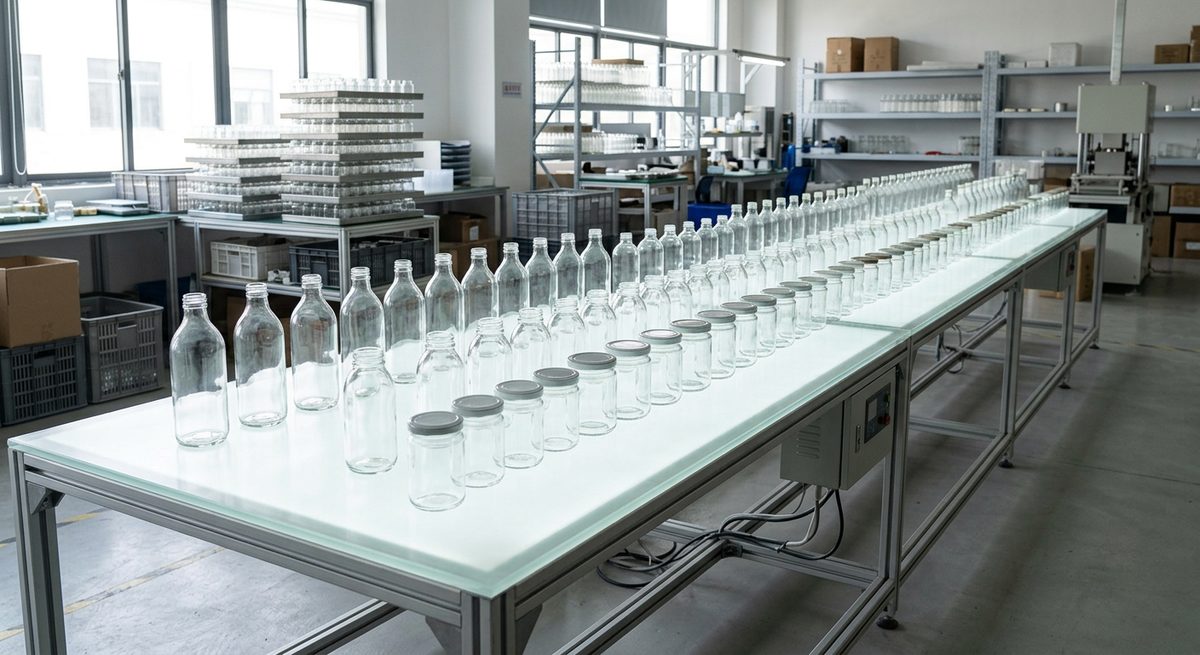
The spray shop is always the loudest room, and it smells like pear drops. Solvent, basically. In a Baiyun district coating plant the glass bottles ride overhead on little jigs, through two lacquer booths and a UV tunnel, and at the end of the line a woman flicks every tenth bottle with her fingernail and listens to it. I’ve stood on that line dozens of times, and it’s still the first place I take buyers.
Photos tell you very little about packaging. A jar that looks perfect on screen can feel cheap the moment you pick it up. The weight, the click of the thread, the way a pump primes on the second stroke, none of that survives a product photo. So if you plan to import cosmetic packaging from China in serious volume, at some point you should stand inside the factory that makes it. Guangzhou makes this easy. Much of the packaging cluster sits in Baiyun district, twenty to forty minutes from the city centre depending on traffic, and you can walk three factories in a day without rushing anyone.
Skip the showroom, ask for the moulding hall
Every packaging factory has a showroom. Every showroom is spotless, air conditioned until it’s cold in August, and stocked with the finest samples the company has ever produced. It’s a lovely place to drink tea. It tells you almost nothing.
Ask to walk the injection hall instead. Watch how the machines are fed. Some run virgin resin through sealed dryers in a closed loop. Others have open sacks of regrind sitting beside the hopper. Both exist, and regrind has legitimate uses in some components, but you want to know which material is going into your jar walls before you find out from a complaint. Look at the floor as well. A hall that sweeps up its sprues twice a shift usually controls colour, weight and cycle times properly too.
Test pumps the boring way
Pumps and droppers cause more claims than anything else in this category. Not because the factories are careless. A pump is a tiny machine with a spring, a ball and a gasket, and tiny machines fail in small numbers no matter who builds them. Your job on a visit is to find out how small that number really is.
So sit at a table with twenty pumps pulled from the line, not from the sample drawer, and do the dull work:
- Prime each one and count the strokes. More than four or five presses on a lotion pump deserves a conversation with the engineer.
- Spray a mist pump at a sheet of dark card and study the pattern. A pump that spits is a refund waiting to happen.
- Fill a few bottles, lay them on their sides overnight, and check for creep around the closure in the morning.
- Screw each cap on and off ten times. Threads that shave plastic in your hands will shave it in your customer’s bathroom.
The whole exercise takes an hour. That hour has saved buyers we work with from repacking entire shipments after arrival.
The decoration room decides your shelf presence
Silk screen, hot stamping, metallising, gradient spray. Whatever finish you’ve designed, it comes out of this room, and it’s the room I judge hardest. Watch a hot stamp being pulled. Clean foil edges at speed mean the press is set up well. Ragged gold dust around the logo means your batch will look like that too, just less often.
Ask how colour gets checked. The better plants keep a light booth near the line and compare coated bottles against a sealed master under two light sources, because a rose gold that glows at noon can look muddy under a shop LED. If nobody can show you a master sample for a current job, that’s your answer.
Artwork and packaging decisions tangle together quickly when you’re launching a line. This is where our brand building support earns its keep: we sit between your designer and the decoration room so a file that looks beautiful on a flat screen actually prints on curved glass.
Cleanliness you can’t stage for a visitor
Your jars will hold product that goes on skin, so look at the plant the way an auditor looks at a food factory. Staged cleanliness is easy to spot once you know where to look. Look up first. Dust settles on beams, cable trays and light fittings long before anyone mops a floor for a guest. Then find where finished bottles wait before packing. Lidded totes in a curtained area is one answer. Open trays under a ceiling fan is a very different one.
Hairnets matter less than habits. I’d rather see a bare-headed technician wipe a nozzle with lint-free cloth between colour changes than a fully gowned crew leaning on open cartons of jars.
Bring your actual product with you
The most useful thing you can carry into these meetings is a pot of your own formula. Creams with high oil content stress certain plastics. Some essential oil blends craze clear materials over weeks, and airless pumps that handle a thin serum happily can stall on a thick balm. Hand the factory your product and ask what compatibility testing they’d run before tooling anything. The quality of that answer tells you more than any certificate on the wall.
We host buyers for exactly this kind of trip all year round. If you’d like to meet us in China and visit the factories with an interpreter beside you, we’ll plan the route through Baiyun, book the meetings and handle the driving.
Questions from the drive back to the hotel
How many packaging factories can I see in one day?
Three is comfortable if they’re all in Baiyun, two if one of them is a glass plant further out. Factory visits run long when they’re going well, and you don’t want to cut a good technical conversation short to sit in ring road traffic.
Will one factory make my jars, pumps and boxes?
Almost never under one roof, and that’s fine. Moulders, pump makers and printers are separate trades. What you actually need is one party who collects components from all of them, checks the fit, and gets the assembled sets packed properly. That’s a coordination job, and it’s most of what we do.
Can I visit before I’ve placed any order?
Yes, and serious factories expect it. Bring drawings or reference samples so the conversation has something to bite on. A visitor with a spec sheet gets the production manager. A visitor with nothing gets the showroom and the tea.
Our team lives and works in Guangzhou, and the Baiyun packaging cluster is home ground for us. Send your project through the contact form or on WhatsApp, and we’ll tell you honestly whether a visit makes sense at your stage or whether a round of samples will answer the same questions for less money.
Read next
Read next
How to Order Custom Packaging & Print from Guangzhou
Packaging is often the first thing your customers notice, and Guangzhou's printing and packaging industry is among the most…
Sourcing Stationery & Office Products from Guangzhou
Guangzhou and the neighboring city of Dongguan are major production centers for stationery and office supplies. From…