
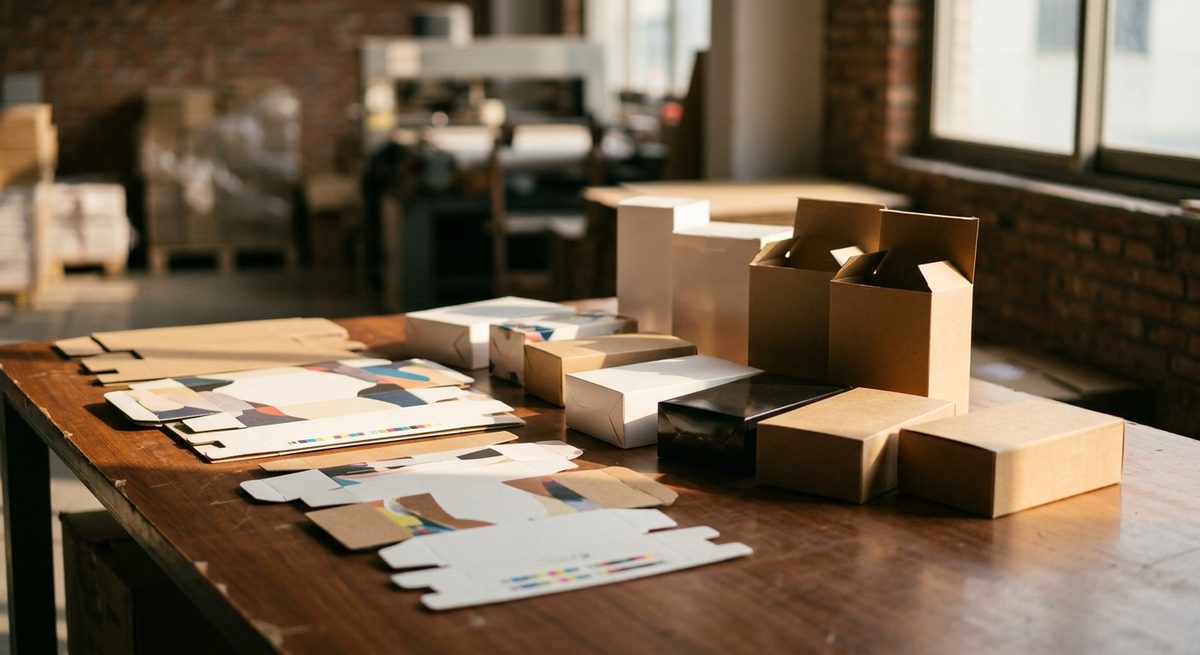
A client of ours once opened a carton of candle boxes and found every single lid sitting crooked, one corner lifted like a badly pitched roof. Those boxes had left the factory flat and true. Somewhere between a humid workshop in Dongguan and a dry warehouse in northern Europe, the board moved. Rigid packaging looks simple. It’s actually one of the easier products to get wrong, and most of the failures happen in ways a first-time buyer never sees coming.
Greyboard remembers the weather
A rigid box is greyboard wrapped in printed paper, and greyboard is compressed recycled fibre. It drinks moisture. Walk the printing belt that runs from Guangzhou out through Dongguan in August and you’ll notice pallets of board sitting untouched in the workshop for days before anyone cuts a sheet. That isn’t laziness. The board is settling to the room’s humidity, and plants that skip the wait ship boxes that warp the first time the air around them changes.
So ask your factory how long board rests before converting, and whether the wrap is balanced on both faces. Paper glued to one side only pulls a lid into a curve as it dries. A good plant answers with specifics. A weak one tells you it’s never a problem, which is its own kind of answer.
The proof looked perfect. The run didn’t.
Colour drift is the complaint we hear most often in this category. The digital proof was approved, then the bulk boxes arrived darker, or the brand’s blue turned faintly green under warehouse lights. There are honest reasons behind it. A digital proofer and an offset press lay down ink differently, and matte or soft-touch lamination shifts everything again after printing, always a touch darker and duller.
The fix is boring and it works. Approve a press proof on the actual paper stock, laminated, before the full run starts. It adds a few days and a small fee. Skip it and you’re trusting a screen, and screens lie about colour all day long.
Foil stamping and embossing bring their own trouble. Fine serif type in foil fills in and turns to mush. An emboss line placed too close to a fold cracks the wrap. Your designer and the factory’s prepress person need a real conversation before any tooling gets cut, and if language sits in the way, having help in Guangzhou inside that conversation is worth more than any clause in the contract.
Lids that stick, magnets that miss
A well made rigid lid closes with a soft sigh of trapped air. Miss the tolerance by a millimetre and it either jams halfway or drops with a clack. Both feel cheap in the hand, which defeats the point of paying for rigid in the first place. Magnetic closures fail in a different way: a magnet glued a few millimetres off centre, or with its poles reversed, and suddenly a percentage of your boxes push themselves open on the shelf.
Sizes drift too. The sample was built by the factory’s best hands around your actual product. The bulk run gets built to the drawing, so if the drawing was reverse-engineered from the sample rather than agreed as numbers, a millimetre of interpretation creeps in. Sign off dimensions on paper, not just a box in your hands.
Ribbon pulls fray. Inserts cut from the wrong density of foam let the product rattle. None of these show up in a photo of a golden sample. They show up at scale, which is why mid-production checks matter so much for packaging.
Glue, smell and the cost of hurrying
Stand next to a wrapping line and the first thing you notice is the warm, sweetish smell of hot glue, and the speed of the hands working through it. Glue is where schedule pressure shows first. Rushed boxes skip proper pressing time, and corners lift weeks later. Solvent-heavy adhesives leave a smell inside the closed box, which a customer notices the moment they open a supposedly premium package.
Gifting seasons make this worse. Every brand wants boxes in the same two months, the plants run flat out, and quality slips exactly when your order is on the line. Book production earlier than feels necessary. It’s the cheapest quality tool you have.
A pre-production list that catches most of it
Before bulk production starts, get these settled in writing:
- A laminated press proof approved by you, not a screen render.
- Board thickness and grammage stated as numbers, matched to the sample you signed.
- Lid fit tolerance agreed, with a sample that opens and closes the way you want.
- Glue type and pressing time confirmed, especially for winter shipments into cold climates.
- A signed golden sample kept at the factory and a twin kept with you.
Half an hour of this beats any amount of arguing after delivery. Factories respect buyers who ask for it.
The journey is part of the spec
Rigid boxes are strong in one direction and fragile in another. Stack the shipping cartons too high and the bottom layer’s corners crush, which is the one defect no customer forgives. Good packing means corner protection, sensible carton counts and desiccant when boxes cross humid ports. If your boxes and your product come from different factories, as they usually do, consolidation and export handling under one roof lets someone check both before they’re sealed into the same container.
Straight answers on packaging orders
What’s a workable minimum quantity for custom rigid boxes?
It varies by factory and construction, but in many cases plants in this belt will quote from around five hundred to a thousand pieces for a custom size. Below that, the setup costs swallow the economics and you’re better off adapting a stock size with custom printing.
How long should I allow from artwork to delivery?
Sampling commonly takes a week or two, production a few weeks more depending on finish and season. Add the press proof round and the freight time on top. If you’re aiming for a holiday launch, work backwards from the shelf date and you’ll find the real deadline is months earlier than instinct says.
Can one factory do the box, the insert and the bag?
Sometimes, and it’s convenient when it’s true. More often the foam insert or the paper bag comes from a neighbouring workshop. That’s fine as long as one party takes responsibility for the fit between all three, because “the insert factory’s problem” is never a phrase you want in an email.
We’re based in Guangzhou, a short drive from most of the print and packaging plants we work with, and we walk those floors with buyers all the time. If you’re planning a packaging project and want it checked at every step, or if you simply want to import gift boxes from China without learning every lesson the hard way, message us through the contact form or WhatsApp.
Read next
Walking a Baiyun Packaging Factory Before You Order a Single Jar
See what actually matters when you import cosmetic packaging from China: spray lines, pump testing, decoration rooms and…
Sourcing Stationery & Office Products from Guangzhou
Guangzhou and the neighboring city of Dongguan are major production centers for stationery and office supplies. From…
How to Order Custom Packaging & Print from Guangzhou
Packaging is often the first thing your customers notice, and Guangzhou's printing and packaging industry is among the most…