
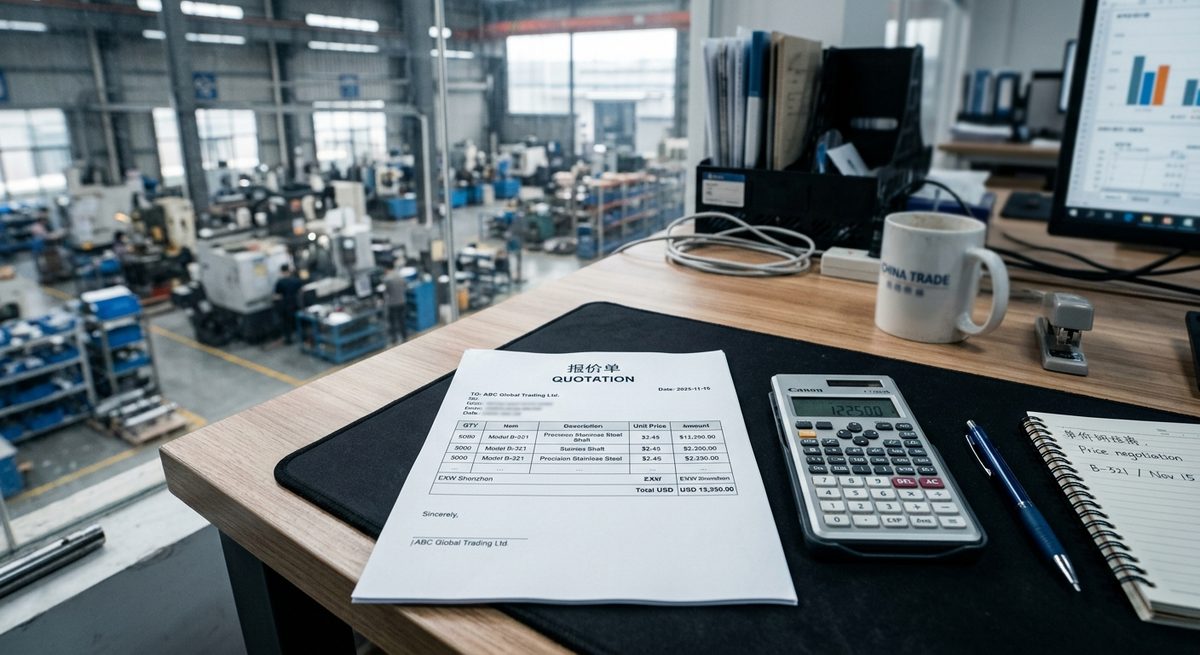
Two power banks sat on our meeting table last autumn, cut open with a rotary tool. Same capacity on the label, same casing style, quoted eleven percent apart by two factories in the same district. Inside, they were different products. The dearer one had a battery cell from a brand we knew and thick copper on the charging board. The cheap one had a lighter cell with no maker’s mark and solder joints that looked tired already. The buyer had been about to order four thousand of the cheap one. He held both halves for a long minute and didn’t say much.
A low quote is a list of things removed
Factories in the delta are competing against neighbours who buy the same materials from the same suppliers, pay similar wages, and run similar machines. There’s no secret efficiency that makes one factory fifteen percent cheaper on an identical product. So when a quote comes in far under the pack, the product is no longer identical. Something came out. The quote won’t say what.
The usual candidates, in roughly the order we find them: material grade drops, wall thickness shrinks, plating gets thinner, the branded component becomes an unbranded one, the carton becomes single-wall, and testing quietly becomes “available on request”. Each removal is small. Stacked up, they’re the eleven percent.
Where the missing money reappears
The savings don’t vanish. They come back later, wearing different costs:
- Returns and reviews. A one-grade drop in material can move a product from three years of life to eight months. You’ll meet that difference in your refund rate, in your ratings, and in customers who never come back.
- Transit damage. Thin cartons crush at the bottom of a container stack. The freight you saved per unit gets spent on the units that arrive unsellable.
- Compliance trouble. Anything electrical or child-facing that skipped testing can be stopped at destination. Storage fees at a port make factory savings look very small very quickly.
- Rework and delay. Fixing a bad batch means either paying someone at destination or arguing for weeks about a reshipment while your shelves sit empty. Stock you can’t sell costs money every day it doesn’t exist.
Anyone planning to import from Guangzhou should price these four lines into every comparison. The low quote rarely survives the exercise.
How to read three quotes properly
Force one specification first
Most buyers do it backwards: collect quotes, then wonder why they differ. Write the spec first. Materials by grade, dimensions with tolerances, component brands where they matter, packaging construction, required certificates, inspection standard. Send the same document to every factory. Now the numbers can be compared, and the factory that quotes without reading it disqualifies itself.
Ask what would change at a lower price
This question is quietly wonderful. Take the mid quote and ask that factory: “What would you change to reach this lower number?” They’ll tell you, in detail, precisely what the cheap competitor probably changed, because they know exactly where the money hides in their own product. You get an engineering lesson and a market check in one email.
Weigh the sample
Put every sample on a kitchen scale. Weight is the cheapest lie detector in this business: less copper, less steel, less resin, thinner glass all show up in grams before they show up in failures. If the production goods later weigh less than the golden sample, you’ve caught a substitution without opening a single seam. Electronics buyers especially should make this a habit, and our guide on How to Order Consumer Electronics & Smart Gadgets from Guangzhou goes deeper on which corners get trimmed in that category.
The price you actually pay is the landed one
Unit price is one line in a longer sum: unit cost, tooling if any, testing, inland haulage from the factory to the port, ocean or air freight, insurance, destination charges, duty at your end, and the cost of money sitting in transit. Confirm the duty side with your own customs broker before you commit, since classification decides more than negotiation does. A quote that’s five percent higher from a factory near the port, with testing included and cartons that stack properly, beats a cheap quote from a factory that gets all of those wrong. Run the whole column. Every time.
Packing efficiency deserves its own line in that column. Two factories quoting the same unit price can land at different totals purely because one fits more cartons into a container through smarter inner packing. Ask both for the carton dimensions and units per carton, then do the container maths yourself. It takes ten minutes. It has changed our recommendation more than once.
Keeping an honest price honest
Say you’ve picked the fair quote, not the cheap one. The work isn’t finished. The spec that justified the price needs defending in writing, in the contract and the purchase order, with the inspection standard named. A pre-shipment inspection against a proper sampling plan is what stops the removed-parts game happening after approval, one production batch at a time. If sampling plans are new to you, start with AQL Explained: Sampling Plans for Pre-Shipment Inspections. It’s the standard the whole trade already speaks.
And keep the losing quotes. Seriously, file them. When your chosen factory asks for a price rise next year, the file tells you instantly whether the market moved or just their mood.
Questions buyers put to us about pricing
Is the most expensive quote the safe choice then?
No. High quotes need the same interrogation as low ones. Sometimes the premium is real engineering. Sometimes it’s a factory that doesn’t want the order, or a trading layer you can’t see. The spec-first method exposes both directions.
How far below the pack is too far?
Our working habit: within a few percent of the median, negotiate normally. Ten percent or more below, stop and find the removal before you find it in your warehouse. There’s no fixed threshold, but there’s always a reason, and it’s your job to hear it before you pay.
Can I just order a small test batch from the cheap factory?
You can, and sometimes we do exactly that for clients. Just know its limits. Factories build test batches carefully and relax at volume, so a good trial proves capability, not habit. The inspection at unit four thousand is what proves habit.
We compare quotes, cut samples open, and stand in factories in Panyu, Shenzhen and Dongguan for buyers who can’t be here themselves. If you’re holding three prices and the low one is whispering to you, send us the spec sheet. We’ll tell you what we think it’s hiding, and we’re happy to walk the factories with you when you visit.
Read next
How to Brief a Chinese Supplier So You Get What You Pictured
Learn to brief a Chinese supplier properly: reference samples, tolerances, packaging and the golden sample, from a sourcing…
What is the Canton Fair in Guangzhou
What is the Canton Fair in Guangzhou The Canton Fair, officially called the China Import and Export Fair, is the largest and…
Sourcing Power & Accessories from Guangzhou, China
Guangzhou is ideally situated near Shenzhen, China's electronics capital, making it a prime location to source power…