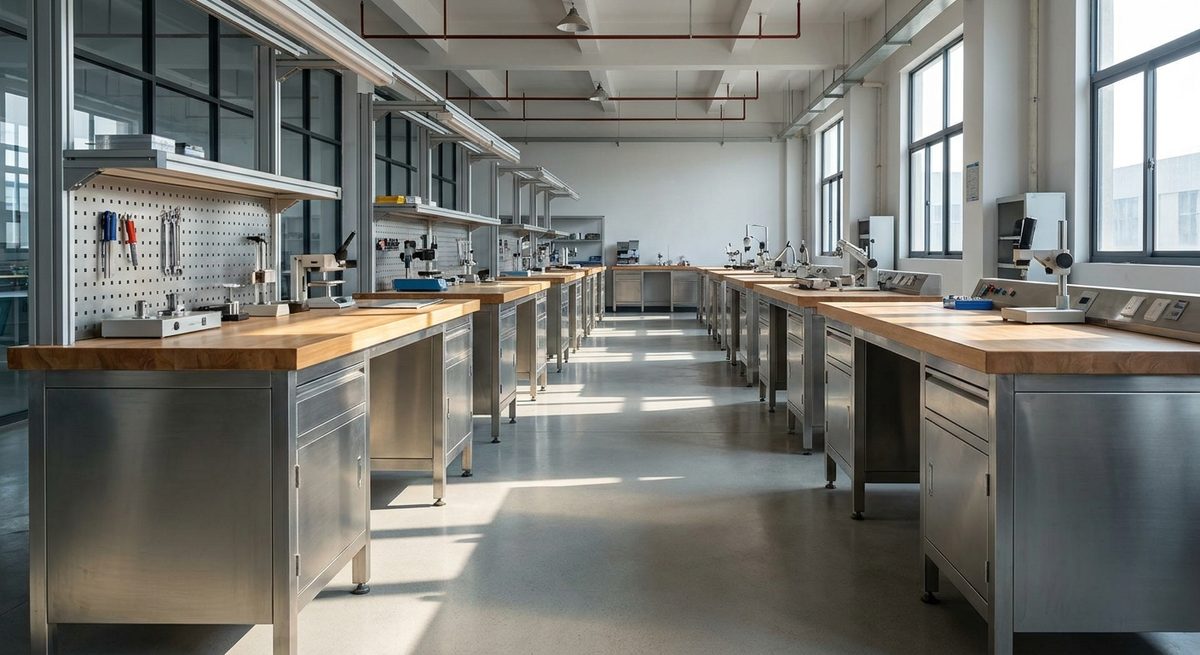
Forty minutes south of Guangzhou the road signs start saying Shunde, and the scenery turns into appliance country. Motor plants in one block. Injection moulding in the next. Sheet metal a street over. If you plan to import air purifiers from China, this stretch of Foshan decides more about your price and quality than any contract ever will, because a purifier isn’t really one product. It’s a fan, a filter stack, a sensor board and a plastic shell, and each of those comes from a different kind of factory.
One box, five suppliers
Pull a purifier apart on a workbench and you’ll find the whole supply chain laid out in front of you:
- The fan and motor. Usually a centrifugal fan on a brushless DC motor, from a specialist motor plant in Shunde or one of the dedicated motor towns.
- The filter stack: mesh pre-filter, pleated HEPA-grade cartridge, often a carbon layer. Filter media converters make these, not the assembly factory.
- The control board and sensors, mostly out of the electronics belt around Shenzhen and Dongguan.
- The housing. Injection moulded panels that need tight, even gaps, or the unit whistles at full speed.
- The packaging: a printed giftbox, pulp or foam inserts, and a master carton that can survive a stacked container.
The factory whose name lands on your invoice is really an integrator. Its skill is airflow design, mould quality and keeping those component suppliers in line. When we vet a purifier plant, we spend as much time asking where the filters and motors come from as we do watching the assembly line. That ratio surprises new buyers. It shouldn’t.
What Shunde makes, and what it quietly buys in
Shunde is the old heart of white goods in southern China, and purifier assembly grew straight out of that base. Motor winding, big-tonnage injection machines, engineers who’ve spent whole careers chasing noise and vibration out of appliances. A good Shunde factory will show you its own mould workshop and some kind of quiet chamber where they measure sound at each fan speed.
The filter media is a different story. HEPA-grade paper and melt-blown layers come from dedicated mills, then local converters pleat, frame and glue them into finished cartridges. Two purifiers with identical shells can carry completely different filters inside. If your market cares about filtration class and lifetime, learn the converter’s name, not just the assembler’s. That’s one of the things we confirm for clients who ask for help in Guangzhou on appliance projects.
The Ningbo question
The delta isn’t the only option. Ningbo and the towns around it form a second appliance belt with a long export history, and plenty of purifier lines run up there too. My rough rule after years of quoting both regions: the south wins on electronics-heavy models with app control and laser particle sensors, because the Shenzhen component ecosystem is next door, while Ningbo makers are often sharper on simple mechanical models and very large runs for chain retailers. Neither side is automatically better. For bigger projects we quote both and let the samples argue it out.
Standing on the line
Walk a purifier line and the sequence barely changes from plant to plant. Housings come in from the injection shop and get checked for sink marks and colour match. Motors are balanced and mounted on rubber isolators. Boards get flashed with firmware and tested on a jig. Then assembly, filter in, and a run test on every finished unit: power draw, airflow at each speed, noise, and a check that the sensor and filter-reset functions actually respond.
Where the good plants separate
The difference shows in small routines. Does every unit get a high-voltage safety test, or only samples? Is there an ageing room? The better factories keep a sealed room where a full batch runs flat out for hours before packing, and when someone opens that door you get a wall of warm air and a low massed hum, with a faint smell of hot plastic coming off the new mouldings. You don’t forget it. Ask what happens to returned units as well. “We rework them” is the wrong answer if nobody can show you the fault analysis behind it. These questions get answered standing on the floor, not in a brochure, which is why we take buyers into the Shunde workshops in person.
Fitting the map to your own spec
Once you know the geography, the sourcing decision gets concrete. A compact bedroom unit with a night mode points you at factories with strong motor suppliers and proper quiet-room testing. A large-room model with app control points at the Shenzhen-adjacent crowd. A pharmacy chain will care most about filtration documents, while an online seller cares about the giftbox and the failure rate in the first ninety days. Same map, different route.
Freight belongs in the same conversation. Purifiers are light for their size, so sea freight cost is a volume game and carton design earns its keep. When units come from Shunde and spare filters from a converter somewhere else, we pull everything into our warehouse for consolidation and export handling, and the client loads one clean container instead of chasing two shipments.
A first order that doesn’t waste a year
The sensible path is short. Write a real spec sheet: coverage area, filter class, noise target, control features and the certifications your market demands. Get quotations from both belts on that identical spec. Sample two or three factories, then test the samples hard at home, in a bedroom at night, not just on a desk. Visit the winner before tooling or first production. Anyone who wants to import air purifiers from China without ever seeing the run-test station is trusting a photograph, and a photograph can’t hum, rattle or leak air around a badly seated filter.
Things purifier buyers ask us
Will the factory still sell me replacement filters in three years?
Usually, but get it in writing. Have the factory commit to filter availability for a stated period and name the converter that makes the cartridges. Much of the long-term margin in this category sits in replacement filters, so treat them as a product of their own, with their own price and packaging.
Can I get a custom housing, or am I stuck with base models?
Both paths exist. A base model with your logo and giftbox needs modest quantities and moves fast. A fully custom housing means new injection moulds, which raises the entry cost and stretches the timeline considerably. My honest advice: prove the market on a base model first. Tooling money spent before you’ve sold a single container is usually money spent too early.
How do I know the filter grade matches what the quotation claims?
Ask for the media specification and a test report from a recognised lab, then have a third-party lab verify a production sample. During inspection we also weigh cartridges and count pleats against the approved sample, because the filter is the easiest place for a spec to slip quietly.
We’ve been sourcing appliances around Guangzhou, Foshan and the wider delta since 2007, and we’re in these factory districts every week. Planning a purifier project? Send your spec through the contact form or WhatsApp. We’ll shortlist suppliers, arrange samples, and when you’re ready, pick you up in Guangzhou and drive you out to the factories ourselves.
Read next
Choosing Products to Import from China: A Working Method
Choosing products to import from China starts with honest margin maths. How unit cost, freight and MOQ decide whether a…
How to Prepare for the Canton Fair Before You Land
Real canton fair preparation from a Guangzhou team that attends every session: badge, hotel timing, phase planning, and the…
How Buyers Choose Between Flying to China and Sending an Agent
Weighing a buying trip against sending an agent to China? A Guangzhou team explains what each route costs, what it catches,…