
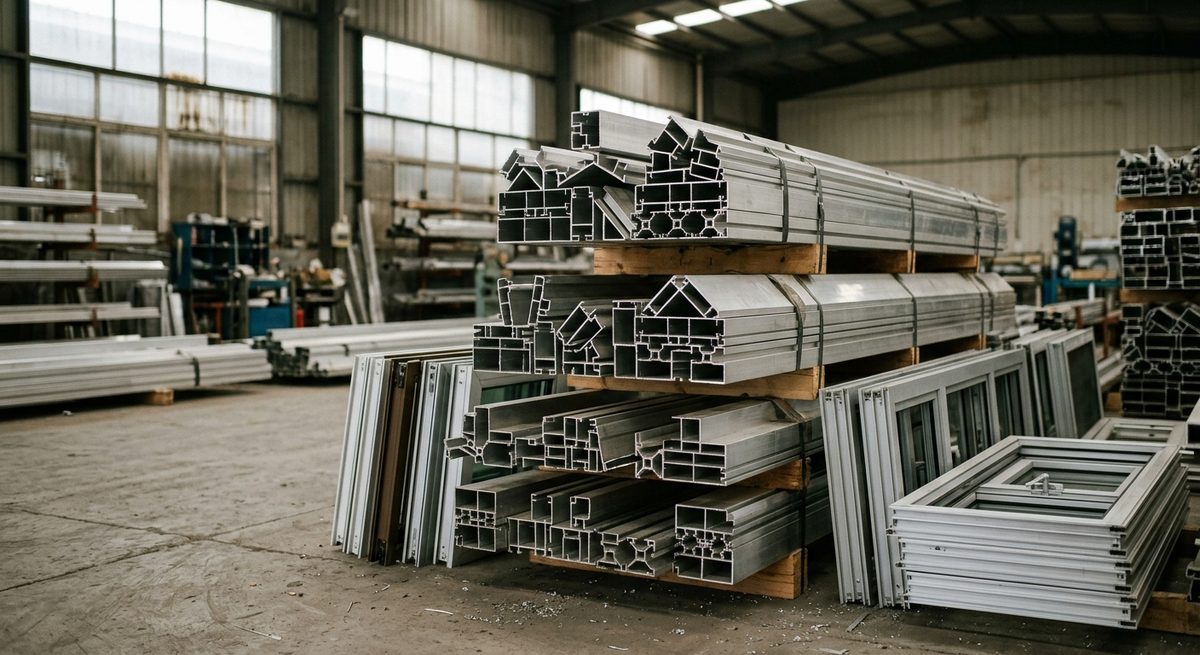
The die room tells you more about an extrusion factory than any showroom. Racks of heavy steel discs, each one numbered in paint, each one the exact cross section of somebody’s window frame, sliding door or shopfront system. When a plant in Foshan’s Nanhai aluminium belt keeps thousands of dies on those racks, it means thousands of customers trusted it with a design of their own. If you want your profile on that rack under your name, the real questions are what you can customise, what the tooling costs, and who owns the die once it’s cut.
Nanhai, where the extruders live
Drive through Dali and the neighbouring towns in Foshan’s Nanhai district and you pass aluminium plants for the better part of an hour. Billets go in one end, heated until they’re soft enough to press. A freshly extruded profile slides down the runout table still hot enough to ruin a cheap glove, and the workers walk beside it like handlers with a racehorse until it cools and gets stretched straight. Guangzhou sits roughly an hour away, which is why buyers in this category usually base themselves with us in the city and make day trips out to the presses. Showrooms are pleasant. The press line is where you actually judge a supplier.
What custom really means for a profile
Your own die
Standard sections already exist for almost everything: cabinet frames, solar mounting rails, LED channels, curtain wall members. A private label programme, though, usually starts with a die cut to your drawing. Factories commonly charge a tooling fee that’s small next to the value of the orders it enables, and many will refund it against volume. The fee varies by profile complexity, so treat any number as a conversation starter. The money isn’t the important part anyway. The important part is a signed clause saying the die belongs to you and won’t be pressed for anyone else.
Alloy and temper
Most architectural work runs on 6063-T5, with 6061 appearing where more strength is needed. Don’t accept a quote that skips the alloy and temper. Wall thickness tolerances matter just as much, and a reputable plant will happily state which national or international tolerance standard it works to.
Finishes are where the brand shows
Raw mill finish aluminium all looks alike. Surface treatment is where suppliers separate. Anodising lines run rows of acid tanks with their own sharp smell, and the film thickness in microns should be part of your spec, not a surprise. Powder coating opens up nearly any colour against a standard colour reference. Wood grain heat transfer, done in big ovens with printed film, has become a signature of this region and sells well in markets that want timber looks without timber maintenance. Whichever finish you pick, get a colour master sample sealed and signed, because batch to batch matching is the thing complaints are made of. We keep one client’s master piece in a drawer in our office, a short offcut in a particular champagne anodise, and every repeat order gets held against it in daylight before we approve the batch. Low tech. It works.
Windows are a different product from profiles
Plenty of our clients skip loose profiles entirely and buy finished windows and doors: thermal break frames, glazing, hardware and mesh, assembled and adjusted before packing. This shifts the quality questions. Now you care about corner joints, drainage slots, hardware brands and the factory’s test rig for air and water tightness. Ask to see a window sprayed on the rig during your visit. A good supplier is proud of that machine. If duty classification for finished windows differs from profiles in your market, confirm the tariff code and rate with your own customs broker before you commit either way.
Small branding touches that cost almost nothing
The cheapest branding trick in this industry is the protective film. Every profile ships wrapped in plastic film anyway, so having that film printed with your logo turns each bundle into a small advertisement on the building site. From there the options build up.
- Printed protective film on every profile or frame.
- Your logo stamped or laser marked on corner cleats and handles.
- Custom cartons with foam corners for assembled windows.
- Woven straps and end caps in your brand colour on profile bundles.
- Installation manuals and warranty cards printed under your name.
None of this needs huge volume. It needs artwork prepared correctly and someone checking the first bundles off the line. Our brand building support covers the artwork, the labels and the packaging design work, so the factory receives print-ready files instead of a sketch.
Where an agent fits in this picture
Extrusion is a category with real engineering in it, and drawings get lost in translation more often than you’d think. A China sourcing agent in Guangzhou earns the fee here by sitting between your technical drawings and the die shop, checking trial pressings with a caliper, logging die numbers with photos, and being physically present when the first production run comes off the press. Plenty of buyers import aluminium profiles from China for years on standard sections before cutting their first die, and honestly that’s a sensible way to start. Learn the supplier on stock profiles. Cut steel once you trust them.
Three things buyers ask before cutting a die
How long does a new extrusion die take?
Commonly a couple of weeks to machine and trial, though complex hollow sections take longer. The first pressing produces trial samples for you to approve, and it’s normal for a die to go back for correction once. Build that loop into your timeline instead of hoping to skip it.
Can I keep my profile exclusive?
Yes, if the contract says so clearly. Die ownership and exclusivity clauses are standard practice in Nanhai, not an awkward request. We photograph each client die with its number and keep the record, so there’s never an argument later about which steel belongs to whom.
Will a factory accept a small trial order?
Extrusion has honest minimums because every press run carries setup time. In many cases a factory wants somewhere near a tonne per profile per finish, though some will run less at a higher unit price. Finished windows are more flexible, since a project lot of thirty or fifty units is normal business here.
If you’ve got a drawing, a photo of a competitor product you’d like to improve on, or just a market you want to supply, get in touch through the form or WhatsApp. We’re in Guangzhou, the presses are an hour down the road, and we’ll happily walk the die rooms with you in person.
Read next
Where Hotel Towels Really Come From, and How to Buy Them Well
Planning to import hotel towels from China? See which cities weave them, how the supply chain fits together, and how a…