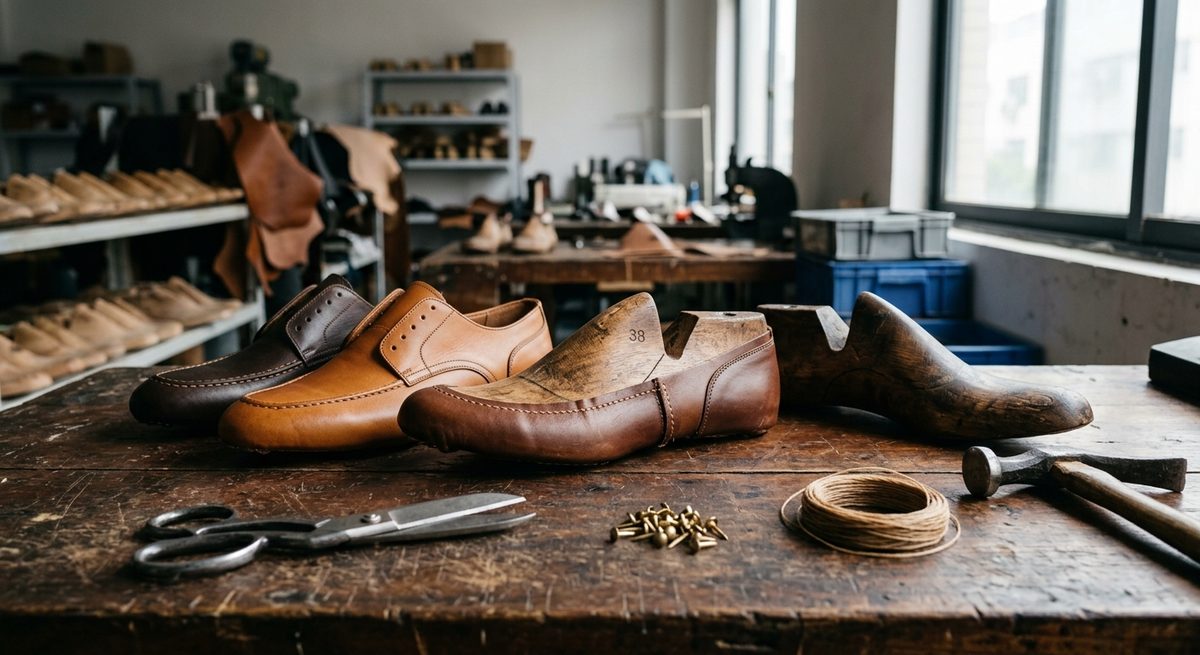
Stand at the end of a lasting line in Houjie for ten minutes and you’ll learn more about a shoe factory than a month of video calls will ever tell you. The pace of the conveyor. The way uppers get pulled over the last. How much cement ends up on an operator’s fingers. All of it shows on the finished shoe, and none of it shows in the photos a salesperson sends you. If you plan to import shoes from China in real volume, one day on a factory floor is the most useful day of the whole project. It also costs far less than one disappointing container.
Book the workshop, not the meeting room
Plenty of factory visits start in a showroom lined with display shelves and end with a slideshow. Ask for the opposite. Tell the supplier before you fly that you want to walk the cutting room, the stitching lines and the assembly floor while they’re running, not paused for lunch. A factory that hesitates usually has a reason. When we take clients out from Guangzhou we book mid-week, on normal production days, so the lines are full and nothing’s been staged. Houjie town in Dongguan is about an hour by car from the city, close enough to see two or three sneaker factories in a day without rushing anyone.
Bring your tech pack and a reference pair of the shoe you want, if one exists. Photograph everything they allow. By the second gate of the day you won’t remember which building had the automated cutting machines and which one still cut every panel by hand. Trust me on that one.
Five stations that tell you the truth
Sneaker making is a chain of small hand operations, and every station leaves evidence you can read on the spot. Stand at these five for a few minutes each:
- Cutting. Look at how patterns are nested on the material. Tight nesting means less waste and a factory that watches its own costs. Check cut edges for fraying, especially on mesh and knit uppers.
- Stitching. Count stitches per inch on a finished upper, then compare three or four random pairs from different trolleys. Wandering stitch density is an early sign of weak line supervision.
- Lasting. Watch whether uppers sit centred on the last. A toe pulled a few millimetres off line becomes a customer return in your shop.
- Cementing. This is where sneakers fail. Look for controlled glue application, real drying tunnels and primer on rubber outsoles. Cement squeezed out over the foxing line means the process is being rushed.
- Finishing and packing. Lace insertion, tissue stuffing, box condition, and whether pairs actually get examined before boxing or simply boxed.
One thing nobody warns you about: the assembly hall itself. The solvent smell hits you first, sweetish and sharp even with the fans going, and the drying tunnels throw off enough heat that in July your shirt sticks to your back within a minute of walking the line. That’s normal. A hall with no smell at all usually means the lines weren’t running that day, whatever you were told.
The warehouse says more than the brochure
Ask to see the materials warehouse and the incoming inspection area too. Uppers, foams, laces and outsoles arrive from subcontractors, and a factory is only as good as what it accepts through the door. You’re looking for labelled shelving, dated material cards and a small testing corner with at least a flexing machine and an abrasion tester. Then ask about sizes. Have them show you lasts and outsole moulds for every size you plan to order, half sizes included if your market uses them. A supplier who owns moulds only for the popular middle sizes will farm the rest out, and consistency suffers when that happens. It’s a boring question. Ask it anyway.
Reading the sample room and the mould rack
The sample room shows you what a factory is genuinely good at, not what the salesperson says it’s good at. Racks full of vulcanised canvas shoes mean something different from racks of cupsole trainers or knitted running uppers, so match the factory’s natural strength to your product instead of forcing a mismatch. The mould rack behind the sample room matters just as much. Outsole moulds are expensive tooling, and how they’re stored, labelled and maintained tells you how your own tooling would be treated. Planning an original outsole? Ask who cuts their moulds and how long a new set takes. An honest answer commonly lands between several weeks and a couple of months, depending on complexity, and I’d be wary of anyone promising much faster.
This is also the room where private label plans get concrete. If you want your own footwear line rather than open designs, our brand building support covers design work, logo embroidery, woven labels, box artwork and the small details that make a pair look like a brand instead of a blank.
The conversation across the tea table
Every visit ends with tea. That’s where the commercial side comes out. Ask how many lines run in peak season, what share of output goes to the biggest customer, which processes are done in-house and which are subcontracted, and what happens to your order in the weeks before major holidays. Listen for specifics. Vague answers about capacity usually mean your order queues behind bigger ones. Interpretation matters here too, because the owner often speaks little English and the export salesperson filters your questions. Travelling with a China sourcing agent in Guangzhou puts someone on your side of the table who hears the answers directly, in Cantonese or Mandarin, and can push back on the spot rather than by email a week later.
Houjie, Jinjiang and planning the route
Sneaker manufacturing in southern China is concentrated, which works in your favour. Houjie handles a wide range of athletic and casual footwear and sits close enough to Guangzhou for day trips. Jinjiang, up the coast in Fujian province, is a separate cluster known for sports shoes and outsole specialists, but it needs a flight or a long high-speed rail ride plus a night in a hotel. My advice for a first trip: base yourself in Guangzhou, cover Houjie and the surrounding Dongguan towns properly, and keep Jinjiang for a second round once samples have narrowed the field. Don’t try to do both in one trip. People who do end up judging factories through jet lag, and it shows in their choices.
Questions buyers ask before a footwear trip
How many shoe factories can I realistically visit in one day?
Two is comfortable. Three works if they sit in the same town and you start early. Footwear visits run long because there are so many stations to see, so plan ninety minutes to two hours inside each factory, plus travel and lunch between them.
Do I need to bring a finished shoe, or is a drawing enough?
Bring both if you can. A physical reference pair answers a hundred small questions about materials and construction in seconds, and factories quote faster and more accurately from a shoe in hand than from a rendering on a screen.
Is a visit still worth it for an order of a few hundred pairs?
Yes, especially combined with other business in Guangzhou. Smaller buyers who import shoes from China gain the most from picking a factory of the right size, and that judgement is far easier standing on the floor than looking at a screen.
We’ve been based in Guangzhou since 2007 and we host footwear buyers all year round. We collect you at the airport, plan the route through Houjie and beyond, sit in every meeting with you, and follow the order after you fly home. If a footwear trip is on your list, send a message through the contact form or WhatsApp and we’ll help you build the schedule.
Read next
Cartons, Kilograms and Containers: Shipping Jeans from Xintang
Import jeans from China without freight surprises. Carton weights, container loading, moisture control and shipping modes…
Test Reports That Matter for Underwear and Sock Imports
Before you import underwear from China, know which lab tests, fibre labels and shipping documents buyers usually need.…