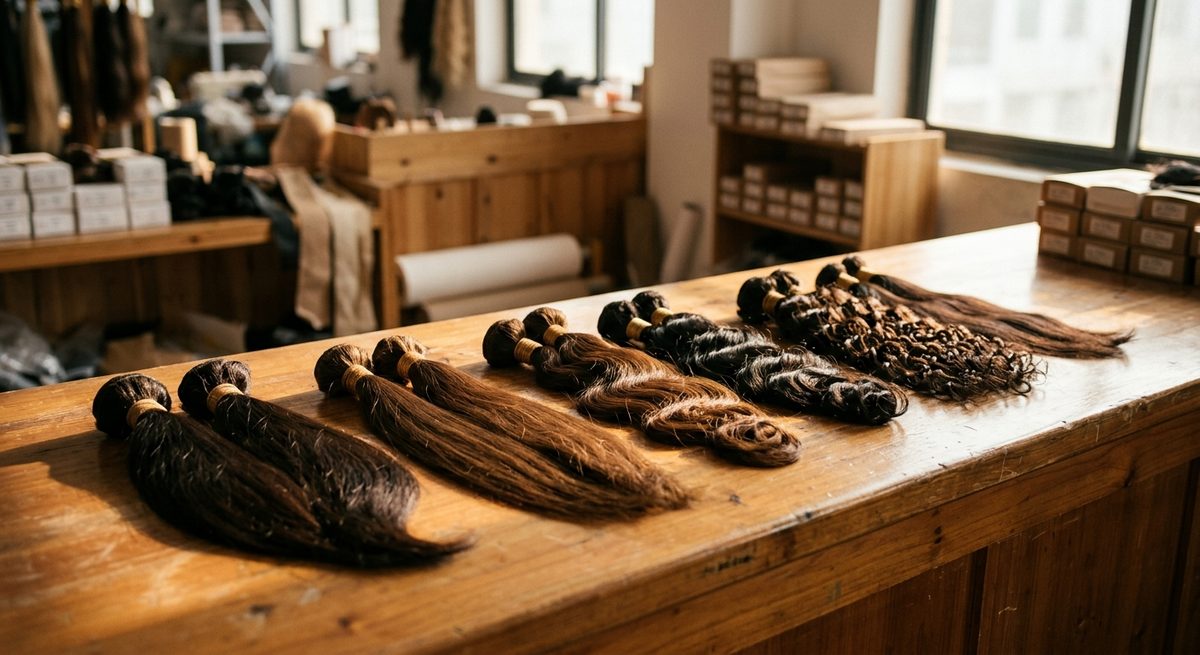
Hair is one of the few products where the word “quality” means something you can physically test in ten minutes with your own hands, and yet most new buyers order from photos. That mismatch explains almost every horror story in this trade. Buyers who import hair extensions from China successfully tend to share one habit: they test before they trust, on samples and again at inspection. Below is how we run those checks from Guangzhou, and which documents your shipment may need on top.
What the grading words are supposed to mean
“Remy” should mean the cuticles all run the same direction, root to tip, the way hair grows on a head. Hair like that stays smooth for months. Non-remy hair has mixed cuticle directions and gets an acid bath and silicone coating to hide the fact, so it feels lovely out of the box and turns into a tangled mat after a few washes. The trouble is that these words appear on invoices without supervision. Nobody polices the label. So the label is a starting point for questions, never an answer.
Grade numbers, drawn standards and origin claims all have the same problem. Treat them as the supplier’s opinion of their own product. Then test.
Bench tests anyone can run on a sample
You don’t need a laboratory for the first round. You need a sink, a comb and an honest hour:
- Run a bundle slowly through your pinched fingers from tip to root. Remy hair resists slightly in one direction. Coated non-remy feels identical both ways.
- Wash a weft three times in warm water, air dry, then comb it out. Count how hard that comb-out fights you. Silicone coatings surrender around wash two or three.
- Tug single strands from the weft. A few strands shedding is normal. A steady rain of hair from a new weft means weak sewing.
- Check colour under daylight, not shop lighting. Bleached tones vary between production batches more than any other spec.
- Smell the bundle. A strong chemical perfume is usually masking heavy processing.
Simple stuff. It filters out most of the disappointing suppliers before money moves.
Where the hair actually gets made
Here’s a thing that surprises buyers on their first visit: much of the raw processing happens far north of here, around Xuchang in Henan, a region that has worked hair for generations. Guangzhou is where a huge share of the finishing, wig-making and export trade concentrates, with wholesale floors and workshops clustered within a taxi ride of each other. In the drawing rooms, workers pull bundles across a hackle, a bed of upright steel pins like a fakir’s board, to align the strands and pull out the short ones. The floor around each station wears a permanent soft carpet of stray hair, and there’s a particular sweet-and-ammonia trace in the air near any room where lifting and toning happens. Once you’ve smelled it you can find the bleaching floor of a building blind.
For a buyer this geography matters practically. Some Guangzhou vendors are factories, some are finishing workshops, some are pure traders. All three can serve you well at the right price, but you should know which one you’re paying, and having help in Guangzhou to visit and verify is the fastest way to find out.
Lab reports and export papers your market may want
Bench tests cover performance. Compliance is a second layer, and it varies hard by destination, so confirm specifics with your own customs broker and, for chemical rules, a testing lab that knows your market.
Chemical and safety testing
Extensions are processed with bleaches, dyes and conditioning agents, and several markets restrict what residues may remain in a product that sits against skin. Third-party labs around Guangzhou test for restricted substances against the standard you name. It’s not expensive at order scale, and serious factories are used to the request.
Shipping documentation
Human hair is an animal-origin product in the eyes of some customs authorities, and certain countries ask for extra paperwork, sometimes a disinfection or fumigation certificate, before clearing it. Requirements differ so much by country that guessing is pointless. Check first, because the goods clearing quickly matters more than the goods leaving quickly.
Inspection day, before anything gets boxed
Our final check on a hair order pulls random bundles across the batch, weighs them against the invoiced weight, measures stretched length, and repeats the wash-and-comb test on samples from different cartons. Weight is worth a special mention. Hair sells by the gram, and a bundle that’s ten grams light across a thousand bundles is a real amount of money quietly missing. We also verify lace tones and curl patterns against the approved sample, since “body wave” can drift between batches.
Then it’s packing, and hair is kind to shippers: light, soft, hard to break. Cartons routinely mix lengths, textures and closures in one shipment, and our consolidation and export handling lets you combine several vendors’ goods into one air or sea shipment with a single document set.
My honest advice on where to spend
Spend on hair quality before packaging, and on testing before both. A silk-touch box can’t rescue hair that mats in week three, while plain packaging around genuinely good bundles builds the repeat customers this business runs on. And order a paid sample from every vendor on your shortlist at the same time, labelled, so you compare them side by side in the same week. Memory is a terrible instrument for comparing hair.
Straight answers to common hair-buying questions
Can I trust “double drawn” on a quote sheet?
Only after you’ve measured it. Double drawn should mean most strands in the bundle run near the full stated length, which you check by stretching a bundle flat and looking at where the volume tapers. Plenty of “double drawn” on paper is single drawn with better marketing, and only a sample settles it.
Do virgin and remy mean the same thing?
No. Virgin claims the hair was never chemically processed. Remy describes cuticle alignment. Hair can be remy but coloured, and genuinely virgin hair is scarcer and pricier than the word’s frequency on price lists suggests. Ask which claim the vendor is actually making, in writing.
Is air freight the only sensible shipping mode for hair?
For small urgent replenishment, air usually wins since the goods are light. Larger stock orders often go sea to cut cost per kilo, and mixed strategies are common: a small air top-up while the sea shipment travels. It depends on your cash cycle more than on the product.
If you’d like a second pair of hands, and eyes, on a hair order, we’re in Guangzhou year round. Fly in and we’ll pick you up, translate, and walk the wholesale floors and workshops with you until the bundles in front of you match the ones you were promised. The contact form or WhatsApp reaches us directly.
Read next

Ordering Beauty & Personal Care Products from Guangzhou
Guangzhou is a major production center for beauty and personal care products, with a well-developed ecosystem of factories…
What You’re Really Paying for in a Wheelchair Built in Foshan
A working cost breakdown for buyers who import wheelchairs from China: frames, batteries, motors, testing and freight from…

Samples, MOQs and Payment Terms for Massage Gun Orders
Import massage guns from China with a clear sampling plan, realistic MOQs and safe payment terms. Practical order advice…