
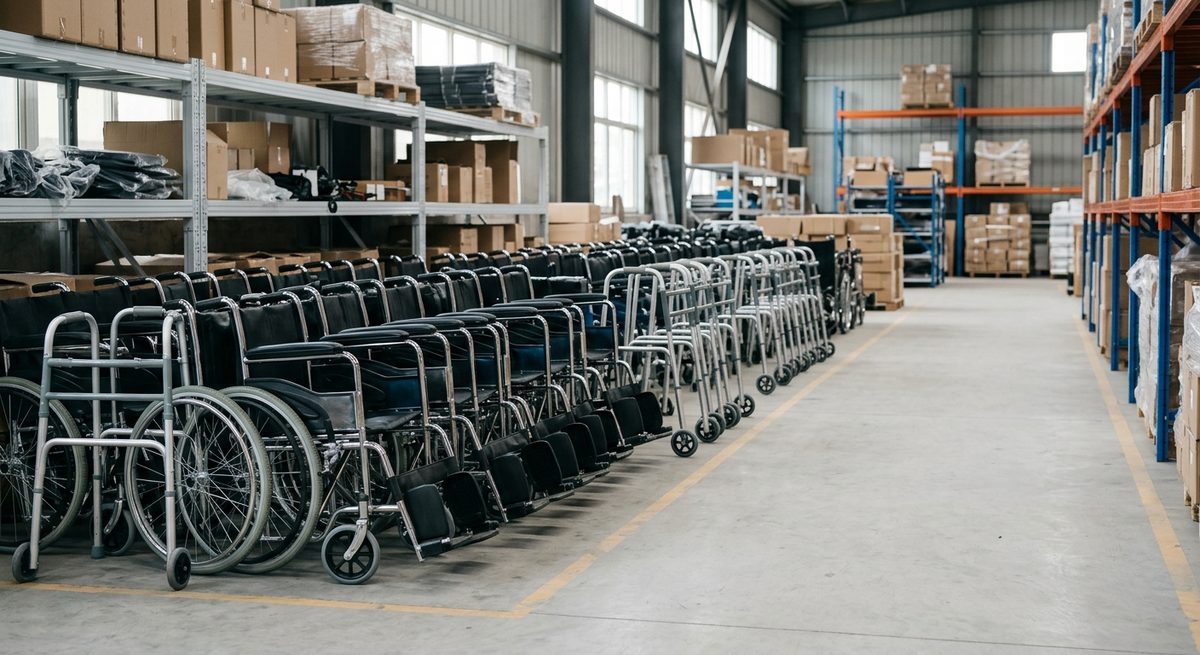
Put two folding wheelchairs side by side and they can look like twins while carrying very different price tags. The gap isn’t marketing. It’s hidden in the tube walls, the weld beads, the bearings and the paperwork, and if you’re planning to import wheelchairs from China you need to know where each dollar actually sits. Once you can read the cost, you can decide where to spend and where to hold back, instead of just picking the middle quote and hoping.
The frame sets the floor
Frame material is the first fork in the road. Steel is cheap, heavy and forgiving to weld. Aluminium costs more per kilo, needs better welders and cuts several kilos off the chair, which matters enormously to whoever lifts it into a car boot every day. Beyond material, you’re paying for wall thickness, tube quality and welding skill. In the Foshan mobility cluster you can stand in a welding bay and watch the difference: a good aluminium bead looks like a neat stack of coins, a bad one looks like chewing gum, and both get painted the same colour afterwards.
Powder coating, folding mechanisms and cross-brace design all add their share. A chair that folds with one smooth motion cost somebody engineering hours. You’re paying for those hours whether the invoice says so or not.
Batteries and motors move the price most
The moment you step from manual chairs to powered chairs and mobility scooters, the battery becomes the single biggest cost lever. Lithium packs cost far more than sealed lead-acid, and the quality of the cells inside a lithium pack varies more than any other component on the product. Motors follow: brushless units with proper controllers cost more than brushed ones and last longer. A supplier who is vague about whose cells and whose motors go into the chair is telling you something about the quote.
Batteries also change the freight picture completely. Lithium packs travel as dangerous goods, with their own documentation, packing rules and carrier restrictions. Plan this early with a shipping agent in Guangzhou rather than discovering at booking time that your chosen battery can’t fly and your sea option just got slower.
The parts nobody photographs
Catalogue photos show the frame and the seat. The cost hides elsewhere:
- Wheel bearings, which decide whether the chair still rolls straight after a year of kerbs.
- Upholstery and cushion foam, where a small saving per chair produces sagging seats at scale.
- Brakes and anti-tip fittings, safety parts that honest factories refuse to cheapen.
- Hand rims and tyres, solid versus pneumatic, each with a real cost difference.
- Small metal parts and fasteners, invisible until one strips during assembly abroad.
When one quote undercuts the others sharply, the difference nearly always lives in this list. Nobody discounts aluminium. They discount bearings.
Testing and paperwork cost real money too
Wheelchairs are mobility equipment, and most destination markets regulate them. Factories that invest in proper test rigs charge for it. The one that sticks with me from Foshan is the double-drum fatigue machine: a loaded chair strapped over two rotating drums with slats on them, rumbling through simulated kerbs and cobbles for days on end in a back room you can hear before you see. Chairs from a plant with that machine cost more than chairs from a plant without one. That premium is among the best money on the whole invoice.
Registration and documentation requirements differ a great deal between markets, so budget for advice from a regulatory consultant in your own country and treat those fees as part of the product cost, not an annoyance bolted on later.
Stacking up the landed cost
The factory price is just the opening number. On top of it come export packing, inland haulage to the port, export clearance, ocean or air freight, insurance, destination port charges, and whatever duty and tax your market applies. We never quote duty rates, and you shouldn’t accept them from a supplier either. Have your customs broker confirm the tariff classification and the current rate for your country before you commit, because that single code can shift the whole business case.
Manual chairs fold flat and stack efficiently, so their freight per unit is modest. Scooters are bulky, battery-laden and awkward. Same category, very different landed maths.
Packing itself deserves a line in the budget. A chair that arrives with a scuffed frame or a bent hand rim was cheap to pack and expensive to sell, so agree the carton spec, the internal padding and the number of units per pallet in writing. It’s small money against the value it protects.
Where I’d spend, where I’d save
After years of watching these orders, my rule is simple. Spend on the battery, the motor, the bearings and the testing. Save on cosmetic options, fancy colour ranges and accessories you can add later once the product proves itself. And never save on the factory audit, because in this category the buyer carries responsibility for a product somebody’s parent will sit in every day. There’s a longer story about how we work and who we are on the site, but the short version is that we treat mobility products as the serious purchase they are.
Costs, quantities and other blunt questions
What minimum order do the Foshan factories expect?
It varies by factory and model, but manual chairs commonly start at a few dozen to a couple of hundred units, while powered chairs and scooters can start lower because of their value. Mixed orders across a factory’s range are often negotiable once they see you’re a real, returning buyer.
Is a cheaper lead-acid scooter ever the right call?
Sometimes, honestly. For rental fleets or price-driven markets, lead-acid still sells and simplifies shipping. For retail buyers who care about weight and range, lithium wins and supports a better margin. Decide based on who ends up sitting on the product, not on the invoice alone.
Can I put my own brand on an existing model?
Usually, yes. Frame stickers, seat embroidery, cartons and manuals are open at modest volumes, and the factories are used to it. Just confirm that the test documentation can be issued to cover your brand name and model number, because a mismatch there causes trouble at registration time.
Our office is in Guangzhou, under an hour from the Foshan plants where much of this equipment is built, and we take buyers through those workshops in person: welding bays, test rooms, packing lines, all of it. If you’re weighing up a wheelchair or scooter order and want the cost picture before the contract, reach out through the contact form or WhatsApp.
Read next
Samples, MOQs and Payment Terms for Massage Gun Orders
Import massage guns from China with a clear sampling plan, realistic MOQs and safe payment terms. Practical order advice…
Hair Extensions From China: The Tests Worth Running First
Before you import hair extensions from China, learn which bench tests, grading checks and export papers matter, and how…
What You’re Really Paying For in a Bottle of Guangzhou Perfume
Break down the real unit cost before you import perfume from China: fragrance oil, glass, pumps, boxes, filling labour and…