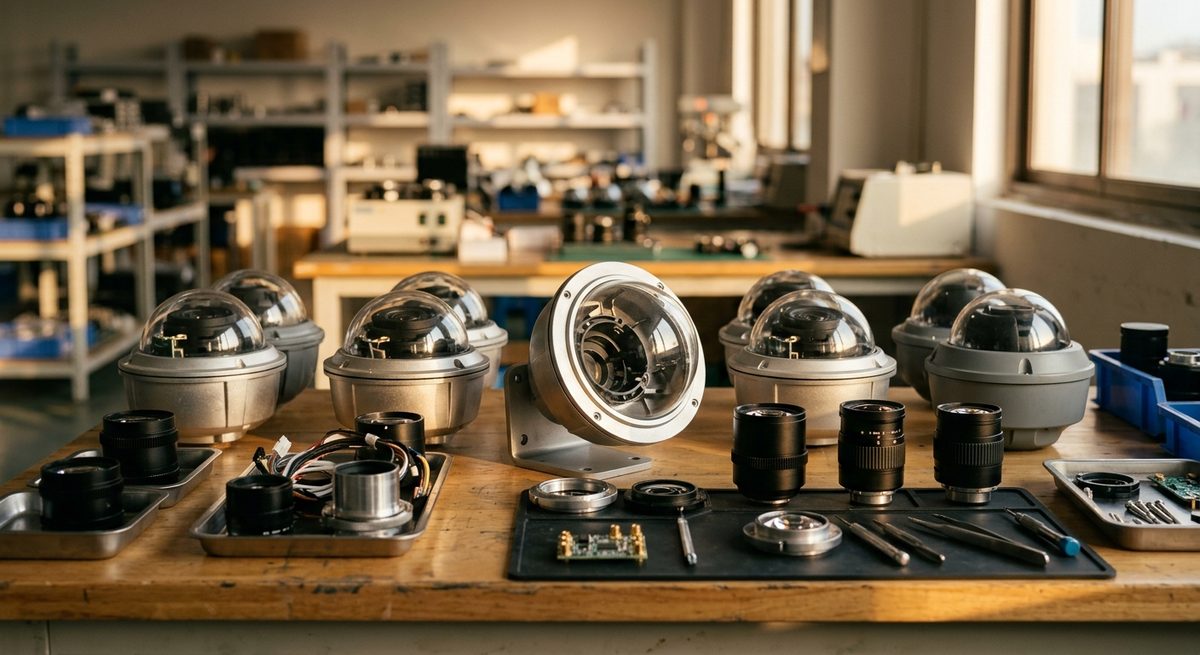
A pallet of security cameras is only as good as the folder of documents travelling with it. Buyers who import CCTV cameras from China learn this fast. The product is half hardware, half paperwork: test reports, declarations, rating certificates, manuals in the right languages. Get the folder right and the shipment moves, the reseller stocks it, the installer trusts it. Get it wrong and perfectly good cameras sit in a warehouse waiting for documents somebody should’ve requested before production even started.
The folder every camera shipment should carry
Before you approve a purchase order, list the documents your market needs and make them a contract condition. Not an afterthought. For most destinations the working folder includes:
- A declaration of conformity from the manufacturer for the exact model numbers ordered.
- Test reports from a recognised laboratory covering electrical safety and electromagnetic compatibility.
- A hazardous substances report for the housings and boards.
- Ingress protection test results for outdoor models.
- Battery documentation for any wireless or solar powered camera shipping with cells inside.
- User manuals and quick start guides in the languages your customers actually read.
Which marks and reports apply depends entirely on where you sell, so confirm the exact requirements with your own customs broker and, where needed, a local test laboratory. The factory’s job is to supply models that can pass. Yours is to specify which papers must exist before the goods leave. Two different jobs, and mixing them up is where projects go sideways.
Test marks without the alphabet soup
Camera factories quote familiar letter combinations, and it pays to know what each one actually covers. Safety and electromagnetic testing says the device won’t interfere with other equipment and is safe to power. Substance restrictions cover what’s in the plastics and solder. Radio testing kicks in the moment a camera has Wi-Fi or any wireless link, and it’s a separate, more involved report than the wired version of the same model. Which brings up a classic trap. A factory holds valid reports for the wired variant, and the buyer assumes the wireless variant is covered too. It isn’t. Reports are model specific, sometimes firmware specific, so match the report number to the exact product code on your order sheet.
Reports age, too. A certificate issued years ago for a model that has since changed chipsets may no longer describe what’s in the carton. Ask when the report was issued and whether the bill of materials has changed since. If the answer takes more than a day to come back, that tells you something as well.
Weatherproof on paper, weatherproof on a wall
Outdoor cameras live or die by their ingress protection rating. IP66 means the housing has been tested against dust and strong water jets. An IK rating speaks to impact. Both claims should trace back to a test report, not a line in a brochure. On factory visits we open sample housings and look for the physical evidence: a rubber gasket seated in a clean channel, cable glands that actually grip, a breather membrane where the design needs one. A housing that passes in a laboratory can still fail on a wall if the line seats gaskets carelessly, which is why production inspection matters as much as the certificate. Selling into a coastal market? Ask how the coating handles salt air and whether the external screws are stainless. Rust streaks on a customer’s wall show up long before any electronic fault does.
An hour on the bench saves a month of emails
Paper says the model can perform. A bench test says your batch does. Before shipping, an inspector should power a random sample and work through what an installer would hit: image quality by day, infrared in a darkened room, power over Ethernet on a standard switch, app pairing on both major phone systems, motion detection, playback from the actual storage in the kit. My favourite room in any camera factory is the burn-in room: shelves of cameras all aimed at the same test chart, and when someone flips the lights off, a hundred infrared rings glow dull red in the dark at once. That room exists because factories know boards fail early or not at all. Your bench check borrows the same logic. For kit sets, count the accessories too, because a missing bag of screws generates more support emails than a dead camera ever will.
Firmware deserves its own pass. Confirm the menu languages, the default password behaviour, and that the on screen branding is yours. Factories in the Shenzhen surveillance cluster build for many customers at once, and a leftover logo or default setting is exactly the slip a thirty minute session catches.
None of this needs to slow anything down. People import CCTV cameras from China on tight timelines every month. The trick is booking the bench check and chasing the document folder while production is still running, so testing never sits on the critical path.
From many factories to one clean container
Camera projects often pull from several suppliers: bullets and domes from one plant, recorders from another, cables, brackets and power supplies from smaller workshops. Some buyers also order custom housings and packaging so the range looks like one family on the shelf. If that’s your direction, you can build your own brand with our team, from logo placement on the housing through to the retail box and datasheets.
All of it then has to leave China as one tidy shipment with the folder complete. Our warehouse receives goods from the different factories, matches carton counts to the packing list, and files the reports with the export documents. That consolidation and export handling step, run from Guangzhou, is where a multi supplier order turns into a single clean delivery your forwarder and broker can process without questions.
Three questions we hear about camera imports
Do I need separate reports for every camera model in my range?
In practice, yes. Reports attach to specific model numbers and hardware versions. Some families share a platform, and laboratories can sometimes extend coverage across close variants, but that’s the laboratory’s call, not the buyer’s assumption. List every model code and make the factory map each one to its reports.
What should I test on a sample before placing the main order?
Run it for at least a week in real conditions. Outdoors if it’s an outdoor model, on your own network, recording continuously. Check the night image, app stability, and how the housing looks after rain and sun. A week of live running exposes weaknesses a bench test misses.
Who handles the export paperwork for a mixed camera and recorder order?
The factories issue their commercial documents, and an export agent compiles the full set: invoice, packing list, certificates, plus battery declarations for wireless models. We prepare this folder as part of shipping from Guangzhou, so you receive one complete document pack per shipment.
Planning a camera range and not sure which papers your market demands? Write to us through the contact form or WhatsApp. The team sits in Guangzhou, we’re in the Shenzhen surveillance cluster every month, and we’d be glad to host you here and walk the factory floors with you before you commit to an order.
Read next
LED Neon Made to Order: Putting Your Brand on a Hand-Bent Sign
Watch artwork become product when you import LED neon signs from China: tube choices, backboards, adapters, packing and…
How to Order Consumer Electronics & Smart Gadgets from Guangzhou
Guangzhou is one of the world's top hubs for consumer electronics manufacturing, and for good reason. From earbuds and…
From Enquiry to Delivery: Ordering Karaoke Machines in China
Follow one order to import karaoke machines from China step by step: spec sheet, Enping factory visits, sampling,…