
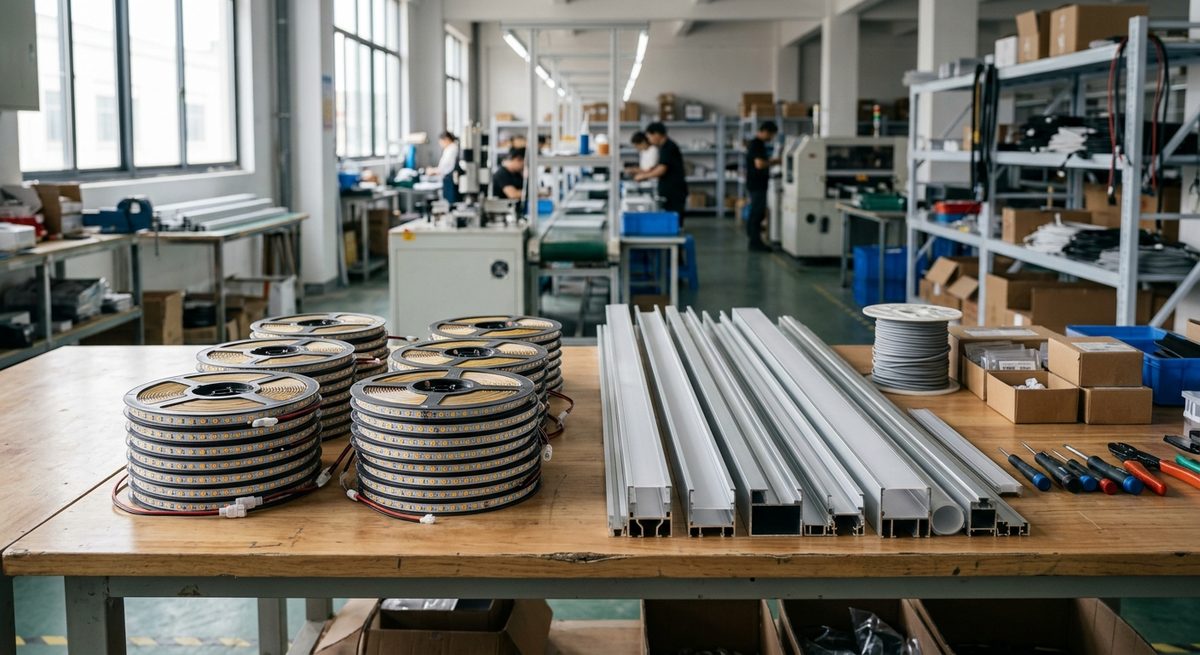
Every LED neon workshop keeps a dark room. The lights stay off, the walls are painted matte black, and finished signs hang in rows so customers can judge the glow the way it will look in a bar at midnight. Out on the floor, the process is more manual than most buyers expect. Your artwork gets printed at full size and pinned to the backboard, and a worker bends warm silicone tube along the printed lines by hand, holding each curve steady for a moment while the glue grabs. That mix of digital file and human wrist is what makes this such a good product to brand. Buyers who import LED neon signs from China aren’t buying a catalogue item. They’re buying a manufacturing service shaped entirely around their own artwork.
Your logo has to survive translation into tube
The first conversation with a sign maker is about geometry, not price. Silicone tube has a minimum bend radius, so tight letterforms fight back. A lowercase “e” at small scale becomes a blob of light. Thin serifs vanish. Good workshops in Guangzhou and Shenzhen employ designers who redraw artwork as a continuous line wherever possible, mark where the tube must break, and send back a proof showing exactly where each cut and wire will sit. Approve that drawing slowly. Every compromise you accept on the proof is one you’ll see lit up on a wall for years.
Size is the other early decision, and people misjudge it in a predictable direction. A lit sign reads smaller than the same shape on paper, because the glow blurs its edges and the wall around it is dark. Measure the wall, tape out the footprint, then go one size up from your instinct. The material cost of the larger board is usually a small slice of the total, and nobody has ever complained to us that their sign was too easy to read from the street.
The choices that quietly define the product
A neon sign looks simple until you spec one. These decisions sit underneath every quote:
- Tube colour versus RGB. A fixed colour is cheaper and crisper, while colour-changing tube needs a controller and heavier wiring.
- Backboard style: a clear acrylic rectangle, board cut tight to the artwork outline, or a mirrored or coloured face.
- Mounting: drilled standoffs for walls, or a hanging kit for windows.
- Dimming and control, from a simple inline dimmer to app control.
- The power adapter, which must carry the right certification markings for the market you sell into.
The adapter deserves more attention than it usually gets. It’s the one part of the sign your customer plugs into a wall socket, and the part a safety inspector will pick up first. Ask for the adapter maker’s certificates and check that they match the plug type and rules of your destination country. A beautiful sign with the wrong adapter is a returns problem waiting in a carton.
Almost no tooling, which changes the economics
Injection moulded products punish small brands with mould fees. Neon doesn’t. There’s no die and no mould. Each sign is built straight from the artwork file, so the cost of developing a new design is close to the cost of making one sign. That has two happy consequences. Sampling means receiving a real, sellable unit rather than a rough prototype. And minimums stay low compared with most factory products, commonly a handful of pieces per design, though every workshop sets its own floor. The flip side is that labour is the cost. A complicated design with many tube breaks costs more every single time it’s made, not just once at a tooling stage, so simplifying the artwork pays back on every future order rather than only the first.
The box matters nearly as much as the sign
Acrylic cracks at corners. That’s the whole packing problem in four words. A sign that survives the parcel network is packed with foam corner blocks, a lid that can’t press down on the tube, and a double wall carton with honest stacking strength. If you’re selling online, ask the workshop to drop test your exact packing from waist height and send you the video. We’ve stood in a Panyu workshop watching that test run, and the sound an unpadded corner makes on concrete is expensive. Insist on the foam. It costs very little against the price of a replacement shipped across an ocean.
From one sign to a range people recognise
Most buyers start with a single custom order for a shop or an event, then realise the same workshop can build a whole retail line: a printed box with your logo, a branded care card, a labelled adapter, even a cable in your brand colour. If you’re heading that way, our brand building support covers the design and packaging side, so the finished line looks like it came from one company, because it did.
Seeing the workshops changes how you order. Once you’ve watched a bender hold a curve, you write artwork briefs differently. If you’d like to import from Guangzhou with someone local checking each proof, each sample and each shipment, that’s the work we do every week across the sign makers of Guangzhou and Shenzhen.
Neon questions we answer a lot
Will my sign look exactly like the mockup?
It will look like the approved tube drawing, which isn’t the same thing. Mockups are often glowing renders. The tube drawing shows real bend limits, breaks and wire crossings. Judge from that document, ask for a lit photo and a short video of your actual sample before production, and check colour against a physical reference rather than a screen.
How long do these signs actually last?
LED neon has no glass and no gas, so lifetime mostly follows the quality of the LED strip and the adapter. Heat is the enemy. A sign driven gently through a decent adapter will outlast one pushed at full brightness around the clock. Spec a slightly larger adapter than the sign strictly needs and you buy yourself headroom.
Can I put ten different designs in one shipment?
Yes, and it’s common. Since there’s no tooling, a mixed order of designs is simply a longer work queue on the bending benches. Keep the backboard sizes grouped where you can, because packing ten different carton sizes is where mixed orders get slow and freight quotes get messy.
Our team lives here in Guangzhou, a short drive from several of these workshops, and we take buyers into the bending rooms in person. Send your artwork through the contact form or message us on WhatsApp, and we’ll tell you honestly what will bend well and what needs a redraw before it’s worth quoting.
Read next
CCTV Camera Imports: Testing and Paperwork Buyers Should Know
Plan to import CCTV cameras from China with confidence: common test marks, IP ratings, sample checks and export documents…
Bluetooth Speaker Quality Control: Catch Faults Before They Ship
Plan quality control before you import bluetooth speakers from China: the defects speakers hide, the audio tests that find…
Electronics in Guangzhou: QC Risks and Golden Rules
Electronics sourced from Guangzhou and neighbouring Shenzhen have powered global supply chains for decades. The region is…