
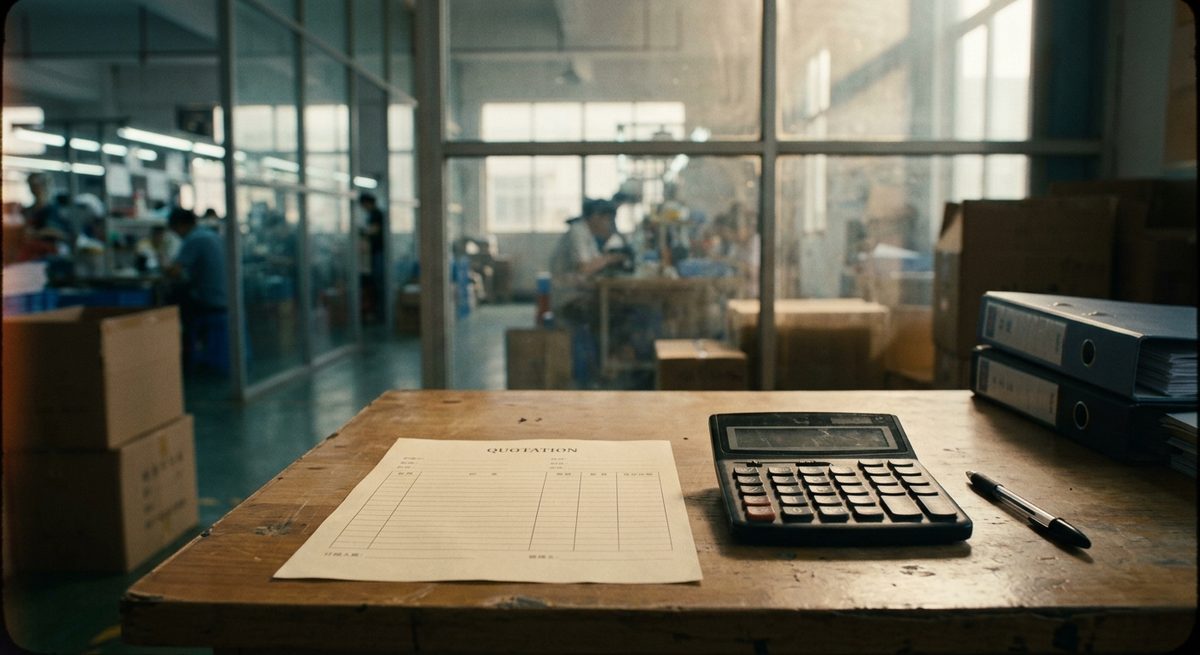
On my desk right now there’s a quotation for stainless steel kitchenware, one A4 page, red company chop stamped slightly crooked over the signature the way they always are. To a new buyer it looks complete. Unit price, quantity, delivery. To anyone who’s processed a few hundred of these, the page is mostly interesting for what it leaves out. Reading one of these documents properly is a skill, and it’s learnable in about twenty minutes. So let’s read this one together, row by row.
The header tells you who you’re really dealing with
Before any numbers, look at the company name at the top and compare it against the name on the business licence and, later, the name on the bank account. Three different names isn’t automatically a problem, group companies and export arms are common here, but you want to understand the relationship before money moves. A quotation from “Guangzhou Something Trading Co.” for goods made by “Jieyang Something Hardware Factory” means you’re buying through an intermediary layer, which changes who controls your quality.
Check the date and the validity period too. Thirty days is typical. Metal prices move, and a Chinese factory quotation from March genuinely can’t be honoured in July, so an expired quote isn’t the supplier being difficult. It’s just expired.
The unit price row, where the definitions hide
The number itself is the least informative thing on the page. What defines it is everything attached to it.
The incoterm changes the number’s meaning
EXW, FOB, CIF. Three letters, wildly different totals. EXW means the price ends at the factory gate and every cost afterwards is yours. FOB includes getting the goods onto a vessel at a named port, and the port matters: FOB Shenzhen and FOB Shanghai aren’t the same trucking bill for a factory in Dongguan. When you compare two suppliers, force both quotes to the same incoterm and the same port or you’re comparing apples to invoices.
The quantity column is really a price curve
Good quotations show tiered pricing: one price at 500 pieces, another at 2,000, another at 10,000. The gaps between tiers tell you where the factory’s setup costs sit. A steep drop between tiers means heavy setup and a supplier who badly wants bigger orders. Nearly flat tiers suggest the product is mostly bought-in components, assembly only. You can read a factory’s cost structure from this column alone, which is a genuinely useful trick.
The rows that go missing
Now the important part. Print the quote and pencil-check whether each of these has its own line. Anything absent isn’t free. It’s undecided, and undecided resolves in the factory’s favour.
- Packaging. “Standard export packing” is not a specification. Inner box or polybag? Carton grade? Printed or plain? Confirm each.
- Tooling and setup. Moulds, print plates, cutting dies. Cost, ownership and who keeps them between orders.
- Sample charges. Cost per sample, courier account, and whether fees are credited back against the bulk order.
- Payment terms. Deposit percentage, balance trigger, and the exact bank account name.
- Quality basis. Which sample or standard the goods will be judged against, and the acceptable defect level.
- Lead time. Counted from deposit receipt or from sample approval? Those can be a month apart.
On the kitchenware quote in front of me, four of these six rows are missing. That’s normal, and it’s not deceit. Factories quote thin because thin quotes look cheap and quick. The buyer’s job is to fatten the document until it can survive a disagreement.
The quiet signals in the layout itself
You can also read the supplier through the document’s manners. A quote that arrives within a day, in clean English, with your product name spelled correctly and a photo of the actual item rather than a catalogue lookalike, comes from an export department that functions. One that arrives as a blurry photo of handwriting, ten days late, tells you what your shipping documents will look like in four months. Documents are a rehearsal.
Currency deserves a glance too. Most export quotes come in US dollars. If a quote comes in RMB, ask whether the supplier can actually export directly or whether an export agency will appear later in the paperwork. Neither answer is wrong. Surprises are wrong.
When we review quotations for clients, this stage often happens with the buyer sitting in our office, both of us marking up the page together. It’s one of the practical, unglamorous services described in Help in Guangzhou: What Foreign Buyers Need on the Ground.
What we’d actually do with a thin quote
Don’t reject it. Reply with a table. List the missing rows and ask the supplier to fill them in, and say plainly that you’re comparing several offers on identical terms. The good factories complete the table within days, and their revised numbers sometimes rise a little as the hidden costs surface. Let them rise. A price that goes up when the spec gets honest is a price you can build a business on. A price that stays magically low is deferring its bad news until after your deposit.
Two rounds of this and the real comparison emerges. It’s slower than picking the lowest number. It’s also how you avoid becoming one of the stories buyers tell at trade fairs.
What buyers ask when we mark up their quotes
Is a very cheap quotation always hiding something?
Not always. Sometimes a factory has genuine scale on that exact product, or wants a foothold in your market. But an outlier deserves a specific explanation, and “we have good price” isn’t one. Ask what material grade and packaging the number assumes, and watch it converge toward the others.
Should I negotiate before or after the quote is complete?
After. Negotiating a thin quote means negotiating a fiction, and every concession you win can be recovered from you through the undefined rows. Complete first, then push, ideally with a competing complete quote sitting beside it on the table.
How many quotations should I collect for one product?
Three serious, completed ones beat eight thin ones. Past five, you’re not learning anything new about the market, you’re just delaying the decision. Pick the categories where the quotes disagree and dig there.
If you’d like a second pair of eyes on a quote before you commit, that’s a small job for us and we do it constantly, along with factory visits arranged through our Finding a Manufacturer in Guangzhou with Private VIP Help service. Our team is in Guangzhou, a short drive from most of the factories doing the quoting, and you can reach us by the contact form or WhatsApp.
Read next
The Questions Buyers Forget to Ask a Chinese Supplier
The questions to ask a Chinese supplier that most buyers skip: subcontracting, tooling ownership, material substitutions and…

What a Week of Supplier Meetings in Guangzhou Looks Like
How we plan supplier meetings in Guangzhou for visiting buyers: the real schedule, the driving, the showrooms, and what a…

How Buyers Choose Between Flying to China and Sending an Agent
Weighing a buying trip against sending an agent to China? A Guangzhou team explains what each route costs, what it catches,…