
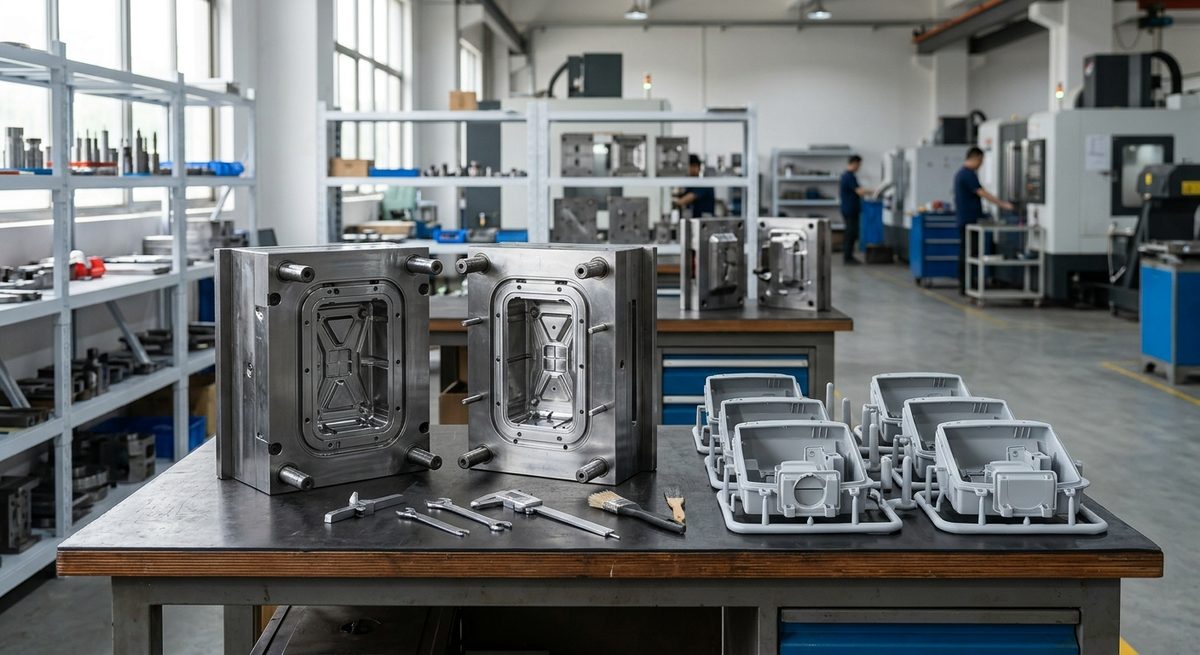
There’s a shelf in our office that clients love and our bookkeeper hates. It holds sample archaeology: version one of a client’s water bottle next to version four, the first attempt at a knitted beanie beside the one that finally shipped. Courier bags of product samples from China arrive here most days, and unpacking them never stops being slightly like a birthday. The question every new client asks while holding version one is the same: how many of these rounds until we can actually produce? The honest answer is between two and four, but the number matters less than what each round is for.
Round zero: the sample you didn’t commission
Before anything custom, get the factory’s existing product. Their stock sample, off the shelf, made with nobody trying to impress you. This tells you their true baseline: the stitching when no one’s watching, the plastic they actually buy, the box their regular customers accept. A custom sample is the factory at its best behaviour. The stock sample is the factory on a normal Tuesday, and you’re going to be living with their normal Tuesdays.
If the stock sample disappoints, stop. No amount of sampling turns a mid-tier workshop into a premium one. Move on and spend your courier budget elsewhere. This single habit saves more time than any other advice on this page.
Round one: proving they understood you
The first custom sample answers one question only: did the factory understand the brief? Judge it on interpretation, not perfection. Wrong shade, rough finish, hand-made fittings, all forgivable at this stage and all normal, since first samples are often built partly by hand before any tooling exists. What’s not forgivable is a sample that ignores your spec in favour of their standard product. That’s not a quality gap. That’s a listening gap, and listening gaps don’t improve with volume.
Give feedback like an engineer, not a critic
“Not what I wanted” produces round two exactly as disappointing as round one. Number every issue, photograph it with annotations, and separate must-fix from nice-to-have. Ten numbered points get ten answers. A paragraph of disappointment gets an apology and the same mistakes.
Round two: the sample that tells the truth
Round two should arrive close to right, made with real materials and real processes. This is the sample to abuse. Drop it. Wash it. Load it. Leave it on a windowsill in the sun for a week. Give one to your most critical customer and watch their face. A sample’s job is to fail in your office instead of failing in a thousand homes, so help it try.
This is also the moment to check the things that aren’t the product. Weigh it, measure the retail box, calculate the master carton and the freight per unit. We’ve seen a beautiful round-two sample kill a project because the packed product came out a centimetre too wide for the client’s shelf plan. Better to learn that here than at the port.
Before you approve round two, it should have proven all of this:
- Made with production materials and processes, no hand-built stand-ins.
- Survives realistic abuse: drops, washing, load, sunlight, whatever your customer will do to it.
- Weight and packed dimensions confirmed, with freight cost per unit recalculated.
- The retail box, and how that box survives a courier journey.
Anything unproven on that list is a question you’re choosing to answer with a full production run.
When rounds multiply beyond three
A third round to lock small corrections is routine. Five, six, seven rounds means something structural is wrong: the brief is drifting because you keep changing your mind, or the factory is at its technical ceiling, or the product needs engineering work that sampling can’t provide. Each round costs three weeks by the time couriers both ways are counted. Somewhere around round four, the calendar becomes the real cost, and it’s usually cheaper to fly someone to the factory, or send us, and settle everything across one table in an afternoon.
The pre-production sample, and the trap after it
Once tooling exists and materials are bought, insist on one final sample off the actual production line. This pre-production piece becomes your sealed reference for inspection, the object every argument defers to later. Sign two, keep one, leave one at the factory.
Then the trap: mass production can still drift from the approved sample, because a line running at speed behaves differently from a line making one careful piece for approval. The counter is an early-production check, a look at the first units off the line while there’s still time to correct, which matters double for regulated goods. Our guide How to Order Medical & PPE Products from Guangzhou Factories shows how much heavier that verification gets when compliance is involved.
For fast product hunting, by the way, sampling sometimes starts with a walk rather than a courier. Buying references straight off the shelves in the city’s trade buildings is a legitimate round zero, and Top Guangzhou Wholesale Markets and What Each Sells maps where to walk for each category.
Sampling questions, answered the way we answer clients
Who pays for samples, and is that negotiable?
Commonly the buyer pays sample cost plus courier, and factories often credit the fee back against the bulk order if you agree it up front, in writing. We think paying is healthy. A buyer with skin in the game gets taken seriously, and a factory that samples free for everyone is sampling carelessly for everyone.
Can I skip sampling for a reorder?
Same product, same factory, no changes: you can usually go straight to production, but keep the sealed sample alive as the inspection standard, and re-sample after any material change, factory move or long gap. “Same as last year” is a hope, not a spec. Lines change, staff change, suppliers of components change.
Should I sample from several factories at once?
For round zero and round one, yes, two or three in parallel is efficient and fair. By round two you should be down to one, maybe two. Running deep sampling with many factories multiplies cost and, worse, tempts buyers to circulate one factory’s corrected sample to another, which is poor form and travels fast in tight manufacturing towns like Shunde.
We manage sampling for clients end to end: chasing factories, consolidating parcels so you pay one courier bill instead of five, photographing everything before it ships, and putting version four on the shelf next to version one so the story stays visible. If your sampling has stalled or hasn’t started, tell us about the product through the contact form or WhatsApp. We’re in Guangzhou, and the shelf has room.
Read next
Import Paperwork and Compliance Basics for Your China Orders
Which import paperwork China orders really need, from invoices and bills of lading to test reports, and who prepares each…
How to Verify a Reliable Agent in Guangzhou
A complete guide for importers, brand owners, and sourcing professionals who want full transparency when working with agents…
How to Verify a Guangzhou Factory in 48 Hours
Guangzhou's industrial clusters are huge; some companies are real factories while others are trading offices. If you don't…