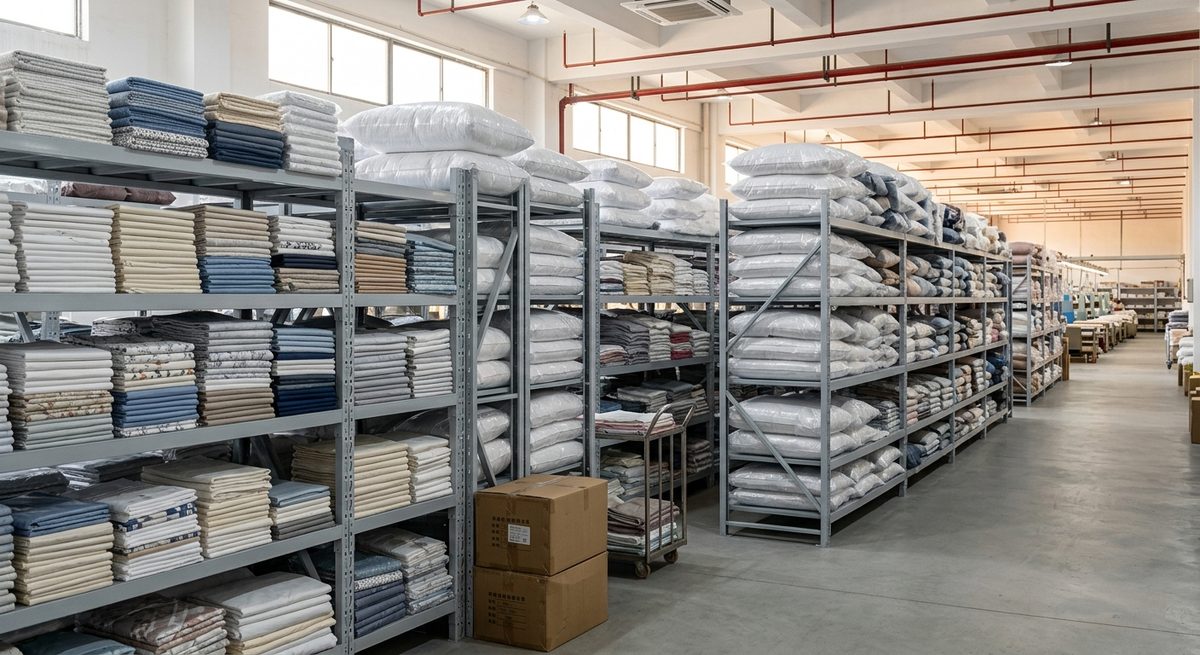
Why do two duvet cover sets that look identical in photos land at prices miles apart? It’s almost never the factory’s margin. It’s the fabric, the density of the weave, the trims, and the minutes of sewing hidden inside each set. Buyers who import bedding sets from China get much better results once they can read a quotation the way a mill reads it, line by line, instead of comparing single numbers. So let’s take one set apart and see where each piece of the cost lives, and where it’s safe to save. And where it isn’t.
Fabric sets the floor under every quotation
In a typical woven bedding set, fabric is the biggest single cost block, and three choices define it. The fibre first: long staple cotton costs more than regular cotton, which costs more than polyester microfibre, with blends in between. Then the yarn fineness and weave density, which together decide how the cloth feels and how much raw material every square metre swallows. Then the finish. Plain dyed cloth is the base case, while printing, brushing and special washes each add their own step at the mill. Move any of the three and the quotation moves with it, which is why a price given without a full fabric description isn’t really a price.
Six lines hiding inside one number
Unroll a quotation properly and a bedding set breaks into parts you can question one by one:
- Fabric consumption, driven by the sizes in your range and the cutting layout
- Dyeing or printing, where small runs per design cost more per metre than big ones
- Sewing minutes, which grow with every extra pillowcase, flange or concealed closure
- Trims: zips, buttons, corner ties, piping and woven labels
- Packaging: the fabric bag, the printed insert card, the barcode sticker
- Testing, inspection, and the factory’s overhead and margin
Seen this way, negotiation stops being a tug of war over one number. You can accept the fabric cost, trim a slow sewing detail, and shift a design between print methods. Keep the quality where the customer feels it. Save where they never will.
Thread count, read with both eyes open
Thread count is the number the whole retail market talks about, and it’s also the least standardised line on any spec sheet. Counting conventions differ, especially for multi-ply yarns, so two sets carrying the same count can be very different cloths. The habit that protects you: specify the fabric by construction and weight in grams per square metre alongside the count, and keep an approved swatch. A slightly lower count on a better yarn often feels smoother than a higher count on a weaker one, and your hand knows it before the label does. On factory visits we put unlabelled swatches in buyers’ hands for exactly this reason. The cloth they pick rarely carries the biggest number. Rarely.
Sewing details that quietly move the price
A duvet cover with a concealed zip, internal corner ties and piped edges takes noticeably more machine time than one that closes with a simple envelope fold. None of those details is wrong, but each should be a decision, not a default. My advice for a first order: spend the sewing budget where returns start. Strong seams. A closure that survives repeated washing. Generous sizing tolerances. Add the decorative touches later. Factories will happily quote the same design in two or three trim levels if you ask, and one page of that comparison teaches you which details your market will actually pay for and which ones only the spec sheet notices.
From Nantong looms to a Guangzhou loading dock
Much of China’s woven bedding cloth comes out of the Nantong home textile cluster near Shanghai, while sewing, packing and export happen in several regions, Guangdong included. That geography matters for cost. Fabric travels to the sewing plant, finished goods travel to the port, and buyers running mixed containers out of southern China often sew close to the port to keep the chain short. Our team gives hands-on help in Guangzhou at exactly this point: comparing quotations, auditing the sewing plants, and holding the mill and the sewing line to one specification.
Landed cost: volume beats weight
Bedding is light but bulky, so sea freight gets priced by the space it fills rather than the kilograms it weighs. Compression packing shrinks a set dramatically. Cut open a vacuum bag in the warehouse and the whole set sighs and swells back up in your hands, which is oddly satisfying and also the reason your carton maths must use compressed dimensions, not catalogue ones. Tune the carton to the pallet or container footprint and you stop paying to ship air. The remaining pieces of landed cost are inland trucking, export clearance, ocean freight, destination charges and import duty, and the duty rests on a tariff code your own customs broker should confirm before you commit. When sets, pillows and protectors come from different factories, our consolidation and export handling gathers everything into one warehouse, repacks where needed, and ships a single consignment with one document set. One arrival at your end. Not three part shipments landing in different weeks.
Bedding buyers usually want to know
Which certificates should I ask for on fabric that touches skin?
Most retail markets expect evidence that the fabric is free of restricted substances, and many factories hold recognised textile safety certificates for their standard cloths. Ask for current documents naming the actual mill, check the scope covers your fabric, and confirm any extra requirements with a testing lab in your own market.
What’s a realistic minimum order for a first bedding range?
It varies by factory and construction. Printed designs commonly carry a minimum per design linked to the fabric printing run, while plain dyed sets are more flexible. Spreading one fabric across several set sizes is the usual way to reach a mill’s threshold on a first order.
Can the factory pack sets ready for online retail?
Yes. Sewing plants in Guangdong pack for e-commerce all the time: compressed sets in printed bags, barcoded, with inserts, even one order per carton if needed. Agree the packing spec in writing at quotation stage, because retail-ready packing carries its own material and labour cost.
If bedding is the next range on your list, send us your target spec through the contact form or on WhatsApp. We’re based in Guangzhou, we’ll happily meet you here in person, and we’ll take you round the mills and sewing plants so you can see exactly what each price level buys.
Read next
From a Photo to a Delivered Container: One Rug Order from China
Follow one real order from photo to delivery and see how to import rugs from China, from spec sheet and sampling to…
Curtain and Blind Orders from China: What Goes Wrong
Learn where curtain orders go wrong before you import curtains from China: fabric swaps, sizing errors, dye lot drift and…

Visiting Guzhen Lighting Factories Before Your First Chandelier Order
Planning to import ceiling lights from China? Here is what to check in person at Guzhen and Guangzhou factories, from hidden…