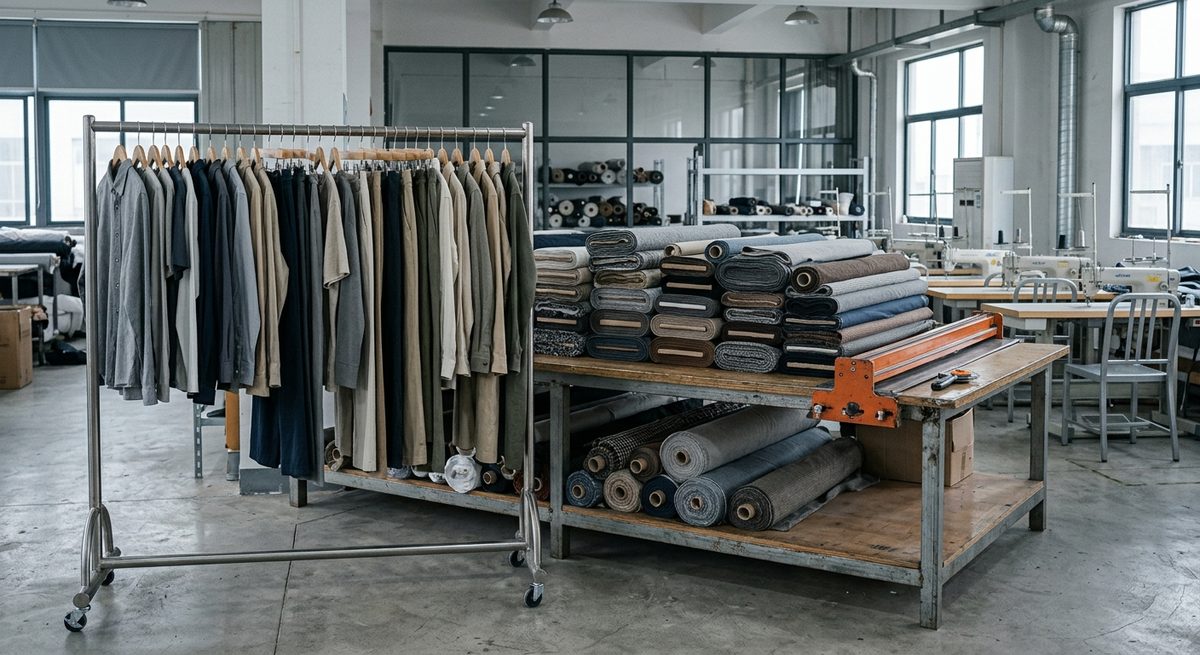
Stand inside a warp knitting mill in Dongguan for a minute and you’ll stop talking, because the room won’t let you be heard. It’s a flat mechanical roar, rows of machines pulling nylon and spandex yarn faster than your eye can track, and the air carries a faint waxy smell from the yarn coating. Most buyers who want to import activewear from China never see that room. They find a sewing factory first and work backwards. I’d do it the other way round. The fabric decides whether a legging survives a squat, and the fabric is born here, long before anyone threads a needle.
One product, two separate industries
On a shelf, activewear looks like one product. In Guangdong it’s really two industries stacked on top of each other, and they don’t behave the same way. The first is fabric: mills that knit, dye and finish stretch cloth, usually nylon spandex or polyester spandex. The second is cut and sew, the garment plants that turn those rolls into leggings, sports bras and training tops. Often they’re separate companies in separate towns. They quote separately. They also fail separately.
Why the split? Equipment, mostly. Knitting and dyeing mean heavy machinery, water treatment and a chemist on staff. Sewing means pattern makers, flatlock machines and operators with fast hands. Few owners want to run both. So when a supplier tells you they’re a full activewear factory, ask which half they actually own. That answer changes how you audit them, and it tells you where your quality risk really sits.
Where the cluster actually lives
Guangzhou is the commercial brain. The fabric trading hub in Haizhu district is where designers hunt stretch cloth by the roll, and the streets around it are packed with trim shops selling waistband elastic, drawcords and heat transfer labels. The sewing side spreads through Panyu and Baiyun, everything from ten machine studios living off small fashion runs to plants with a few hundred operators sewing purely for export.
Dongguan is the muscle. Its knitting towns hold the warp knitting mills, the circular knitters and the dye houses that feed them, and that’s where the technical fabrics behind modern activewear actually get made. Brushed high waist cloth, ribbed knits, compression fabric: most of it starts on a Dongguan machine. Foshan adds more dyeing and finishing a short drive west. So one legging can touch three cities before it’s folded into a polybag. That’s normal here. Nobody blinks.
How one order crosses the map
Yarn arrives at the mill and gets knitted into greige fabric. Lab dips go back and forth until you approve the colour, then the greige moves to dyeing and finishing, and if the design uses printed panels, polyester heads off to a sublimation printer as well. Finished rolls get trucked to the sewing plant. Trims come in from Guangzhou. Only then does cutting start, and sewing, pressing, needle detection and packing close the loop.
No single factory controls that chain, which means somebody has to chase every handover: the mill waiting on yarn, the dye house juggling machine slots, the truck stuck between cities. That’s the honest reason buyers look for help in Guangzhou instead of managing four suppliers from another time zone. We can stand in the dye house on Tuesday and on the sewing line on Wednesday. Email can’t.
What the geography does to your calendar
Fabric is nearly always the longest line on the schedule. Knitting, dyeing and finishing commonly eat several weeks on their own, and sewing can’t start until the rolls are approved and delivered, so you’re really running two projects joined in the middle. A few habits keep that join from turning into a gap:
- Approve lab dips and a hand feel swatch before any bulk knitting starts.
- Book fabric capacity early for repeat colours, especially before the autumn rush.
- Keep the same dye house between orders. Changing it is the fastest route to a colour mismatch.
- Inspect twice: once at the mill for the fabric, once at the plant for the garments.
- Plan one export point, because garments, packaging and accessories rarely finish in the same town.
That last point earns its place. When cartons finish in Dongguan and hangtags print in Guangzhou, consolidation and export handling pulls it all into one shipment with one set of documents. Cheaper to move. Far easier to track than three partial deliveries chasing each other across an ocean.
The checks that separate good leggings from returns
Once you understand the map, the quality work gets sharper. Sheerness under stretch is mostly a fabric weight problem, so weigh cut panels instead of trusting the roll ticket. Recovery after stretch tells you whether the spandex content matches the spec. On the garment side, look hard at the gusset, at the join where waistband elastic meets the side seam, and at how even the flatlock stitching stays over a curve.
Brushed fabrics deserve a pilling check. Any sublimated panel should be rubbed against a white cloth before a customer’s washing machine runs the same test for you. None of this needs a laboratory. It needs someone standing at the factory with a checklist and the nerve to hold a carton back.
Questions buyers ask about the Guangdong activewear belt
What fabric weight should I specify for compression leggings?
Compression styles commonly sit somewhere between 220 and 300 grams per square metre, though the right number shifts with the blend and the knit. Agree a weight tolerance per roll with the mill, then have the inspection team weigh actual cut panels. A light roll is behind most sheerness complaints we’ve seen.
Can one supplier really handle both fabric and sewing?
Vertical setups exist in Guangdong, but most orders still split between a mill and a garment plant even when one company fronts the deal. That’s fine. Just judge each half on its own merits: audit the fabric source the way you’d audit the sewing floor, and ask to see both sites if you visit.
How do I keep colours consistent across repeat orders?
Hold a physical colour standard, approve lab dips against it under a light box, and don’t change the dye house between repeats. Keep swatches from each approved bulk lot too, so the next order is matched against production reality rather than the original design file.
We’ve worked from Guangzhou since 2007, within driving distance of every mill and sewing plant described here. If you’re planning to import activewear from China, or still weighing it up, reach us through the contact form or WhatsApp. We’ll meet you at the airport, sit with you in the sample rooms and walk you onto the factory floors in Guangzhou and Dongguan, so decisions get made in front of the actual fabric.
Read next
Hoodie Quality Control: Inspecting Sweatshirts in Guangzhou
The defects that hit buyers who import hoodies from China, from twisted side seams to print cracking, and how inspections in…
The Real Cost of Importing Custom Printed T Shirts from China
See what actually drives the price when you import T shirts from China: fabric weight, printing method, freight and the…