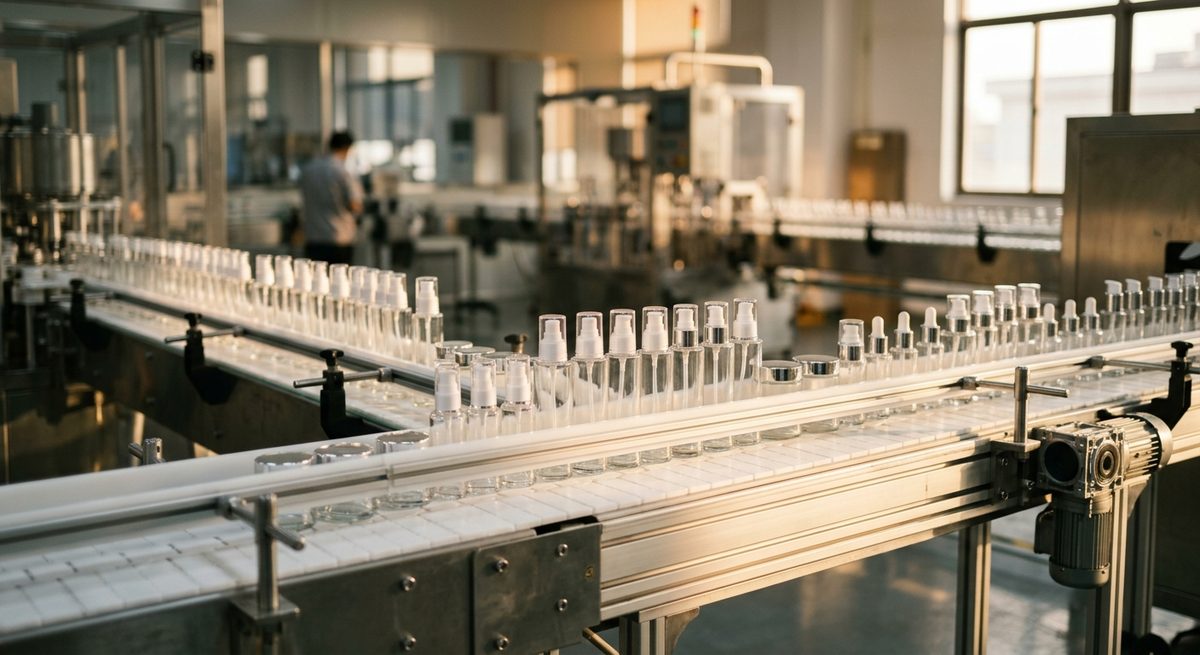
The first time we take a client into a filling plant in Baiyun, the bit they remember isn’t the machinery. It’s the air shower: a stainless booth between the changing room and the filling hall that blasts you from all sides for ten noisy seconds before the far door unlocks. Hairnet, coat, shoe covers, blast, and only then do you see the cream actually going into jars. That little ritual says a lot about how this industry runs, and it’s a decent place to start explaining how sampling, minimums and payments really work when you develop skincare here.
Baiyun, the neighbourhood that fills your bathroom shelf
Search for cosmetics OEM China and a striking share of what you find traces back to one part of Guangzhou. The Baiyun district holds a dense belt of cosmetics manufacturers, packaging suppliers and raw material traders, factory after factory along the same roads. That density is genuinely useful to you as a buyer. Your formula lab, your bottle supplier and your carton printer can be twenty minutes apart, which shortens every development loop, and comparing three factories can be done in a single day on the ground.
The sample loop, honestly described
Nobody gets the formula right on the first pass. Expect a loop, and budget time for it.
It starts with a briefing: texture, scent direction, actives you care about, the benchmark products you admire. The lab returns small bench samples, often unlabelled jars with handwritten codes. You test them for weeks, in your actual routine, in your actual climate, because a cream that feels perfect in humid Guangzhou can sit differently on skin in a dry winter elsewhere. Then revisions. A little less silicone feel, a quieter scent, more slip. Two to four rounds is normal. One round is rare. Eight rounds means the briefing was vague, and that’s usually the buyer’s side of the problem, not the lab’s.
Once you approve the formula, the factory runs stability and compatibility testing: heat, cold, cycling, and the formula living inside your chosen packaging for weeks. This is the stage impatient brands try to skip. Don’t. A separating emulsion or a pump that clogs at week six costs a full production run, and the calendar time you “saved” comes back with interest.
What actually sets the minimum order
Buyers assume the MOQ is a negotiating posture. Mostly it isn’t. It’s arithmetic from three directions at once:
- The batch tank. An emulsifying vessel has a working minimum, and a few hundred litres of cream converts into thousands of filled units of whatever size you chose.
- The components. Bottles, pumps, jars and printed cartons carry their own supplier minimums, and printed packaging is usually the strictest of the lot.
- The changeover. Cleaning down a filling line between products takes real hours, so a factory needs a run long enough to be worth the scrub.
Understand which of the three binds your project and you know exactly what to negotiate. Stock packaging with your label instead of custom-printed components can cut the effective minimum dramatically for a first run. A shared “open formula” instead of a custom one does the same on the tank side. Factories vary a lot here, which is why we shortlist by project shape, not by reputation alone.
How the money usually moves
Development and production are priced separately, and it’s healthier for both sides that way. Sampling and formula work sometimes carries a modest development fee, commonly offset against the first order; it filters out window shoppers and buys the lab’s serious attention. Production then typically runs on a deposit before manufacturing starts, with the balance due against completion or shipping documents. Exact splits vary by factory and by how new the relationship is, and terms soften as trust builds. First orders rarely get the terms third orders get. That’s fair enough.
Two cost lines catch first-time brands: testing and compliance for the destination market, and freight for goods that are mostly water in glass. Creams are heavy, boxes are printed, and the shipping quote deserves attention before the retail price is set, not after. As a shipping agent in Guangzhou we handle that leg ourselves, which means the freight estimate lands on the table at the same time as the unit price, where it belongs.
Paperwork is part of the product
Skincare crosses borders on documents as much as on pallets. Depending on your market you may need ingredient disclosures, safety assessments, labelling in specific formats and product registrations, and the factory’s certifications will be asked about by your regulators or retailers. Ask early which export documentation the manufacturer routinely provides and which parts you must arrange in your own country with your own advisors. A factory that exports to your region already will answer in specifics. Vague answers are a signal worth respecting.
Where a local team earns its keep
Our part in these projects is unglamorous and constant: shortlisting factories whose tanks and minimums fit the project, sitting in the briefing meetings so nothing dies in translation, chasing the sample rounds, checking the filled goods before they’re boxed, then consolidating product and packaging into one clean shipment. We’ve done it since 2007. You can read who we are if you want the background, but honestly the better introduction is walking a Baiyun factory floor together.
Three questions from brand founders, answered plainly
Can I start with one product, or do I need a full line?
Start with one, or two at most. A single strong product finds out whether your brand has a customer, and every additional product multiplies sampling rounds, component minimums and cash locked in stock. The factories won’t push back on a one-product launch. Your budget will thank you.
Who owns the formula we develop together?
Settle it in writing before development starts, because the default varies. Custom formulas developed at your cost can be contracted as yours; open formulas remain the factory’s and appear under other labels too. Both models are legitimate. Problems come from assuming one while paying for the other.
How long from first meeting to sellable stock?
Longer than the factory’s production lead time suggests, because sampling rounds and stability testing sit in front of it, and destination-market compliance runs alongside. Months, not weeks, for a custom formula. Plan the launch date backwards from that reality and the whole project gets calmer.
If you’re serious about building a skincare product and want to see the tanks, the filling lines and the air shower for yourself, come to Guangzhou. We’ll collect you at the airport, bring an interpreter, and spend the day in Baiyun factories that fit your project. The contact form and WhatsApp both reach the team directly.
Read next
Hair Extensions From China: The Tests Worth Running First
Before you import hair extensions from China, learn which bench tests, grading checks and export papers matter, and how…