
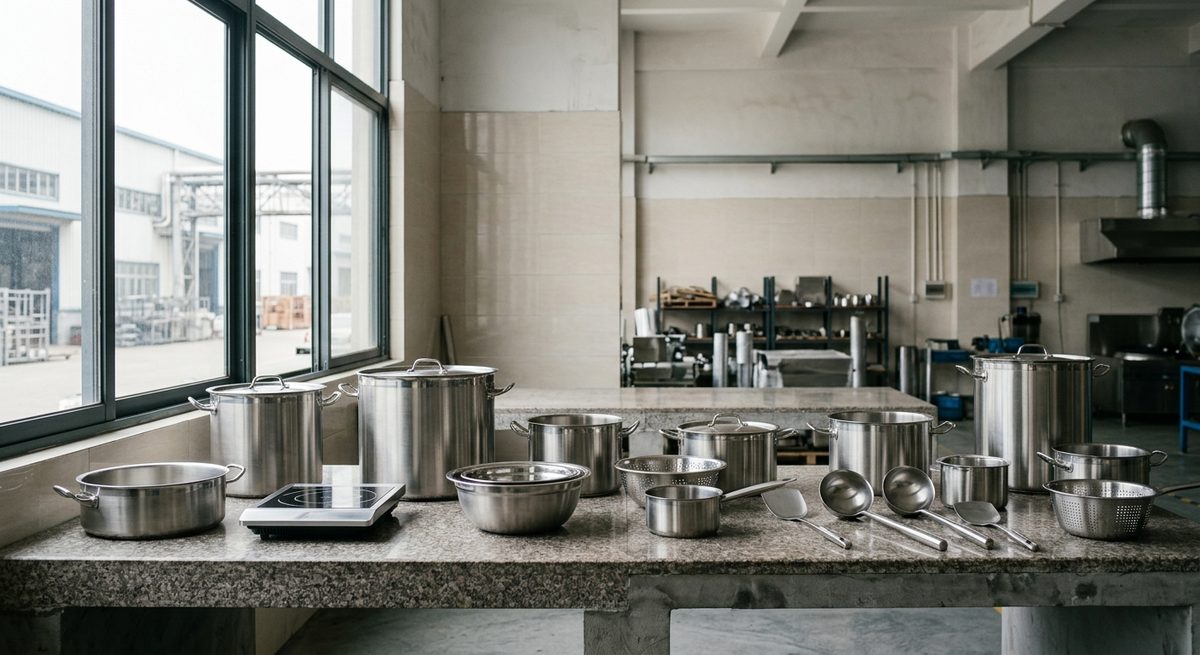
You hear a Shunde metal workshop before you see it. The guillotine shear drops on a stainless sheet with a bang you feel through the floor, then the folding brake sighs, then the bang again. Out of that rhythm come the worktables, sinks, hoods and cooking lines that end up in restaurant kitchens on every continent. Getting the equipment built is honestly the easier half of the job. Getting a mixed load of stainless steel, glass and refrigeration across an ocean without damage is where these orders are won or lost.
An hour from Guangzhou, a whole kitchen industry
Shunde, a district of Foshan about an hour’s drive from Guangzhou, is where catering equipment clusters in this part of China. Fabrication shops, refrigeration plants and cooking equipment factories sit close enough together that a buyer can see four suppliers in a day and still be back in Guangzhou for dinner. Almost nobody buys a kitchen from a single factory. The cooking line comes from one plant, refrigeration from another, and the smallwares get picked up from the Guangzhou catering market. That mix is exactly why the freight side needs a plan of its own.
Stainless ships big and light
People who import commercial kitchen equipment from China for the first time usually underestimate the cube, not the cost. A prep table is mostly air. So is a shelving unit, a hood, a sink bench. Sea freight for this cargo is effectively bought by volume, which means clever packing is real money. Factories will nest sinks, unbolt legs and flat pack shelving if you ask before production, and the difference between a lazy load plan and a tight one can be the difference between one container and two. Ask early. Once the goods are welded and boxed, the cube is what it is, and you can’t negotiate with a tape measure.
Crates for the fragile third
Cartons are fine for the tough stuff. The fragile third of a kitchen order, glass door merchandisers, sneeze guards, anything with a control panel, belongs in plywood crates with foam corner protection and film under the wood. Two details worth checking rather than assuming. First, wood packing rules: solid wood needs the ISPM 15 treatment mark to clear most destinations, while plywood generally avoids the issue, so confirm which one your factory actually uses. Second, moisture: a sea container sweats, so desiccant bags inside the crates and film between steel strapping and stainless surfaces prevent the tea-coloured staining that ruins an unboxing.
Refrigeration plays by its own rules
Chillers and freezers are the items we treat most carefully. They travel upright, marked with arrows nobody is allowed to ignore, and after the journey the compressor oil needs time to settle before anyone plugs the unit in, so the installation crew at destination should be told to let delivered units stand first. Voltage and plug type must match your country, which sounds obvious and still goes wrong on rushed orders. It’s a thirty second check that saves a very bad morning. Before packing, we film each unit running, with a thermometer in frame. That short video has settled more than one arrival dispute in minutes.
Your own container, or space in someone else’s
A compact restaurant fit-out commonly fits a 20 foot container, and a full kitchen with refrigeration and furniture pushes toward a 40. When the order is smaller than that, shared container space works, but stainless in shared loads collects forklift dings from every handling point along the way. Our rule of thumb: if the volume gets anywhere near a small container, take the container. You gain a sealed box loaded once, under supervision, heavy pieces low and strapped, blankets between polished surfaces. Loading day at a Shunde factory is genuinely worth attending. One reason clients choose to import from Guangzhou with a local team is having someone stand at the container door with the packing list, checking crates in one by one.
Before anything ships, we run through a fixed checklist with the factory:
- Photos of every crate and carton, inside and sealed.
- A packing list that says which crate holds which item.
- Corner protection on every glass panel and worktop edge.
- Upright arrows and lifting marks on refrigeration crates.
- Water drained from any unit that was test run.
- The spare parts box location written on the load plan.
One extra trick from years of doing this: number the crates by kitchen zone, cold line, hot line, wash-up, and load them in reverse installation order. The crew at destination then opens exactly what they need next instead of unpacking the whole shipment onto a loading dock to find one sink. Installers notice. So does the project schedule.
Paper for the border, badges for the brand
Commercial equipment attracts questions at import: certifications for electrical items, and classification codes that shift between cooking, refrigeration and furniture. Don’t guess rates. Confirm the tariff code and the current rate with your own customs broker before the goods sail, and make sure the invoice descriptions match reality. Separately, a fair number of our clients resell equipment under their own name in their home market, and our brand building support covers the badge plates, control panel decals and printed manuals that turn a plain fabrication into a branded product line.
Freight questions we field most weeks
How much kitchen fits in a 20 foot container?
It varies with how much refrigeration and how much open shelving you’re buying, since both eat volume fast. The honest method is boring: get carton and crate dimensions from each factory before production, add them up, and leave a margin, because crates tend to measure bigger than the drawings. We do that arithmetic for clients as a matter of course.
Should refrigeration go by sea or air?
Sea, in almost every case. These units are heavy and bulky, which is the worst combination for air freight pricing. Air only makes sense for an urgent small item, like a replacement control board, not for the unit itself. Plan the timeline around sea and the question disappears.
Who pays if something arrives dented?
It depends on your shipping terms and whether the load was insured, which is why we document the loading so thoroughly. Photos of intact crates going in, a clean tally at the door, and cargo insurance on the shipment give you a straightforward claim instead of an argument. Skip any one of those and you’re negotiating from memory.
Fitting out a restaurant, hotel kitchen or dark kitchen and wondering how it all gets to you? Tell us what you’re building, through the form or WhatsApp. We’re in Guangzhou, Shunde is up the road, and we’ll take you around the factories and stand at the container with you when your kitchen ships.
Read next
Putting Your Name on Aluminium: Profiles and Windows from Foshan
Thinking of putting your own brand on extrusions? How to import aluminium profiles from China with custom dies, finishes and…
Where Hotel Towels Really Come From, and How to Buy Them Well
Planning to import hotel towels from China? See which cities weave them, how the supply chain fits together, and how a…