
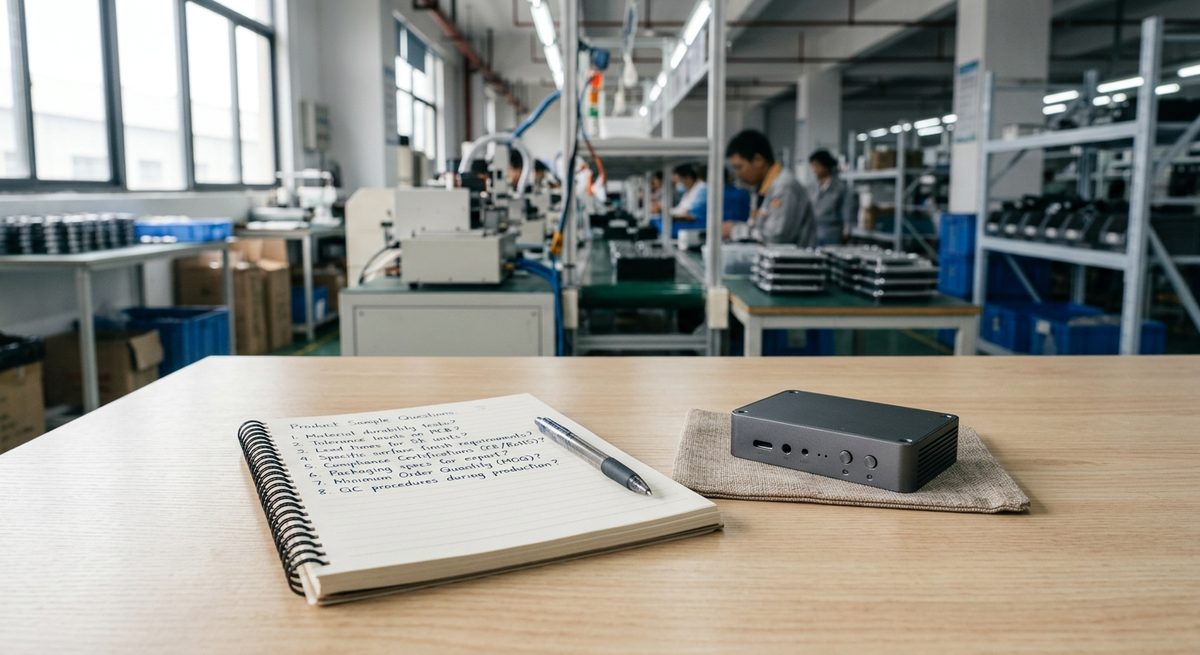
A buyer we hosted a couple of years ago ran his meetings from a printed checklist. Price, MOQ, lead time, payment terms, certifications. Tidy work. Then, at the fourth factory, our interpreter asked one question that wasn’t on the list: “Which processes here are done in this building?” The sales manager paused, then admitted the surface plating went to a workshop forty minutes away. You could have guessed it from the air, actually. Plating shops have a sharp chemical smell that clings to a building, and this factory smelled only of cardboard and hot glue. Nothing on the checklist would have caught that.
The questions everyone already asks
Price, minimums, lead time, sample cost. Fine. Ask them. But understand that every supplier has polished answers to these ready before you walk in, because every visitor asks the same five things. Search for questions to ask a Chinese supplier and you’ll find the identical list on a hundred sites, which is precisely why the answers come pre-polished. The answers are real, mostly, and they tell you almost nothing about how your order will actually go. What separates a smooth order from a painful one lives in the questions below, the ones that don’t get rehearsed.
Who actually makes what
Subcontracting is normal in Chinese manufacturing and it isn’t a dirty word. A furniture factory in Foshan that sends its metal legs to a specialist welder often gets better legs than one insisting on doing everything badly in-house. The problem is never subcontracting. The problem is not knowing, because quality problems hide in the steps you didn’t know existed.
So ask it plainly
“Which processes for my product happen in this factory, and which go outside?” Then the follow-up that matters even more: “Who inspects the subcontracted parts when they come back?” If the answer to the second question is a shrug, you’ve learned where your future defect reports will come from, and you learned it for free, in a meeting, before any money moved.
What happens to your money’s leftovers
Three questions in this family, all forgotten constantly.
- Who owns the tooling? If you pay for a mould, get your ownership in the contract, with the mould number. Otherwise the factory owns it in practice, whatever was said over tea.
- What happens to excess production? Factories overrun on purpose to cover defects. Ask where the extra units go. If your product carries your brand, you want that answered in writing.
- Can they substitute materials if a supply runs short? The honest answer is “sometimes we must.” The right arrangement is “never without written approval.” Get the arrangement, because a quiet resin swap is how a good product becomes a returns problem.
None of these feel urgent in a first meeting. All of them are cheaper to ask before the deposit than after. We walk through this exact list when we sit in on negotiations, which is part of the accompanied visits described in Finding a Manufacturer in Guangzhou with Private VIP Help.
The failure questions
Buyers avoid these because they feel pessimistic in a friendly meeting. Ask them anyway. How a supplier answers a failure question tells you more than any certificate on the wall.
“If the inspection finds defects above our agreed limit, what happens?” You want to hear something concrete: rework at their cost, replacement in the next run, a credit. What you don’t want is “our quality is very good, this will not happen.” Every factory’s quality is very good until the Thursday afternoon it isn’t.
“What was your last production problem, and how did you fix it?” A supplier who can describe a real mistake and a real fix is a supplier with a working system. One who claims a spotless history is either new or performing. Neither is reassuring.
And one about the calendar
“What does your production schedule look like around Chinese New Year and October?” Lead times quoted in a quiet month quietly double in peak season. A supplier who volunteers this is being straight with you. Factor the holidays in yourself either way, because the whole Pearl River Delta, from Guangzhou out to Dongguan, moves to the same calendar.
Questions about the people
Ask who your day-to-day contact will be after the order is signed, and meet that person before you leave. The charming export manager who ran your meeting often hands you to a junior colleague the moment the deposit clears. That’s normal, but you want to judge the actual person you’ll be messaging at midnight when a shipment question comes up.
Ask how long the key production staff have been there, too. High turnover on a line shows up in your third order, not your first. A workshop where the supervisor has been running the same machines for a decade is worth a slightly higher unit price. My opinion, but I’ll defend it.
One more from this family: “Which markets do you export to now?” A factory already shipping to your region has met your labelling rules, your plug types, your documentation quirks. One that mostly serves other regions may make excellent products and still stumble on requirements it’s never handled. Neither answer disqualifies anyone. You’re mapping how much teaching your order will involve, and teaching costs time on both sides.
Three follow-ups buyers send us afterwards
Won’t all these questions offend the supplier?
Asked politely, no. Serious factories deal with professional buyers weekly and expect exactly this. What we see in the room is usually the opposite effect: the questions raise your standing, and the pricing conversation afterwards gets more honest.
Should I ask everything in the first meeting?
No, you’ll drown the meeting. First meeting: capabilities, subcontracting, the calendar. Second meeting or the pre-contract call: tooling, overruns, substitutions, failure terms. The failure terms then go in the contract, not just in your notebook.
What if I can’t visit and have to ask remotely?
The questions still work over a video call, though answers are easier to polish at a distance. Ask for evidence rather than assurances: photos of the process in question, the mould register, a copy of their incoming-inspection form. Or have someone local ask on your behalf, inside the building, where the cardboard-and-glue smell test still applies.
If you’d like the awkward questions asked well, that’s a large part of our job. We prepare the question list with you beforehand, and our guide Your First Sourcing Trip to Guangzhou: How to Prepare Well covers the rest of the preparation. We’re in Guangzhou, we sit in the meetings with you, and we hear the answers in both languages. The contact form or WhatsApp reaches us directly.
Read next

What a Week of Supplier Meetings in Guangzhou Looks Like
How we plan supplier meetings in Guangzhou for visiting buyers: the real schedule, the driving, the showrooms, and what a…

How Buyers Choose Between Flying to China and Sending an Agent
Weighing a buying trip against sending an agent to China? A Guangzhou team explains what each route costs, what it catches,…
Your First Order from a Chinese Supplier: What Actually Happens
What a first order from a Chinese supplier really involves: proforma invoice, deposit, production, inspection and shipping,…