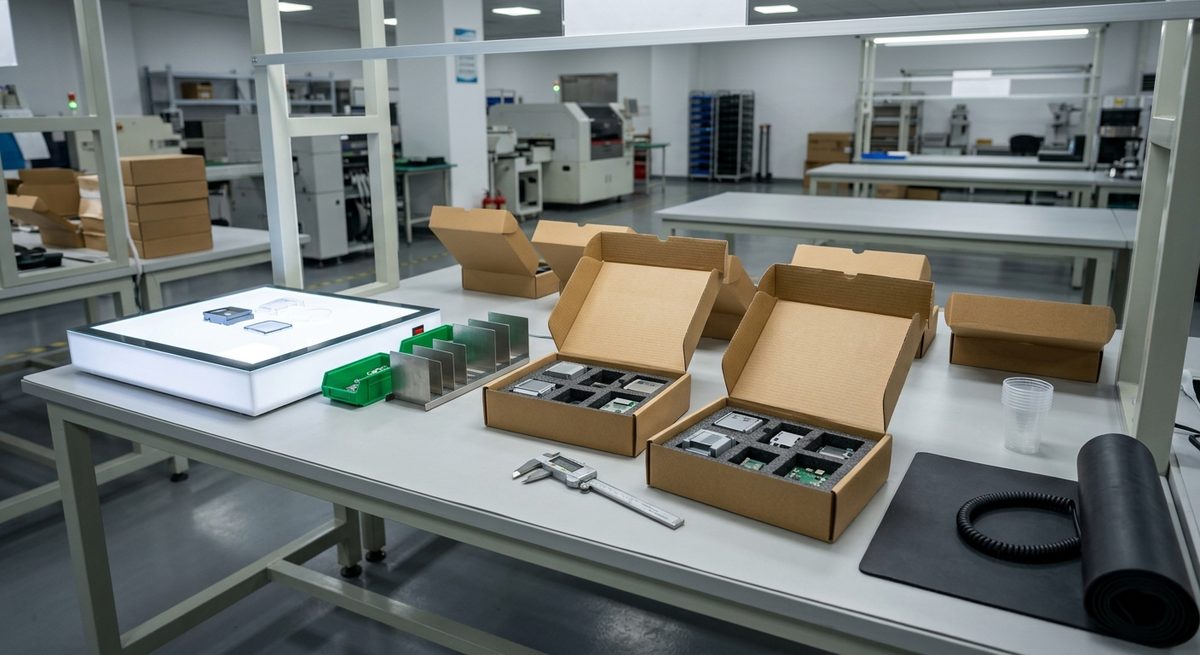
A buyer once asked us to quote all three inspection stages for an order of four hundred plain canvas tote bags. We quoted one stage and told him to keep the rest of his budget. The next month, a different client ordered custom electronics with a new tooling run and asked for a single final check. We talked him into three. Same service menu, opposite advice, and both calls were right. Anyone selling quality control services in China should be able to tell you which checks your order doesn’t need. That, more than the price list, is what this article is about.
Three doors on the same corridor
The trade sorts inspections by when they happen, and the timing decides everything about what they can catch.
- Before production: checking materials and components after they arrive at the factory but before they’re cut, moulded or assembled. Sometimes paired with a first-article check on the earliest units off the line.
- During production: a visit when a chunk of the order exists, commonly somewhere between a fifth and half, looking at real units and the process making them.
- After production: the pre-shipment inspection, run when goods are finished and mostly packed, before the balance payment moves.
The logic is brutal and simple. The earlier a problem is found, the cheaper it is to fix. The later a check happens, the more it can see. Early checks buy correction time. Late checks buy certainty. You’re choosing your mix of the two.
Before: the check that prevents instead of detects
The incoming-material check is the least ordered and, for certain orders, the most valuable. Fabric rolls verified for weight and shade before cutting. Resin, hardware and coatings matched against spec before the machines start. Once a thousand chair frames are welded from the wrong tube gauge, there is no rework, there’s only a negotiation about who eats the loss.
The first-article side matters most when tooling is new. The first fifty units off a fresh mould carry every tooling error at full strength, and catching a sink mark or a short shot at unit twenty costs a tooling adjustment. Catching it at unit ten thousand costs the argument of the year. This is why development-heavy projects, the kind we described in Private Label Manufacturing in China: How It Really Works, almost always deserve an early-stage check even when the budget is tight.
When to skip it: stock goods, proven products, repeat orders from a supplier whose materials haven’t wobbled. Which is most simple orders, honestly.
During: the only check that can still change the outcome
The mid-production visit is the working one. The line is running, the noise is real, and half-packed cartons sit in rows at one end while raw components sit at the other. You can stand in the middle and see the whole order’s future in one room.
What it sees that a final check can’t
Process problems, mostly. An assembly step done out of sequence. A glue drying too fast in summer heat. An operator improvising because a jig broke on Monday and nobody escalated it. At final inspection these appear as scattered defects with no visible cause. Mid-production, you can watch the cause happen and fix it while most of the order is still unbuilt.
The pace question
It also answers the schedule honestly. A factory can promise any date on the phone. It can’t fake how many units exist in the room. If a third of the order exists a week before the promised finish, you’ve just bought yourself three weeks of warning to rebook the vessel and manage your customers, instead of finding out at the end.
When to skip it: short runs that finish in days, and orders where rework is cheap and easy. When never to skip it: long runs, new tooling, and anything where a process defect would be invisible in the finished unit. Sealed electronics are the textbook case, one of several traps we listed in Electronics in Guangzhou: QC Risks and Golden Rules.
After: the gate the money waits behind
If you only buy one check, buy this one. The pre-shipment inspection draws a random sample from the finished, packed goods, checks quantity, function, workmanship and packaging against your standard, and produces the report your balance payment should wait for. It’s the last moment where problems are the factory’s to fix. Twelve hours after loading, they become yours to import.
Its honest limitation: at this stage nothing can be prevented, only accepted, reworked or refused. A bad final inspection on a tight vessel booking is a miserable place to stand. Every stage you skipped earlier was a bet that you’d never stand there. Usually you win that bet. The one time you don’t pays for a decade of mid-production checks, which is the whole argument in one sentence.
How we’d actually spend your budget
For a stock product from a decent supplier: final inspection only. For a first order of anything custom: material check plus final. For new tooling or electronics: all three, and we’ll say so plainly. For a long-running repeat order: final inspection every time, plus a during-production visit once or twice a year as a spot audit, rotated so the factory can’t predict which order gets one. Predictable inspection schedules train factories to be excellent in predictable weeks.
Distance changes nothing in this logic. Being based in Guangzhou just makes the visits cheap for us to run across Dongguan, Huizhou and Zhongshan, which is why splitting one stage into two visits doesn’t carry the cost it would if someone flew in for each.
What people ask when they’re choosing stages
Can one visit combine two stages?
Sometimes. On a fast-moving order an inspector can check late-arriving materials and early finished units in the same day. It works when the factory’s schedule genuinely overlaps the stages. It fails when it’s just a discount dressed as efficiency, so ask what will physically exist in the building on the visit day.
What percentage of production should exist for the middle check?
Enough finished units to judge real quality, and enough unbuilt order to be worth correcting. In practice people aim somewhere between twenty and fifty percent complete. Earlier if tooling is new. Later if the process is proven and you mostly want a schedule reality check.
Do these checks replace lab testing?
No, they answer different questions. Inspections verify this lot against your spec by eye, gauge and function test. Labs verify materials and compliance against standards with equipment no inspector carries. Regulated products commonly need both, and neither substitutes for the other.
We’ve run inspections at every stage since 2007, and the first thing we’ll tell you is which ones your order can safely skip. Send the product and the quantities through the contact form or WhatsApp and we’ll map the stages onto your actual risk. If you’re visiting Guangzhou, join an inspection day. Watching the sample draw teaches more than any article.
Read next
What an Inspection Report Should Tell You, and Often Does Not
A good inspection report China side proves how the goods were checked, not just that they passed. Here's what to demand in…