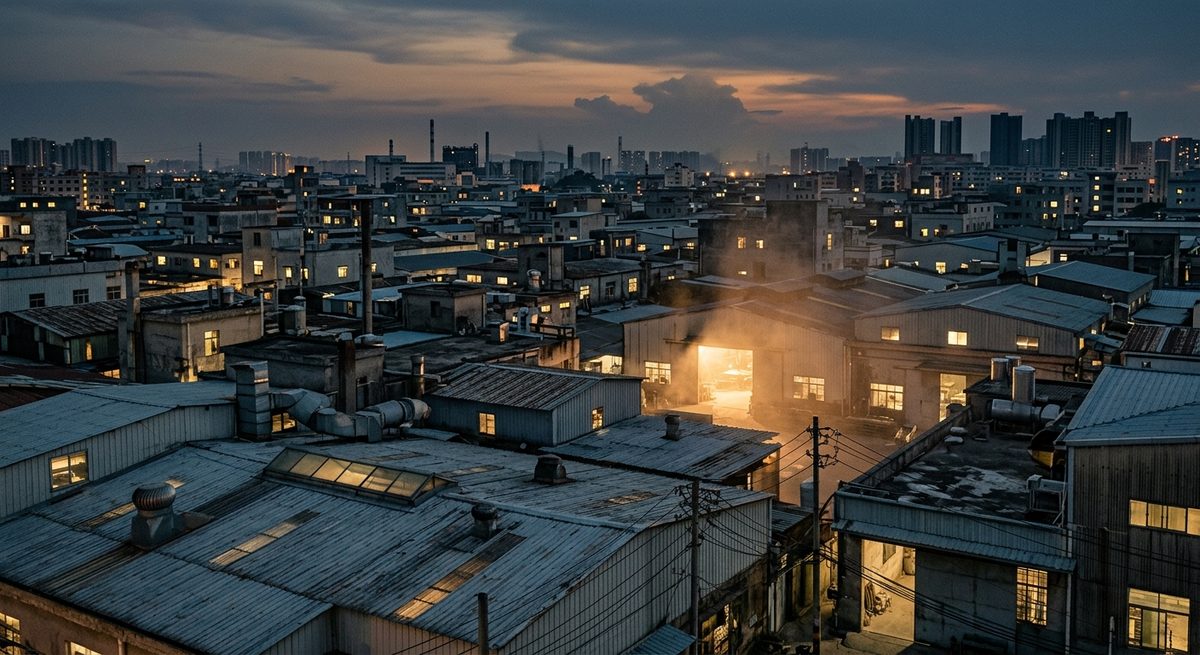
Three quotations were sitting on our office desk last month for the same product, a metal phone stand. One came from a trading office in Guangzhou, one from a workshop in Chang’an town in Dongguan, one from a company registered in Shenzhen whose production, when we checked, also happened in Dongguan. Same drawing, three cities, three stories. Buyers email us weekly asking which city they should source from, and the honest answer is that the question is slightly wrong. The Pearl River Delta works as one connected workshop, and each city plays a different position on the field.
Guangzhou: the trading floor of the Delta
Guangzhou is old. It’s been a trading port for many centuries, and that history shows in what the city does best today: it gathers, displays and sells. The wholesale clusters are the visible face of it, whole districts given over to a single category. Garments around the railway station and in Shahe, leather goods near Sanyuanli in Baiyun district, cosmetics at the Xingfa centre, fabric in the enormous Zhongda cluster in Haizhu, electronics along Dashatou. Twice a year the Canton Fair at Pazhou pulls the whole manufacturing region into one set of halls.
Production inside Guangzhou proper leans toward garments, leather, printing and packaging, and food processing, with heavier industry pushed out to districts like Huadu, where the Shiling cluster turns out bags and small leather goods, and Panyu, which has a long jewellery tradition. But plenty of what’s sold in Guangzhou is made an hour away. That’s not a problem. It’s how the region is designed.
Dongguan: where things get made
Dongguan doesn’t really behave like one city. It’s a patchwork of thirty-odd towns, and each town grew around a trade. Chang’an does metal: stamping, CNC machining, moulds. Walk into a mould shop there and you’ll see racks of steel tools taller than you, each block labelled in wax pencil, and the whole room smells faintly of cutting oil. Houjie does shoes and furniture. Dalang does knitwear, with machine halls that clack like a room full of typewriters. Humen does apparel. Qingxi and Tangxia lean electronic, feeding parts to assembly plants across the border of the city line.
What Dongguan lacks is a showroom culture. Factories there are used to contract work for brands and don’t always bother with a polished reception. Some of the best workshops we use have an office that looks like it was furnished in 2004. Don’t judge the tooling by the sofa.
Reading a Dongguan address
When a supplier gives you a Dongguan address, the town name tells you more than the city name. A knitwear quote from Dalang makes sense. A knitwear quote from a town known for die casting deserves a question, because it usually means the company is brokering the order to someone else. We look up the town before we look up the company.
Shenzhen: electronics, speed and the price of both
Shenzhen is the youngest of the three and behaves like it. The city concentrates electronics design, prototyping and the trade around Huaqiangbei, plus genuine manufacturing out in Bao’an and Longgang districts. If your product has a circuit board, firmware, or a battery, the engineering talent you need is densest here. The flip side is cost. Shenzhen rents and wages have climbed for years, so simple assembly work has drifted outward, much of it into Dongguan, which sits directly between the two big cities. That’s why so many “Shenzhen” suppliers ship from somewhere else: the sales office kept the prestigious address while the line moved.
Buyers comparing Dongguan and Shenzhen factories for an electronic product often find the same pattern we do: development and final testing in Shenzhen, plastics, metal parts and packaging from Dongguan towns, everything meeting at one assembly site. The supply chain crosses the city border thousands of times a day and nobody involved thinks twice about it.
So which address should be on your purchase order?
Match the city to the job, not to the map. A rough sorting that has served our clients well:
- Finished goods you can buy from stock, mixed categories, smaller trial quantities: start in Guangzhou’s wholesale clusters
- Custom mechanical products, moulds, furniture, shoes, knitwear: expect the real maker to sit in a Dongguan town
- Anything with electronics inside: Shenzhen for engineering and sourcing of components, with production possibly elsewhere
- Ceramics, furniture and building materials: neither of the three, look at Foshan next door
- Lighting: Guzhen in Zhongshan, a separate trip south
Categories blur, of course. Stationery is a good example of a product family that spreads across the whole region, with printing in Guangzhou and plastic parts inland, and we wrote up how that works in Sourcing Stationery & Office Products from Guangzhou.
The practical geometry of a visit
Here’s the good news: you don’t have to choose a base three times. Guangzhou works as the anchor for the whole triangle. High-speed trains from Guangzhou South reach Humen in about twenty minutes and Shenzhen North in roughly half an hour, and a hired car covers the Dongguan towns better than any train can, since workshops sit in industrial lanes a taxi app struggles to find. We routinely run day trips where a client sleeps in Guangzhou all week and still sees factories in three cities.
A workable three-city week
Two days in Guangzhou for markets and supplier meetings. One full day driving Dongguan towns, grouped by geography so you’re not crossing the city twice. One day in Shenzhen for the electronics side. One spare day, because someone will reschedule. They always do.
What it costs you to skip the visit
Nothing forces you to come at all; plenty of orders run on inspections and video calls. But the buyers who’ve walked Chang’an once read quotations differently forever. They know why the metal part is cheap and the anodising isn’t. That education is worth a plane ticket.
Common questions about the three cities
Is one of the cities cheaper across the board?
No. Prices follow the product, the town and the factory’s order book, not the city name. A busy Shenzhen plant can beat a quiet Guangzhou trader on the same item one month and lose the next. Compare quotes per product, always.
Can I cover all three cities in one trip without an agent?
Yes, if your appointments are confirmed and your suppliers speak workable English. The trains are easy. The hard part is the last mile to factory gates and the technical talk once you’re inside, which is where an interpreter earns their fee.
Why does my supplier’s office address differ from the factory address?
Usually because sales sits in a city centre while production sits where land is cheap. It’s normal here. What matters is that the factory named in your contract is the one that actually makes your goods, and that someone you trust has stood inside it.
Our team lives at the centre of this triangle and drives it every week. We’ve collected the practical side of visiting, interpreters, hotels, day planning, in Help in Guangzhou: What Foreign Buyers Need on the Ground, and if you’d like company on the ground, from airport pickup to factory floor, message us through the site or WhatsApp and we’ll build the route with you.
Read next
Metro, Taxis and Timing: Moving Around Guangzhou on a Buying Trip
How to move around the city on a Guangzhou buying trip: the metro lines that matter, when a DiDi beats the train, and how to…