
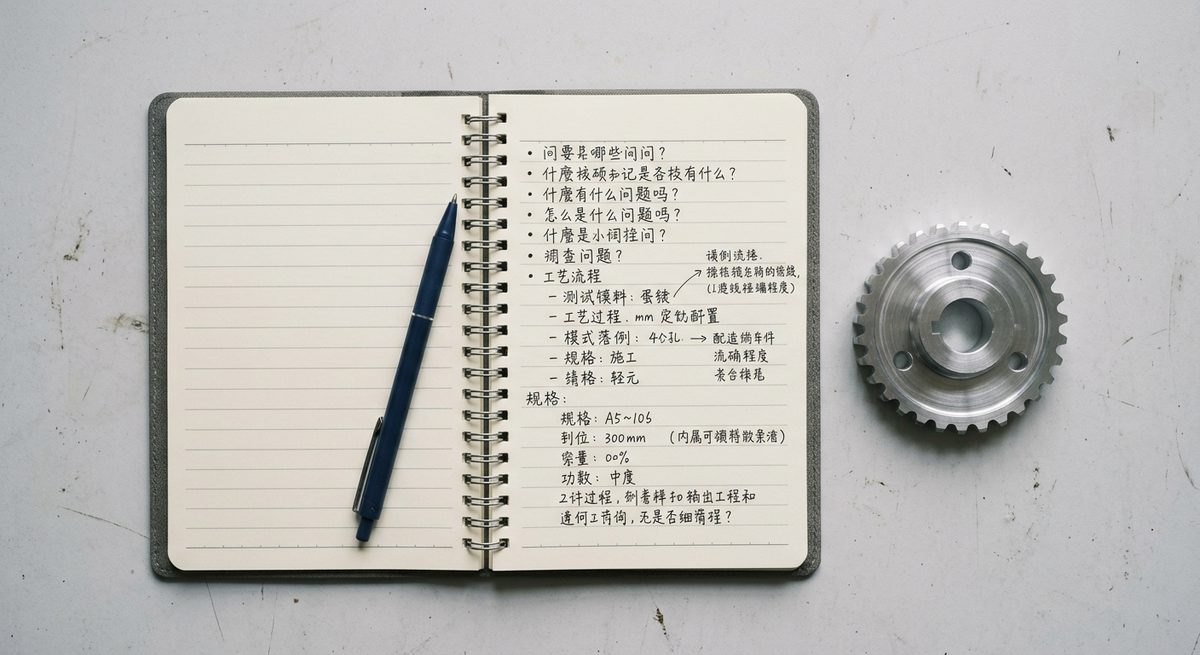
The single most expensive sentence in all of importing is “you know what I mean.” A client of ours once approved a leather bag order with the instruction “same as the sample but in dark brown.” The factory in Shiling, the leather goods town up in Huadu district, delivered eight hundred bags in a brown that was, by any fair reading, dark. Just not his dark. Nobody had lied. Nobody had cut corners. There was simply a gap where a specification should’ve been, and the goods poured straight through it, the way goods always do.
Write for the person who’ll never meet you
Your brief isn’t really for the sales manager you’ve been charming over video calls. It gets translated, summarised and taped to a workstation for a line worker who has never heard your name and will make four hundred of your product before lunch. Write for that person. Short sentences. Numbers instead of adjectives. Pictures wherever a picture can replace a paragraph.
The test we apply: could someone build the product correctly from the document alone, with no phone calls? If any line needs a follow-up question, the factory won’t ask it. They’ll answer it themselves, using their standard practice, and their standard practice is what you were trying to change by writing a brief in the first place. Photos of defects help enormously here: a page showing “this stitching is acceptable, this is not” communicates across any language barrier faster than three paragraphs of description ever will.
The anatomy of a brief that survives translation
Numbers, not adjectives
“Sturdy” is not a spec. “Withstands 15kg static load” is. “Soft-touch finish” is not a spec. A named coating type with a reference sample is. Every adjective in your brief is a decision you’ve delegated to a stranger’s cost sheet. Hunt them down and replace each one with a measurement, a standard, or a physical reference.
Colours by code, always
Colour names die in translation and screens lie about colour anyway. Use an international colour reference number for every colour, including the packaging. For products where finish matters, require a colour swatch approval before mass production, on the actual production material, because the same code lands differently on cotton, ABS and coated steel.
Tolerances, or your numbers are decorations
A dimension without a tolerance is a suggestion. State the range you’ll accept: 200mm plus or minus 2. And be honest with yourself about which tolerances matter. Tight tolerances everywhere raise cost and get quietly ignored. Tight tolerances on the three dimensions that affect fit or function, with looser ones elsewhere, get respected because they’re obviously deliberate.
Packaging is part of the product
Specify inner packing, master carton contents, carton grade, and the markings on the outside. Standing next to a carton taping machine in a packing room, that screech-thunk rhythm all day long, you realise packing is a production line of its own, and it’ll run on defaults unless you’ve written yours down.
The golden sample outranks the document
However good the paperwork, the real contract is a physical object: the pre-production sample you approve, sign, and split into two sealed copies, one for you and one kept at the factory. When a dispute comes, and occasionally one does, nobody argues with the object. We’ve watched disagreements that were heading toward lawyers dissolve in five minutes once the sealed sample came off the shelf.
By the time production starts, the golden sample file should hold:
- Two sealed, signed samples, one at your office and one at the factory.
- Dated photos of the approved piece from every side, shared with both parties.
- The exact spec sheet revision it was approved against.
- Approved colour swatches on the real production materials.
Every later conversation should reference it. Inspections check against it. Reorders cite it. If you change anything, even slightly, make a new golden sample rather than amending the old one verbally. Verbal amendments are how “same as last time” drifts, order by order, into a different product.
What to leave out, and what briefing does to your price
A good brief is also edited. Leave out your marketing story, your feelings about the product, and requirements you can’t actually verify at inspection. Every unverifiable requirement teaches the factory that some of your document is decorative, and you don’t get to choose which parts they then take seriously.
Expect a proper brief to move your quote, usually upward, sometimes noticeably. That’s the system working. The vague version’s lower price was the price of the factory’s assumptions, and you’d have paid the difference later in returns. Where the number lands after a real spec is where the negotiation should start, and our piece MOQ & Price: How to Negotiate Effectively picks up from exactly that point.
A clear spec also stabilises everything downstream. Once you can brief a Chinese supplier in numbers and references, your landed cost stops jumping around, because the product stops quietly changing between orders. The full journey from unit price to your warehouse door is mapped in Import Costs from China: From Factory Price to Landed Cost.
The briefing questions we hear most
My product is simple. Do I really need all this?
Scale it to the risk. A stock product bought as-is needs a one-page brief: exact model, colour codes, packaging, quality standard. Anything custom, anything carrying your brand, needs the full treatment. The question isn’t how simple the product is, it’s how expensive the misunderstanding would be.
Should I send my brief in Chinese?
A bilingual brief is ideal, with drawings and numbers doing the heavy lifting since they need no translation. If you translate, have someone who knows the product category do it. General translators reliably mangle technical vocabulary, and a wrong term in Chinese is worse than English the factory puzzles over, because it reads as confident and gets built.
The factory says they understand everything. Good sign?
Mixed, honestly. Instant total comprehension with zero questions usually means nobody senior has read it yet. The suppliers we rate come back with questions and small objections, “this tolerance will cost you, do you really need it here?” That’s a factory actually engaging with your document. Welcome the pushback.
Half our working week is turning a client’s idea into a document a workshop can’t misread, then defending it through sampling and inspection. We’re in Guangzhou, close enough to hand-carry a golden sample to a factory and watch it go in the cabinet. If you’ve got a product brewing, send us what you have through the contact form or WhatsApp, rough is fine, and we’ll tell you what’s missing.
Read next

What Buyers Get Wrong About Prices in Guangzhou
Prices in Guangzhou confuse first-time buyers: market stalls, factory tiers and quotes that move. A local sourcing team…

Why Two Suppliers Quote the Same Product So Differently
Comparing supplier quotes China wide and seeing wild gaps for one product? The differences come from spec, structure and…
Reading a Chinese Factory Quotation Line by Line
A Guangzhou sourcing team takes apart a Chinese factory quotation line by line: unit price, incoterm, validity, packaging,…