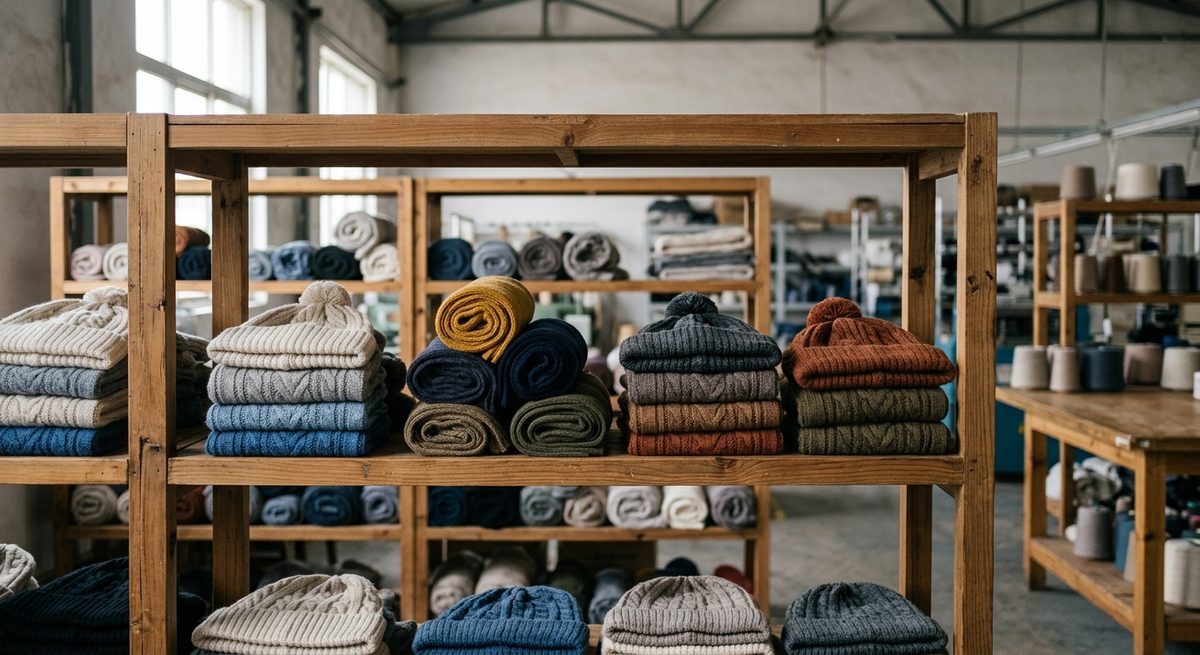
Why do two caps that look almost identical come back with quotes far apart? It’s rarely greed and it’s never magic. A six-panel cap is a bundle of small costs, and each one can be specified up or down without changing the photo. Buyers who import caps from China get much better results once they can read a quote the way a factory reads it: fabric, embroidery, trims, labour, tooling, freight, stacked in that order. So let’s pull the stack apart, using what we see daily with cap makers around Guangzhou’s Baiyun district and down in Zhongshan.
Start with the fabric on the roll
Fabric is the base of the price. A brushed heavy cotton twill costs more than a standard cotton-poly blend, and both cost more than a light polyester. Acrylic-wool blends for flat-brim snapbacks sit in their own band, and performance fabrics with moisture-wicking finishes climb again. Weight matters as much as fibre. A heavier twill drapes better and holds its shape after washing, and you pay for that per metre. A cap doesn’t use much fabric, so the difference per unit looks tiny, but multiply it across an order and it’s the first lever worth discussing. Make every quoting factory state composition and weight in grams per square metre. Otherwise you’re comparing nothing.
Embroidery is priced in stitches, not logos
The front logo is where cap pricing surprises first-time buyers most. Factories cost embroidery by stitch count. A small flat logo might use a few thousand stitches, while a big 3D puff logo across the front panels can use several times that, and puff runs slower on the machine too, which adds labour time. I’ve stood in embroidery halls in Zhongshan where forty machine heads hammer away in sync, loud enough that the supervisors mostly use hand signals, and every extra thousand stitches is more minutes under that noise. Extra positions add up the same way: a side mark, a back arch above the closure, a little logo under the brim. Each position needs its own digitised file, its own setup, its own stitches. If a quote seems high, question the stitch count first. Simplifying a logo or dropping one position often trims more from the unit price than any amount of haggling over fabric.
Other decoration paths
Woven patches, printed transfers, leather badges and metal plates each carry their own cost logic. A woven patch sewn onto the crown can come in cheaper than dense embroidery at scale, and it photographs sharply. Sublimation across the whole crown moves the cost from stitches to setup, which favours bigger runs.
The small parts nobody notices until they fail
Past fabric and decoration, a cap carries a list of minor components, and every one has a grade:
- Closure: plastic snap, metal buckle, self-fabric strap with a brass slider, or a fitted stretch band.
- Eyelets: embroidered ones cost more than punched metal and read as a premium detail.
- Sweatband: standard polyester, cotton, or a branded woven sweatband with your name in it.
- Brim board: recycled paperboard or plastic, curved or flat, stitched rows on top counted per row.
- Interior taping and a woven size or brand label, plus the hangtag and its string.
None of these costs much alone. Together they can move a unit price by a meaningful margin, and they’re exactly where a factory quietly economises when it’s been pushed too hard on price. Specify each one in writing and the quote you compare is the cap you receive.
The one-off costs that ambush first orders
Some costs sit outside the unit price entirely, and they catch new buyers off guard. Logo digitisation for embroidery is usually a small fee, sometimes waived against an order. A custom metal buckle or badge needs a mould, and that’s real tooling money paid once. Pre-production samples typically carry a sample charge plus courier fees, often credited back when the order confirms. Ask for all of these as separate lines in the quotation. It keeps the unit price honest, and it makes the reorder, where the tooling already exists, noticeably cheaper than the first run. My advice: don’t pay for custom buckle tooling on a first order at all. Prove the design with a stock buckle, then invest once the style has sold.
Where the quotes come from: Baiyun and Zhongshan
Headwear production around Guangzhou splits roughly into two zones. Workshops and mid-sized factories around Baiyun district handle fashion caps and fast turnarounds, close to the fabric and trim markets of the city. Zhongshan, a couple of hours south, hosts the larger dedicated headwear factories, long embroidery halls, higher capacity, plenty of export-focused cap specialists. Prices differ between the zones for the same spec. Partly wage structure, partly scale. For a small first order, the Baiyun side often makes sense; for a programme running tens of thousands of pieces, Zhongshan capacity earns its place. We quote both zones side by side from the city, which is part of who we are as a team.
Freight’s share of a landed cap
Caps ship light and semi-bulky. Structured caps can’t be crushed flat, so cartons hold fewer units than the weight suggests and sea freight gets charged on volume. Unstructured dad caps stack tighter and land cheaper per unit. Nesting caps carefully, choosing carton sizes that fill a container cleanly, and consolidating with other goods you buy in the region all pull the freight share down. A shipping agent in Guangzhou can combine your cap order with cartons from your other suppliers into one shipment and prepare the export paperwork in one set. For import duty on headwear in your own market, confirm the tariff code and current rate with your customs broker rather than trusting any figure you read online.
Quick answers on cap costing
What order size gets me sensible pricing on custom caps?
Custom production commonly starts around 500 to 1,000 pieces per design, varying by factory and specification. Below that, factories often propose stock blanks with your embroidery. That’s a legitimate way to test a market before committing to full custom, and honestly the route I’d take first.
Does 3D puff embroidery cost much more than flat embroidery?
It usually costs more, since puff uses a foam underlay, denser stitching and slower machine time. The gap per cap is modest at volume, so pick the technique that suits the design rather than defaulting to the cheapest quote.
Why did my reorder come in cheaper than the first order?
Because the one-off costs were already paid. Digitising, moulds and approved samples exist, so the reorder carries only materials, labour and freight. Perfectly normal. Worth planning for in your margin calculations too.
If you’re costing a headwear line and want real quotes instead of guesses, talk to us. Buyers who import caps from China through our team get quotes from both Baiyun and Zhongshan, and we’ll happily host you here, meet you at the airport and walk the production floors with you. The contact form and WhatsApp both reach us directly.
Read next
A Backpack Order from Guangzhou, Traced from Enquiry to Delivery
Follow a real order path to import backpacks from China: enquiry, sampling in Baiyun, price confirmation, production checks…
Leather Handbag Orders from China: Problems Buyers Hit and Fixes
Import handbags from China with fewer surprises. The leather, hardware and colour problems that hit handbag orders, and how…
Inside a Footwear Factory Visit: Checking Sneaker Suppliers in Person
Planning to import shoes from China? Here is what to check in person on the factory floor in Dongguan and Jinjiang, from…