
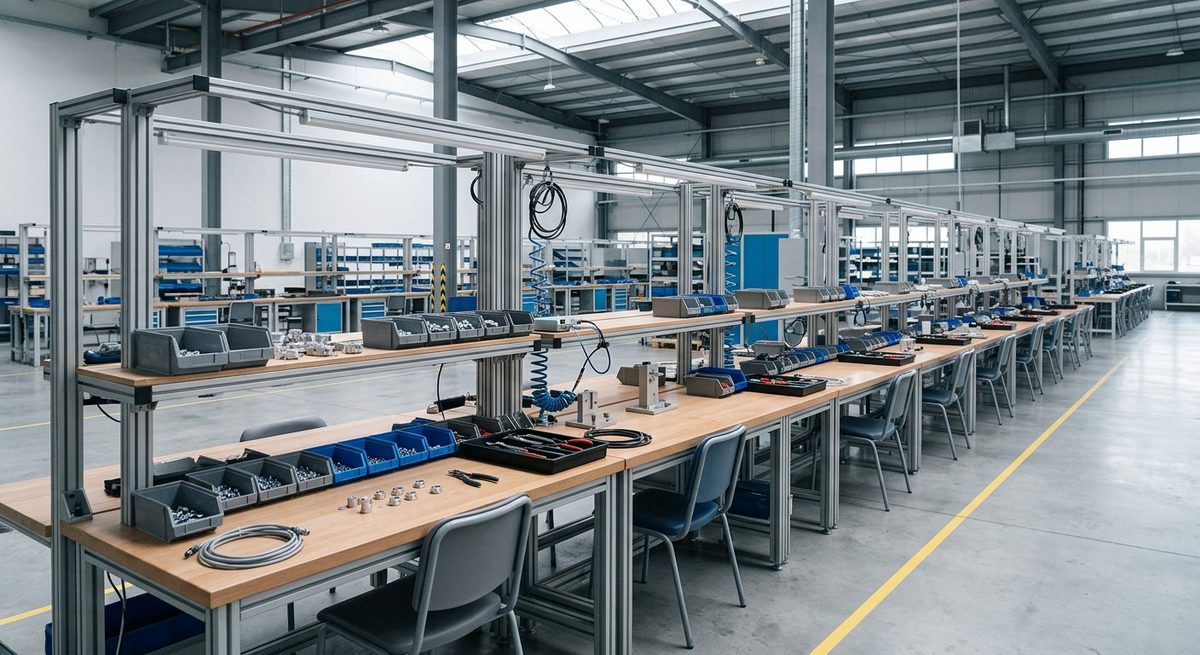
We were walking an injection moulding shop in Dongguan with a client last autumn, and I watched where his eyes went. Ceiling. Banner with the company slogan. The certificate wall in the lobby, laminated and level. Meanwhile our colleague had drifted off to the corner where a woman sat trimming flash off parts with a blade, next to a red crate nobody had mentioned. That crate told us more about the factory than the certificate wall ever could. Every factory visit China buyers pay for produces the same tour, the same route, the same tea. The difference is what you notice along the way.
The tour is a script, so read the background
A factory tour is theatre, and that’s fine, ours would be too. The owner shows the newest machine, the biggest client’s boxes, the export cartons stacked for a famous market. None of it is fake. It’s just arranged by someone who knows the route.
So we look at what the route wasn’t built around. The aisle behind the good line. The state of the tools hanging at each station, whether they’re worn from daily use or dusty from none. Whether the machine hour counters roughly agree with the story about how busy they are. A shop that claims full order books but has three of eight presses cold on a Tuesday is telling you two different things, and one of them is wrong.
Five places we always end up standing
Ask any of our team what they check first and you’ll get slightly different answers, but these five come up every time.
- The rework corner. Every real factory has one. Its size relative to the line tells you the current defect rate better than any spoken number.
- The raw material store. Labels, dates, and whether the resin or fabric matches what your product needs, or whether everything is unmarked sacks.
- The QC bench. Is it a working station with live records and today’s date on the sheet, or a clean desk that exists for visitors?
- The packing area. Mixed client cartons packed carefully is a good sign. Your competitor’s goods packed sloppily is a preview.
- The toilets and the canteen. Workers stay where they’re treated decently, and stable workers are half of stable quality.
None of these require permission to see. You just have to know they matter and walk toward them.
What the small details actually mean
The red crate problem
Back to that Dongguan crate. It held rejects, parts with short shots and sink marks, and the trimming lady was salvaging the borderline ones. Salvage isn’t a scandal. Every moulder does it. What mattered was the ratio: the crate was filling faster than the good bins beside it, on the same tool that would run our client’s product. We asked about it, got an honest answer about a moisture problem with that batch of resin, and ended up agreeing a simple incoming-material check for our order. That conversation only happens if someone stands next to the crate.
Machines age in ways photos hide
A press can look fine on video and be thirty years old at the platens. We look at the mould storage racks too. Tools stacked bare on the floor rust. Tools greased, tagged, and racked tell you the factory respects the thing your money would be buying. In Foshan we once chose between two metal shops with near identical quotes on the strength of the tool room alone.
Who actually answers the technical question
On the floor, we’ll ask a line worker something specific, what temperature the solder profile peaks at, how often the torque driver gets calibrated. If every question gets relayed to the boss and comes back smoothed over, engineering depth is thin. If the line leader answers directly, in numbers, without checking anyone’s face first, that factory can probably hold your spec when the boss is away.
The gap between the front company and the building
Here’s the uncomfortable one. Sometimes the company you’ve been messaging and the factory you’re standing in aren’t the same business. There are legitimate reasons, group companies, a sales office in Guangzhou fronting a plant in Qingyuan. We don’t treat it as a crime. We do insist on knowing which building the goods will really come from, whose name is on the business licence, and who inspects quality inside those walls. If the answers wobble, the visit just paid for itself.
The floor also tells you what’s subcontracted. A factory selling finished kitchen goods with no surface treatment line on site is sending parts out for coating, which means a second factory you’ve never seen touches your product. Worth knowing before you commit, and it changes how we set up inspections. It changes negotiation too, because you finally know which costs are theirs and which are bought in. We covered that side of the conversation in MOQ & Price: How to Negotiate Effectively.
Bring your product knowledge, borrow the floor knowledge
To be fair to buyers, the traffic runs both ways. You know your market, your customer’s tolerance for a rough edge, which feature actually sells. We’ve had clients spot a problem no inspector would flag, a handle angle that felt wrong to anyone who’d actually used the competing product. The best visits pair the two: your product sense, someone else’s floor sense.
That’s why we like accompanying buyers rather than replacing them. For everyday categories, the trip is worth making at least once. If you’re building a range of housewares, for instance, a day around the factories that feed the trade, the sort we described in Sourcing Home & Kitchen Products from Guangzhou, China, will sharpen every remote decision you make for the next two years.
And take notes on paper. Phones die. Paper doesn’t.
Questions buyers ask before they fly
How long should a proper factory visit take?
Half a day per factory is our working rule for anything you’re serious about. An hour covers the tour. The remaining time is for the material store, the QC records, a technical conversation, and tea that isn’t rushed. Two factories a day is a full day once Guangdong traffic gets its share.
Will a factory hide things from a visitor?
They’ll present well, the way you would for a guest. Outright concealment is rarer than buyers fear. Most of what matters is in plain sight anyway, you just need to know which sights count. The rework corner is never in the brochure, but it’s rarely locked either.
Can’t I just judge a supplier from samples?
A sample proves the factory can make one excellent piece, often on its best machine with its best operator. The floor tells you what unit number four thousand will look like in week six. Those are different questions, and the second one is where wholesale money lives or dies.
Our team has walked factory floors around Guangzhou, Foshan, Dongguan and Shenzhen since 2007, usually with a buyer beside us asking good questions. If you’re planning a trip, or want us to walk a floor on your behalf first, reach us through the contact form or WhatsApp and we’ll put a sensible route together.
Read next
The Paper Trail That Proves a Chinese Supplier Is Real
The documents we ask for to verify a Chinese supplier before money moves: licence, export record, bank details, test…
Import Paperwork and Compliance Basics for Your China Orders
Which import paperwork China orders really need, from invoices and bills of lading to test reports, and who prepares each…
Trading Company or Factory: Telling Them Apart in Guangzhou
A China agent explains how to tell a trading company from a real factory in Guangzhou, what the licence reveals, and when a…