
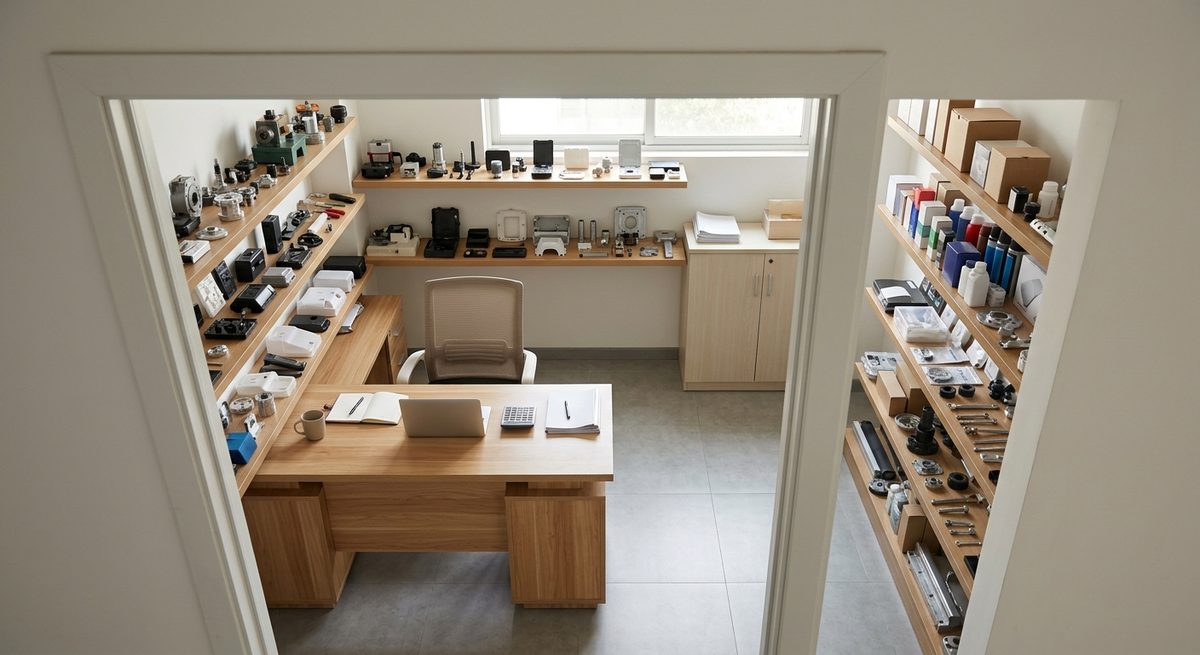
A buyer from Poland once forwarded us photos of “his factory” in Guangzhou. Beautiful showroom, LED walls, a smiling team in matching polo shirts. One problem. The address was the 14th floor of an office tower near the East Railway Station, and nobody runs injection moulding presses on the 14th floor of anything. He’d been dealing with a trading company for two years without knowing it. The goods were fine, mostly. The prices were not.
Why the question matters less than people think, and more
Let’s get the honest part out of the way first. A trading company is not a trick. Plenty of them do genuinely useful work: they consolidate small orders, they speak better English than most factory sales teams, and they’ll take on the mixed twenty-product orders a factory won’t touch. What matters is that you know which one you’re talking to, because the two behave very differently when something goes wrong, and they price very differently when volumes grow.
A factory owns the machines and the problem. A trader owns neither. When a batch fails inspection, the factory can stop the line, rework, and reschedule. The trader has to go and negotiate with someone you’ve never met, on terms you’ll never see. That’s the real difference. Not the price margin.
What the business licence quietly tells you
Every registered company on the Chinese mainland has a business licence with a defined scope of operations, and the scope is where the truth sits. A manufacturer’s scope will say something like “production and sale of plastic products”. A trader’s will say “wholesale and retail, import and export”. Ask for the licence early. A real supplier sends it within the hour, usually as a slightly crooked phone photo of the framed original on the office wall.
Then cross-check the registered address against the address they invite you to visit. If the licence points to an industrial district in Panyu or Dongguan and the meeting is in a downtown office, ask why. Sometimes the answer is innocent: lots of factories keep a city showroom because buyers hate driving two hours. Sometimes the answer takes a while to arrive, and that pause tells you plenty.
If you want the full document-by-document routine, we wrote up our own process in How to Verify a Guangzhou Factory in 48 Hours, and most of it can be done before you ever book a flight.
Questions that separate the two in one phone call
You don’t need a private investigator. You need five questions and a video call:
- Walk me to the line. Ask them to carry the phone from the office to the machines making your product, live, without cuts. A factory does this happily. A trader stalls.
- Which machine makes this part? Factory people answer in model numbers and tonnage without thinking. Traders answer in adjectives.
- What’s your monthly capacity for this item? Then ask how many shifts. The two answers should fit together.
- Can I meet the production manager? Not the sales manager. The person with dust on their shoes.
- Who owns the mould? If your product needs tooling, the answer reveals the whole supply chain in one sentence.
None of these questions is rude. Chinese factory owners respect buyers who ask them. It’s the vague buyers who get vague suppliers.
Timing helps too. Call during Chinese working hours and ask your questions live rather than by email, because email gives a trading office a day to source answers from the real factory. Live, the difference shows in seconds. A factory salesperson turns the camera around. A trader asks if they can get back to you.
What you see when you actually go
The showroom test
A trader’s showroom is a museum of unrelated things: power banks next to garden tools next to yoga mats. A factory’s showroom is boring. Forty versions of the same product, three generations of the same handle, and a shelf of failed prototypes nobody threw away. Boring is what you want.
The floor itself
Real production floors have a texture no office can fake. In a metal workshop in Dongguan you’ll feel the punch presses through the soles of your shoes before you see them, and there’s a thin film of lubricant in the air that settles on your notebook while you write. You can’t video-call that. It’s one of the reasons we still drive out to factories instead of trusting a showreel.
The people ratio
Count sales staff against production staff. Ten desks of salespeople and a workshop of six machines is a trading operation with a workshop attached, which is fine, as long as your order isn’t priced like it came straight off the line.
When the trader is the right answer
Ask me and I’d say: if you’re buying one product, in volume, repeatedly, you belong at the factory. If you’re buying fifteen small SKUs across categories to fill your first container, a good trading company or an agent will save you money even after their margin, because factories won’t give small mixed orders their good pricing or their good schedule slots. We’ve moved clients in both directions. The point isn’t purity. The point is knowing what you’re paying for.
Volume changes the answer over time, too. A product that starts as one line in a mixed order can grow into something worth taking directly to the manufacturer, and choosing which products deserve that move is its own discipline. Our method for that decision is in Choosing Products to Import from China: A Working Method.
Straight answers to the questions we get
Is a trading company always more expensive than the factory?
On a single product at volume, nearly always. On small mixed orders, often not, because the factory’s minimums and setup costs punish you harder than the trader’s margin does. Run the numbers per order, not on principle.
Can a company be both?
Yes, and around Guangzhou it’s common. A factory makes its core product and trades everything adjacent to it. Treat each product line separately: their own goods come off their line, the rest gets sourced like any trader would.
Do I really need help with this, or can I check it myself?
You can do most of it yourself with the licence, the video call, and patience. Where a China agent earns their fee is the physical visit, the dialect small talk that loosens real answers, and knowing what a normal workshop in that industry should look like. If you only need one supplier checked once, honestly, try it yourself first.
We’re based in Guangzhou and we drive out to factories in Panyu, Foshan and Dongguan most weeks. If you’d like a second pair of eyes on a supplier, or company on the visit itself, send us a message and we’ll meet you here.
Read next
Sample Rounds: How Many You Need Before Production
How many rounds of product samples from China you actually need before mass production, what each round should prove, and…