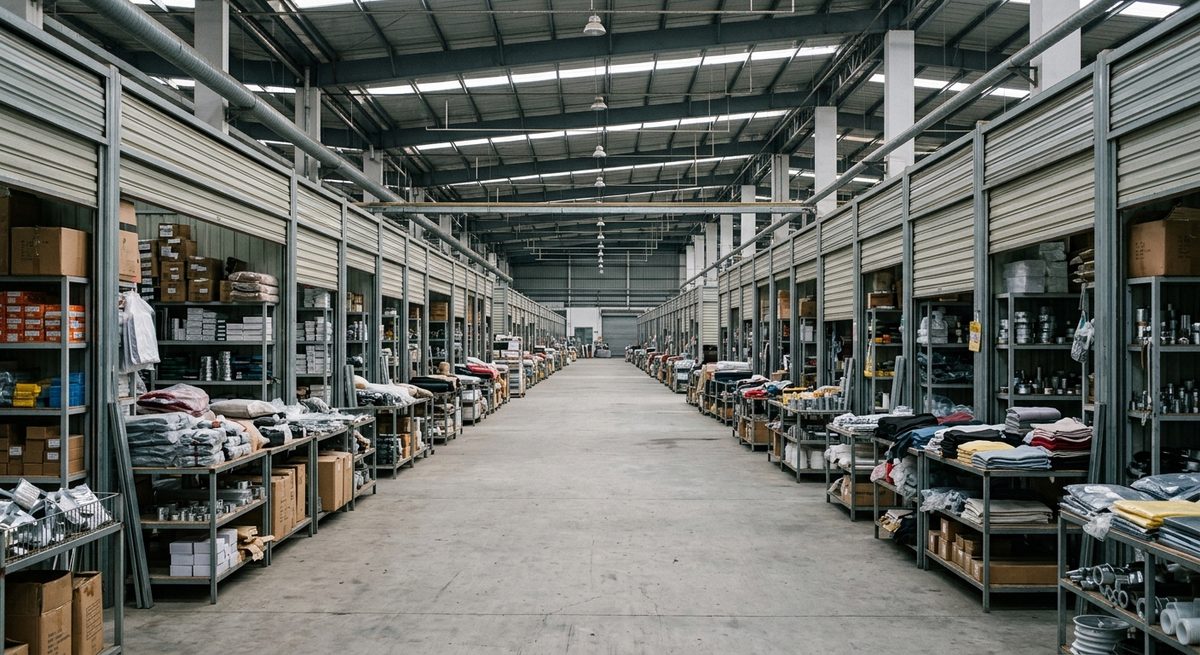
The stall was maybe three metres wide, stacked with power banks to the ceiling, and the owner quoted a price, in seconds, for five hundred pieces she could hand over that afternoon. The buyer standing next to me had spent six weeks negotiating a factory order for a similar item. His unit price was lower. Her goods existed today. Both of them were right, and that little scene is the whole subject: Guangzhou wholesale buying splits into two different games, market stock and factory orders, and mixing up their rules is where money quietly leaks.
What a market really sells you
A wholesale market stall is a shop window for stock that already exists. Somebody has already chosen the specification, the colours, the packaging, and produced a batch. You’re buying the tail end of those decisions. That gives you three genuine advantages. Speed, because goods can move to a warehouse the same day. Low commitment, because many stalls will sell a few cartons where a factory wants thousands of units. And touch, because the product is physically in front of you before any money moves.
The trade-off is control. You can’t change the plug type, the label, the gift box or the firmware of something that’s already made. What’s on the shelf is what ships. For some businesses that’s completely fine. For anyone building a brand, it rarely is.
The mixed-provenance problem
Stock in one stall often comes from several workshops, bought at different times. Two cartons of the “same” item can differ in shade, in battery cell, in stitching. We open cartons across the lot for exactly this reason, and the difference between cartons is the most common surprise we document for clients who bought from stalls without checking.
What a factory order buys instead
Ordering from a factory means you’re purchasing production, not product. Everything becomes negotiable: material, colour, logo, packaging, certification testing, spare parts ratio. You also inherit everything that comes with production. Lead times of weeks, not hours. Minimum quantities. Tooling costs if your design needs a new mould. And the need for inspections, because you’re paying before the goods exist.
The unit price is usually better than market price for the equivalent item, though not always by as much as buyers expect once inspection, sampling and freight from a distant town are added up. What you’re really paying for is the right to decide. On regulated goods that right stops being optional. Anything medical-adjacent needs documents that trace to the actual maker, which is why we walk buyers through the paperwork in How to Order Medical & PPE Products from Guangzhou Factories before they commit anywhere.
The decision, product by product
Ask four questions about the specific item and the answer usually falls out on its own:
- Does it carry your brand? Brand means factory, almost without exception
- Does it plug into a wall, touch skin or go to a child? Then you need traceable certification, which points to a factory relationship
- Do you need it in under three weeks? Market stock, or a factory’s existing inventory
- Is your test quantity under a few hundred pieces? Markets will take that order; most factories won’t
Plenty of importers run both lanes at once, and that’s often the smartest shape. Market stock to test whether a product sells at all. A factory order for the second round, once real customer feedback justifies the minimums. We like that sequence because the market purchase becomes cheap research rather than a gamble.
Where each option hides its costs
Market purchases
The stall price is not the landed price. Add consolidation, export packing, freight, and the cost of the units you’ll reject once cartons are opened. Add, too, the risk that the identical item won’t be available when you reorder, because the stall sold out and restocked from a different workshop. Repeatability is the market’s weakest muscle. Timing plays into it too: stall stock turns over quickly after each fair season, so the item you photographed in October may be gone by December, replaced by a near-twin from a different workshop at a different standard.
Factory orders
The quotation is not the landed price either. Sampling courier fees, a mould if you customised the housing, one or two inspection visits, and the classic slow bleed: a lead time that stretches two weeks past the promise, right into your selling season. None of these are scandals. They’re just line items first-time buyers forget to write down.
An opinion, since you’re asking one of us
If your product is generic, your volumes are small and your margin is healthy, buy stock and don’t overthink it. You genuinely don’t need an agency for a two-carton market purchase; take your phone, take your time, and enjoy the haggling. The moment the order carries your logo, needs a certificate, or exceeds a value you’d be uncomfortable losing, switch to the factory lane and put inspections in the contract. Electrical accessories are the category where we’ve seen the stakes climb fastest, and our notes in Sourcing Power & Accessories from Guangzhou, China explain why chargers and cables deserve the careful lane even at small volumes.
One more habit worth stealing. Whichever lane you choose, write down the specification as if you were choosing the other one. Market buyers who note the exact cell model and cable gauge can reorder intelligently later. Factory buyers who know the market price of ready stock negotiate with their feet on the ground.
Things buyers ask us before choosing a lane
Can I visit the factory behind a market stall?
Sometimes. Stalls that are factory-owned sales counters will often host serious buyers, and that visit is a great shortcut. Stalls that are pure traders can’t take you anywhere, and how they answer the request tells you which kind you’re talking to.
Is market stock lower quality than factory goods?
Not inherently. Some stalls carry export-grade surplus from excellent plants. The issue isn’t quality on average, it’s variance and traceability. You know less about what you’re holding, so inspect more.
What quantity makes a factory take me seriously?
It varies by product and by how full their order book is, but as loose experience, orders worth a few thousand dollars with a clear specification get real attention. A precise buyer with a small order beats a vague buyer with a big one more often than you’d think.
We work both sides of this line every week: escorting buyers through the stalls in the morning and inspecting factory production runs in the afternoon. If you’re weighing the two lanes for a specific product, send us the details through the site or WhatsApp and we’ll tell you honestly which one fits, including when the answer is that you can do it without us.
Read next

Guangzhou, Dongguan and Shenzhen: Which City Makes What
A ground-level map of the Pearl River Delta for buyers: what Guangzhou trades, what Dongguan and Shenzhen factories build,…
Metro, Taxis and Timing: Moving Around Guangzhou on a Buying Trip
How to move around the city on a Guangzhou buying trip: the metro lines that matter, when a DiDi beats the train, and how to…