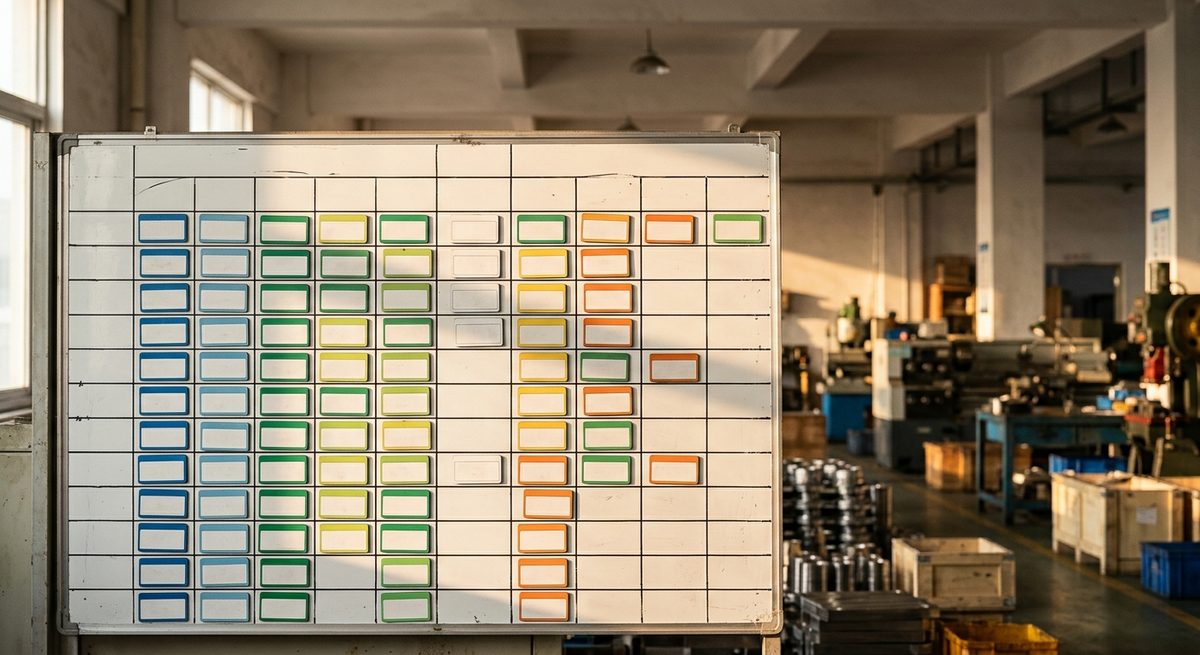
Order one was excellent. Order four was good. Order seven brought the first complaint email, and order nine is the one the buyer forwarded to us with the subject line “what happened??”. Nothing happened. That’s the trap. No single decision at that factory in Jiangmen was large enough to feel like a decision, yet the stack of small ones moved the product somewhere nobody chose. If you came here searching for repeat order quality China suppliers can hold over years, the honest answer is that they can, but not passively. Drift is the default. Holding a standard is the active act. These are the engines that drive the drift, because you can’t stop what you can’t name.
Engine one: the substitution nobody announces
Material prices move constantly, and when a resin, a fabric or a bearing gets expensive, someone in purchasing finds an equivalent. Equivalent is a hopeful word. The replacement usually matches on the datasheet line that purchasing reads and differs on the line your customer feels. The new zipper runs a little stiffer. The new board is a shade more brittle in cold weather. Nobody hid it from you, exactly. It just didn’t rise to the level of a phone call, because from inside the factory it truly seemed the same.
The counter is contractual and physical at once: named materials and named component brands in the spec where they matter, plus the sealed reference sample the new batch will be compared against. And one blunt question on every reorder, asked as routine rather than accusation: what’s different this time? Asked every order, it stops being an insult and starts producing real answers.
Engine two: the people change and the knowledge doesn’t transfer
Factories here reshuffle heavily after Spring Festival. Lines lose experienced hands, gain new ones, and the small unwritten tricks that made your product come out right, the extra second on the heat seal, the way the fabric gets fed slightly off-square, walk out the gate inside someone’s head. Your product’s quality was partly stored in people, and nobody told you that part of the spec existed.
You can’t stop turnover. You can make the first post-holiday order the one you inspect hardest, which is exactly the opposite of most buyers’ instinct after years of smooth deliveries. We also push clients to get the tricks written down while the experienced crew is still there: a one-page work instruction with photos costs the factory an hour and preserves what turnover would otherwise take.
Engine three: the tool is wearing while everyone watches the product
Moulds, dies, screens and jigs age with every cycle. On an injection tool the first symptom is flash, a whisker of extra plastic along the parting line that trimming hides for a while. On silk screens the print edge softens. On cutting dies the edge rounds and the cut starts to fray. Run your thumb along the parting line of unit one and unit forty thousand from the same tool and you can feel the years, a tiny ridge on the later part where the steel has opened up.
Watch the numbers, not the mood
This is why measured inspection data beats pass and fail verdicts on repeat orders. Wear is a trend, and trends only show in numbers laid side by side across orders. When the measurement that used to sit mid-tolerance starts camping against the limit, the conversation about tool maintenance or a new tool should start then, months before the first true reject exists.
Know whose tool it is
If you paid for the mould, its maintenance schedule and its end-of-life are legitimately your business. Ask for the shot count. A factory that tracks it will answer instantly. A factory that doesn’t track it has told you something too.
Engine four: the price squeeze you asked for
This one’s uncomfortable, because the buyer builds it. Push the price down a few percent every reorder, as plenty of buyers do on principle, and the factory has three honest options: efficiency, margin, or the product. Efficiency runs out first. Margin runs out second. After that, every further cut you win is funded by something inside the product, and you won’t be consulted about which something.
Our opinion, after watching this cycle for years: on a product that’s selling well, stable pricing with a reliable factory is a quality strategy, not weakness. Negotiate hard at the start, then let the relationship compound. The buyers with the flattest quality curves we know are the ones factories describe as strict about standards and fair about money. The two reputations work together.
The habits that hold the line
None of the fixes are dramatic, which is fitting for a problem that isn’t dramatic either.
- Inspect on a cadence forever, lighter if you like, but never zero. Skipping checks after three good orders is exactly when the drift engines get quiet approval.
- Keep measured data and compare across orders. Drift lives in trends.
- Refresh the signed reference sample on a schedule, and version every agreed change.
- Ask what changed, every order, as a standing question.
- Visit again. The factory you audited three years ago is not the factory you’re buying from today, even at the same address. The re-verification can be quick, the way we outlined in How to Verify a Guangzhou Factory in 48 Hours, but it has to actually happen.
And this applies to trading relationships as much as factory ones. Plenty of long supply relationships around here started casually, a good stall, a good conversation, somewhere in the wholesale halls we listed in Top 10 Popular Markets in Guangzhou for Visitors (with addresses), and the supplier behind the stall changes factories more freely than a factory changes anything. The looser the relationship, the faster the drift.
Things repeat buyers ask us
My last four orders were fine uninspected. Am I wasting money restarting checks?
You’re buying trend data, not just defect detection. A light check on a good order isn’t wasted, its measurements become the baseline that makes the first drifting order visible. Four clean orders means your factory is good. It doesn’t mean the engines above stopped running.
Quality slipped already. Rebuild or walk away?
Rebuild first, in most cases. A factory that made it right once can usually make it right again, and your tooling, your samples and your history there are real assets. Walk away when the ownership or the attitude changed, not merely the output. Output is fixable. Indifference isn’t.
How often should the reference sample be renewed?
For colour-critical or material-sensitive goods, roughly yearly, from a production run both sides agree was good. For stable hard goods, renew when any agreed change lands. The renewal meeting itself is half the value: it forces both sides to look hard at the current product side by side with the original.
We watch repeat orders for buyers year after year from Guangzhou, with regular rounds through Foshan, Jiangmen and Dongguan, and drift-hunting is honestly some of our favourite work, because it’s where a decent supplier relationship gets protected instead of replaced. If your order nine doesn’t quite match your order one, get in touch through the contact form or WhatsApp and we’ll help you find which engine is running.
Read next

Golden Samples: Keeping Everyone Honest for Two Years
A signed golden sample China factories and buyers both keep is the quiet referee of an order. How to create, store and…
The Defects That Get Through a Standard Inspection
Even careful product inspection in Guangzhou lets certain defects through. We list the escape routes, from time-delayed…
How Buyers Set Quality Standards a Factory Can Actually Hit
Quality standards for Chinese suppliers fail when they're vague or impossible. Here's how we agree defect lists and limits…